




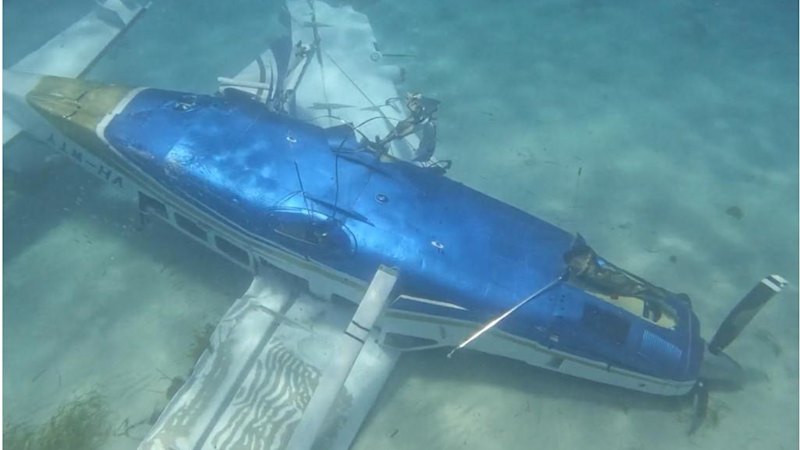
“The investigation is considering the crashworthiness of the Cessna Caravan aircraft and the suitability of the manufacturer and operator’s emergency equipment and procedures for accidents involving immersion in water.”
Wong had surveyed the normal take-off area twice in the afternoon of the accident, according to the report, and due to strong winds had decided against the usual southerly track, opting instead for an easterly take-off.
Seven people were on board the Swan River Seaplanes-operated flight when it crashed in January.Credit: Nine
The plane crashed after passing Phillip Rock, when it hit sea swell and chop, became airborne, then rolled to the left before crashing back into the water.
“While the investigation is interested to understand the role of the pilot’s actions and decision-making on the accident, the procedures and other risk controls used by Swan River Seaplanes for operations in the Thomson Bay area are also an area of focus,” Mitchell said.
“The investigation will also consider the operator’s identification and assessment of Thomson Bay for floatplane operations, and its operational oversight practices.”
The report also noted passenger video from the time of the crash did not capture any stall warning sounds, and the system’s circuit breaker had been found in the disconnected position after the accident.
The report said the plane’s operator, Swan River Seaplanes, stated they had been aware some Cessna 208 pilots would disconnect the stall warning circuit-breaker due to false alarms and their impact on passengers during water take-offs, but “this was not a common practice of Swan River Seaplanes pilots”.
The ATSB is expected to hand down its final report in the second half of next year.
“Until then, if any critical safety issues are identified, the ATSB will immediately notify relevant parties so appropriate and timely safety action can be taken,” Mitchell said.
Read the full article here