





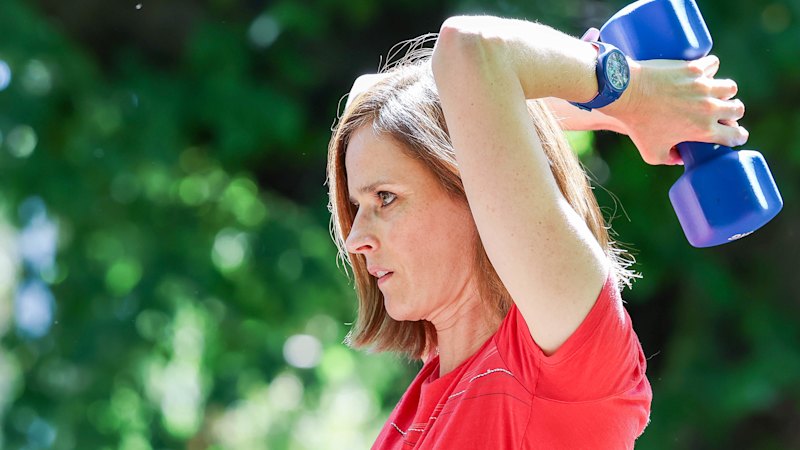
Whereas men’s decline is slow and steady, “our findings show a clear acceleration of muscle ageing when women are in their 40s, 50s and 60s and undergoing the menopausal transition”.
Loading
“In younger women, but also in men, age-related muscle decline happens gradually. In middle-aged women, many indicators of muscle health display a sudden and sharp decline that coincides with the onset of menopause, when the ovaries stop producing female sex hormones,” Lamon said.
The study suggests there is a window of opportunity between the early 40s and the end of the menopausal transition to take steps to reduce muscle loss.
“And the best way to build muscle mass is pushing against external loads: it is the simplest and most efficient way to built up skeletal protein muscle mass,” Lamon said.
Having adjusted her own exercise routine to include two weights sessions a week at home with a friend, Lamon’s advice is to start lifting weights as early as possible, but do not assume it is ever too late to begin.
Loading
“If there was a time in life where you should start lifting, it would be in your early 40s…[but] my public health message is any exercise is better than no exercise, and if a person feels all they can do is go walking at the moment, then that’s fine.
“Even walking can maintain muscle mass, to a small extent.”
Exercise physiologist and athlete resistance-training coach Dr Ashlee Hendy said that as women’s health research increases, awareness is spreading that women need resistance exercise to protect their muscles from hormonal changes, but that some women still do not feel at home in the weights area of gyms.
“I’ve been walking into weights sections of gyms since I was a teen, due to my sporting background [as an elite rock climber] and I’ve definitely seen a shift in acceptance and popularity of lifting among women, but it can still be an intimidating space,” Hendy said.
“They can feel outnumbered, but I’ve definitely seen a shift towards women lifting heavier weights and not just little colourful dumbbells, and also older individuals no longer considering it something they would be afraid of [due to] injury.”
I’ve definitely seen a shift towards women lifting heavier weights and not just little colourful dumbbells.
Exercise physiologist and elite rock climber Dr Ashlee Hendy
Wendy Glen, 63, said taking up weights midlife had delivered such striking results for her that she was now running faster in events, such as her local Parkrun, than she had been when she was 50. It also enabled her to run her first marathon at 60.
“I went to see an exercise physiologist … and he took my running more seriously than I ever did, and made me do exercises to help me with running,” Glen said.
“I’m doing some dead-lifts, bicep curls, overhead presses, chest presses – I’m deadlifting 65 kilograms.”
Seeing her running improve due to resistance training has been joyous, she said.
Wendy Glen, 63, said since taking up weight lifting to help her stay fit for running, her times are now better than they were when she was 50.Credit: Jason South
“I’ve discovered this immense enjoyment in running and being outside; whilst I’m probably never going to actually enjoy doing the resistance training, what it gives me more than makes up for it.”
Make the most of your health, relationships, fitness and nutrition with our Live Well newsletter. Get it in your inbox every Monday.
Read the full article here