



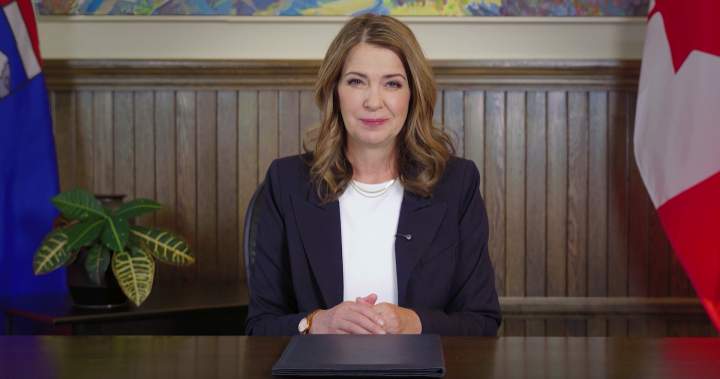
Alberta Premier Danielle Smith says out-of-control immigration levels are overwhelming the province’s core social services and has announced a referendum will take place nine months from now, asking residents to weigh in on nine questions addressing both that and possible changes to Canada’s Constitution.
(Scroll down to see the questions)
In a televised speech Thursday night, Smith said the Oct. 19, provincial referendum will be primarily focused on finding out how Albertans want the government to “deal with the issue of immigration, as well as steps we can take as a province to strengthen our constitutional and fiscal position within a united Canada.”
Smith said the changes her UCP government has determined the province needs to make to immigration are a significant departure from the status quo.
“These were far and away the issues most strongly identified by Albertans during last year’s Alberta Next panel town halls and online submissions, and in my view, it is time to act on them,” Smith said in a 13-minute televised speech that the government paid to air during the 6 p.m. primetime news hour.
“The fact is, Alberta taxpayers can no longer be asked to continue to subsidize the entire country through equalization and federal transfers, permit the federal government to flood our borders with new arrivals, and then give free access to our most-generous-in-the-country social programs to anyone who moves here,” Smith said.
The premier noted the province will be unveiling a large deficit in next week’s budget and lower oil prices have contributed to less revenue.
According to the Alberta government, each $1 drop in the price of oil means roughly $750 million fewer royalties for the province.
However, Smith said social services costs going to more new residents is making Alberta’s budget woes even worse.
“This is not only grossly unfair to Alberta taxpayers, but also financially crippling and undercuts the quality of our health care, education and other social services.”
Mount Royal political scientist Lori Williams challenges that assertion.
“To suggest that this budget deficit is primarily caused by immigration — that non-citizens who come to Alberta are filling emergency rooms and classrooms and that’s where problems coming from — it creates, I think, a distorted picture of what’s actually going on,” Williams said after Smith’s speech aired.
Danielle Smith has been Alberta premier since 2022 and Williams believes Thursday’s speech aimed to redirect public attention away from the province.
“People are concerned very much about affordability, they’re concerned about health care, and they are concerned about education. And the government has invested in some areas, has been addressing some of the problems that have been raised — but they persist.”
“People, when a government has been in power for years, start to notice if promises aren’t fulfilled. They start ask questions and they start make more demands of a government.”
Bradley Lafortune, executive director of Public Interest Alberta, said a bad news budget is not unheard of in a province that gleans so much of its income from oil and gas royalties.
“That’s nothing new in Alberta. But what is new, I think — at least with this degree of focus and tone — is the shift in blame towards immigration and newcomers,” he said after listening to the speech.
“Fundamentally, this is a Trump-style, MAGA government that is doing their best to imitate the current Republicans in the United States,” Lafortune said.
“And what that means is blaming newcomers, cutting services, reducing taxes, and then telling everyone that we need to do more with less, at the same time as friends and insiders are receiving massive amounts of grift on the public dollar.”
Lafortune thinks Albertans should prepare for a “very bad budget” next Thursday that he predicts will contain more cuts to frontline services and the administration of them.
“What I mean by bad is it’s going to be bad for Albertans, working middle-class Albertans. I think its gonna be very bad.”
Smith said in the short-term, the government will not be implementing drastic cuts in the 2026 budget but will instead be cutting unnecessary bureaucracy, improving efficiencies in program delivery (such as more income testing for social programs) and prioritizing needs before wants as much as possible.

Get breaking National news
For news impacting Canada and around the world, sign up for breaking news alerts delivered directly to you when they happen.
“The approved wage increases for our doctors, nurses, and teachers will remain in place so we can continue to attract the skilled professionals needed to catch up with our growth,” Smith said.
According to Statistics Canada, Alberta’s population surged by 202,324 residents in 2023. That’s the largest annual increase in the province’s history, the equivalent of 550 people moving to Alberta every day.
While the bulk of the growth came from international migration, Alberta also shattered a national record for interprovincial migration, most of whom came from Ontario and B.C.
The province’s population growth peaked in the third quarter of 2023, with it dropping off significantly in 2024 and 2025, according to the most recent Statistics Canada data.
“I think the federal government started realizing that they’ve been pushing too strongly on the population growth through different types of migration, international migration,” Carleton University economics professor Christopher Worswick said of the decline that began in 2024.
“So we saw caps on the number of international students coming in. I think that needed to be done because the program was growing just way too fast.”
Premier Smith blames the former Justin Trudeau Liberal government for Alberta’s population woes, saying over five years almost 600,000 people moved to Alberta, pushing the population over five million people.
“Ottawa throttled our most important job creating industries and prioritized immigration away from economic migrants and instead focused on international students, temporary workers and asylum seekers,” Smith said.
In 2022-23, the province ran a $4.95 million “Alberta is Calling” campaign aimed at attracting skilled workers to the province from other parts of the country.
“Although sustainable immigration has always been an important part of our provincial growth model, throwing the doors wide open to anyone and everyone across the globe has flooded our classrooms, emergency rooms and social support systems with far too many people, far too quickly,” Smith said.
Overcrowded classrooms and a strained health-care system has been a documented issue in Alberta for well over a decade and Williams said blaming it on newer residents is a deflexion of responsibility.
“There’s no question that we have seen very large numbers of newcomers to Alberta. Part of that is because the Alberta government has invited people, citizens of Canada to come here and to work in Alberta.
“To somehow suggest that the problem has been created by immigration — as if these problems didn’t exist before those immigration numbers ticked up — I think is inaccurate.”
She fears it will create strife and inflame racial tensions.
“I think that impression is potentially quite problematic, particularly for those who are already struggling with people’s hostility toward them.”
The October referendum, a year before the province’s scheduled general election, could be even longer.
Last year, Smith promised a referendum on separation in 2026 if citizens gathered the required number of signatures on a petition.
One citizen-led petition to be put to lawmakers this spring could lead to a referendum vote on making it a provincial policy that Alberta stay in Canada.
Another petition effort, with a deadline for signatures in early May, seeks a referendum question about pulling the province out of Confederation.
Smith said Thursday that strengthening Alberta’s “constitutional and fiscal position within a united Canada” and immigration were the biggest issues her Alberta Next panel heard as it toured the province last year.
One of the issues tabled for debate was whether Alberta should withhold social services from some immigrants. The panel was propped up by calls from in-person attendees who at times called for mass deportations.
In January, Smith’s United Conservative Party government walked back what it called a “premature” decision to cut off temporary foreign workers from provincial health-care coverage, including those who had already obtained work permits.
The ministry in charge said, at the time, the move was on pause pending review.
On Wednesday, Smith’s chief of staff, Rob Anderson, reposted a social media infographic about immigration numbers and invited readers to watch the premier’s televised address.
“This absolute insanity needs to stop. It will,” he wrote.
The executive director of the premier’s office, Bruce McAllister, also pointed to the same social media post to sound off on population growth.
“Does their contempt for Canada’s core values and traditions drive them to flood our borders with millions from societies not built on the same foundations that have made us thrive?” McAllister said on X.
“Why import from nations with failed systems when our Judeo-Christian heritage and principles have worked so well here? It almost feels like these elites are ashamed of what built this great country.”
Smith was asked Wednesday if her government shared McAllister’s values. She didn’t directly answer but said western society is based on “the Socratic Judeo-Christian tradition.”
“However, Alberta was also created since 1905 based on the immense diaspora communities that come here,” she said.
She said the federal government has made changes to refocus on economic migrants and that the previous system “broke.”
“It was the No. 1 issue that we heard,” she said, referring to the Alberta Next panel.
As it stands right now, the referendum in October will ask Albertans nine questions concerning immigration and the Constitution:
Immigration
1. Do you support the Government of Alberta taking increased control over immigration for the purposes of decreasing immigration to more sustainable levels, prioritizing economic migration and giving Albertans first priority on new employment opportunities?
2. Do you support the Government of Alberta introducing a law mandating that only Canadian citizens, permanent residents and individuals with an Alberta-approved immigration status will be eligible for provincially-funded programs, such as health care, education and other social services?
3. Assuming that all Canadian citizens and permanent residents continue to qualify for social support programs as they do now, do you support the Government of Alberta introducing a law requiring all individuals with a non-permanent legal immigration status to reside in Alberta for at least 12 months before qualifying for any provincially-funded social support programs?
4. Assuming that all Canadian citizens and permanent residents continue to qualify for public health care and education as they do now, do you support the Government of Alberta charging a reasonable fee or premium to individuals with a non-permanent immigration status living in Alberta for their and their family’s use of the healthcare and education systems?
5. Do you support the Government of Alberta introducing a law requiring individuals to provide proof of citizenship, such as a passport, birth certificate, or citizenship card, to vote in an Alberta provincial election?
Constitution
6. Do you support the Government of Alberta working with the governments of other willing provinces to amend the Canadian Constitution to have provincial governments, and not the federal government, select the justices appointed to provincial King’s Bench and Appeal courts?
7. Do you support the Government of Alberta working with the governments of other willing provinces to amend the Canadian Constitution to abolish the unelected federal Senate?
8. Do you support the Government of Alberta working with the governments of other willing provinces to amend the Canadian Constitution to allow provinces to opt out of federal programs that intrude on provincial jurisdiction such as health care, education, and social services, without a province losing any of the associated federal funding for use in its social programs?
9. Do you support the Government of Alberta working with the governments of other willing provinces to amend the Canadian Constitution to better protect provincial rights from federal interference by giving a province’s laws dealing with provincial or shared areas of constitutional jurisdiction priority over federal laws when the province’s laws and federal laws conflict?
With files from Lisa Johnson, The Canadian Press
Read the full article here