




Iran’s ongoing blockade of the Strait of Hormuz has brought oil flows from the Persian Gulf to a near standstill, with experts now warning that the resulting energy shock could soon spark an acute economic crisis for certain regions of the U.S.
According to recent research from analysts at JPMorgan Chase, the last oil deliveries to the U.S. from the Gulf will arrive on April 15, provided the Strait of Hormuz remains closed, with other global markets experiencing an even shorter window to source alternative supplies or face the fallout.
Keland Rumsey, an energy markets analyst at East Daley Analytics, told Newsweek that U.S. business reliant on “continuous fuel supply” will face “higher costs and price volatility, especially for diesel and jet fuel,” with transportation and operating costs spiking for logistics-heavy industries in particular.
Given the reliance on Middle Eastern imports, combined with the recent closure of major refineries, Rumsey added that “the West Coast, especially California, is the most susceptible to this supply shock.”
Why It Matters
Prior to the war, around 20 percent of global oil supply passed through the Strait of Hormuz, and its effective closure has resulted in a 95 percent decline in these transits compared to pre-conflict levels, according to a recent report from Clarksons Research.
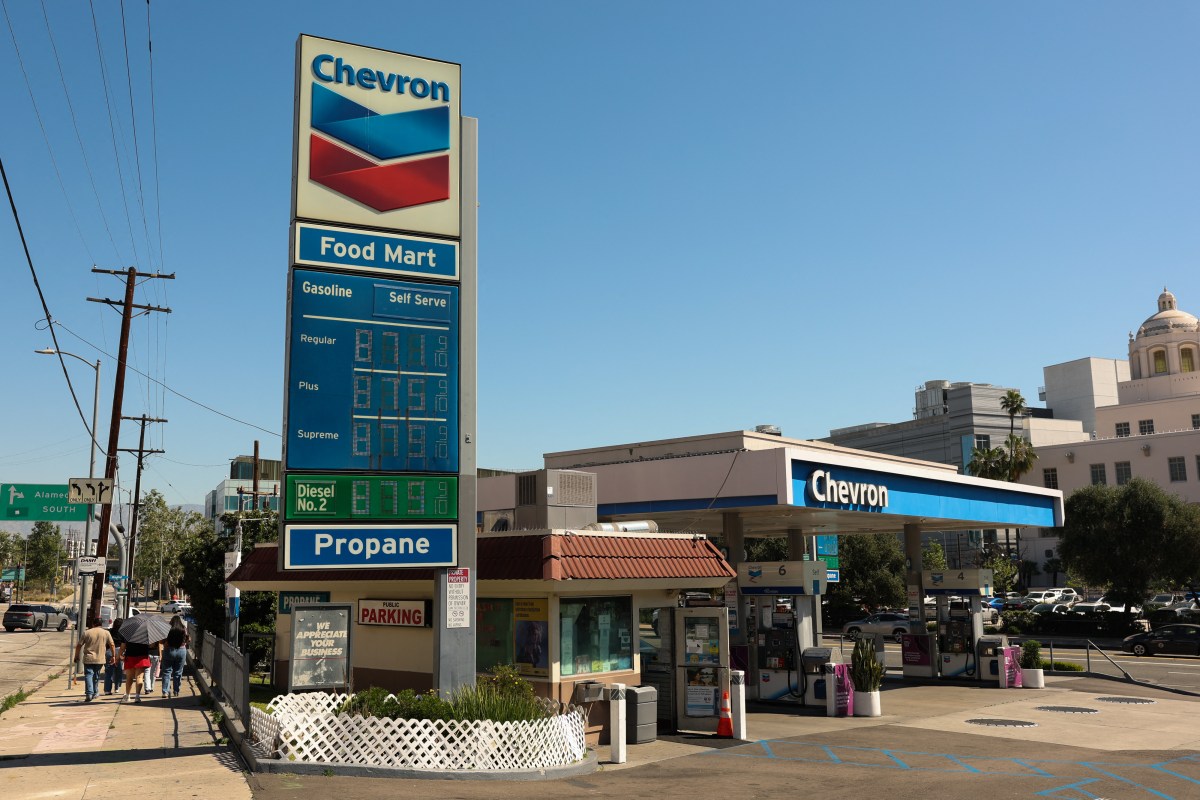
The blockade has driven up oil prices and domestic pump costs, raising fears that alongside disruption to other shipments—chemicals, fertilizer and general cargo—this could soon fuel an economy-wide inflation surge.
While much of the price pressure has so far remained speculative, driven by expectations of shortages rather than actual supply gaps, experts believe the imminent end to Middle Eastern flows will intensify the economic impact.
What To Know
Relative to overall demand, the U.S. is less reliant on Persian Gulf oil compared to other regions—sourcing around 650,000 barrels per day, according to JP Morgan, compared to the over-20 million barrels the U.S. Energy Information Administration (EIA) estimates the country consumes daily.
As a result, other markets are set to feel a more pronounced effect once the Hormuz Strait closure brings Middle Eastern supplies to an effective halt.
EIA data shows around 84 percent of the crude oil and 83 percent of the liquefied natural gas (LNG) which passed through the Hormuz Strait went to Asian markets in 2024, and Rumsey told Newsweek that the region is currently “taking the biggest hit” as a result.
“China, India, Japan, and South Korea are the ones being affected the most because of their reliance on the medium to heavy sour crude,” he said. “The Middle East producers themselves are also under severe stress, because blocked exports quickly become forced production shut-ins once local storage fills.”
“Import reliant countries in Asia and Africa are already feeling the pinch,” Christopher Haines, global head of oil at the energy market research firm Energy Aspects, pointing to the Philippines, Thailand, Vietnam as some of the nations that have already implemented mitigating measures, such as suspending their own fuel exports.
“The longer shipping disruptions persist, the way to solve the huge loss in supply will be by higher prices to curb demand,” he told Newsweek. “That will mean costs for anything that needs transporting will go up.”
Within the U.S., however, Rumsey noted that California has an outsized reliance on Middle Eastern supplies. Some 2025 data from the California Energy Commission shows that around 29 percent of crude oil imports were sourced from the Middle East.
And Rumsey notes that disruptions to this supply could prove particularly acute given threats to California’s domestic sources, such as the closure of the Phillips 66 Los Angeles Refinery and the planned shutdown of Valero’s Benicia Refinery, set to occur this month.
What People Are Saying
Economist Paul Krugan, commenting on JP Morgan’s research in a recent blog post, wrote: “Deliveries to Asian markets will end this week; deliveries to Europe will end next week.
“And once the crisis gets physical, there will no longer be room for jawboning the markets. Since the war began there have been several occasions on which Donald Trump has been able to talk prices down by asserting that meaningful negotiations are underway with his invisible friends the Iranian regime, but that won’t work once the oil runs out.”
Analyst Keland Rumsey, on the results of a protracted Hormuz Strait closure, told Newsweek: “Oil markets would increasingly favor reliable, geopolitically stable supply sources, and are currently placing a premium on barrels from regions like the U.S., Canada, and the Atlantic Basin. This could drive longer-term diversification, with buyers securing more U.S. crude and shifting trade flows away from Hormuz-dependent routes. The U.S. would adapt by modestly increasing production (led by the Permian) and expanding refinery/export infrastructure. However, while the U.S. can help offset disruptions, it cannot fully replace Gulf volumes, meaning global markets remain structurally sensitive to Middle East risk.”
What Happens Next
Global oil prices briefly dipped on Wednesday after President Donald Trump said that the U.S. military operation in Iran could end within two to three weeks.
Iran, however, has said it will only reopen the Strait for nations “who comply with the new laws of Iran,” according to an X post from the head of the parliament’s National Security and Foreign Policy Committee.
Even if the Strait were to reopen, Haines told Newsweek that it would take time for flows to “normalize,” as “each crew, shipping company, charterer, buyer and seller would have different levels of risk tolerance to go through Hormuz.”
“A reopening does not immediately release trapped supply into the global system,” added Rumsey.
“If the waterway is physically reopened and shipowners believe the risk is manageable, some flows can resume within days, especially for cargoes already waiting nearby,” he told Newsweek. “But a full return to normal usually takes weeks to months, because insurers, naval escorts, charterers, terminals, and refineries all need confidence that the route is durable and safe.”
Read the full article here