




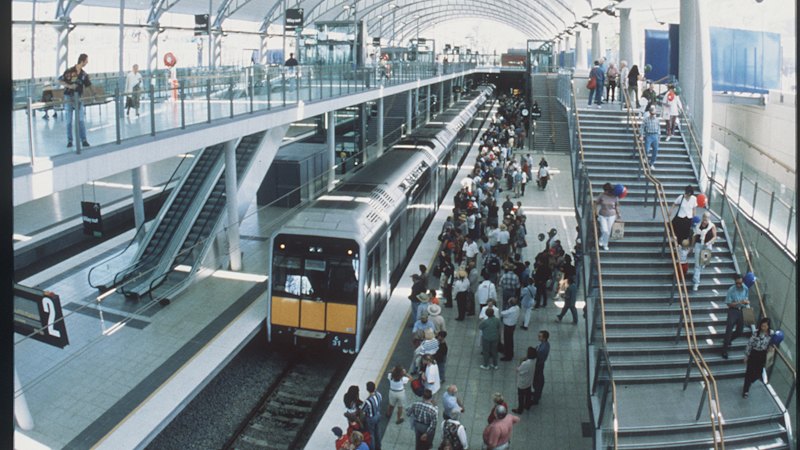
With its vast glass-vaulted roof that sent rays of sun onto platforms below, Sydney’s Olympic Park station won every major architecture award including the prize for enduring architecture in 2023.
But a new masterplan from the Sydney Olympic Park Authority puts the roof of the grand entryway that welcomed visitors to the 2000 Sydney Olympics at risk of being demolished by 2050. It has sparked concerns that it would be replaced with what leading Sydney architect Phil Thalis has called a “rote office block”, in a failure of imagination and vision.
Winning a top architecture prize is not always a guarantee of survival. The winner of the 1988 Sulman prize for public architecture, the Wran wing of the Powerhouse, is mostly demolished.
Olympic Park station’s lead architect, Ken Maher, the former chair of architecture studio Hassell, said demolition would be an act of cultural vandalism. “We seem to have an inability to preserve some of the wonderful buildings we have, including relatively new ones,” he said.
The project won the NSW award in 2023 for enduring architecture, the national Sir Zelman Cowen award for public architecture in 1988, and won Maher the profession’s highest prize, the gold medallion.
Olympic Park had been designed to last 50 to 100 years, Maher said. And building an office block on top would also be unfeasible, he added.
The finalised Sydney Olympic Park 2050 masterplan, released earlier this month, revealed commercial “over-station development” would be built at the train station to help meet employment targets in the area.
A spokesperson for the Sydney Olympic Park Authority – a state government-owned body under the Department of Planning – said any future redevelopment of the station precinct would be subject to detailed planning and design processes. It would need to consider the architectural significance of existing elements.
Barely 30 years old, the canopy was designed to “lift the lid” off the typical underground station.
Thalis said the station was the best thing built for Sydney’s Olympic Games, and it was where many of today’s leading architects cut their teeth.
When it won the enduring architecture prize, the jury said it celebrated a memorable cultural event, and had endured as an “exemplar of generative urban architecture”.
Hassell said it had welcomed 80 per cent of the 1.2 million people attending the Games, and managed commuter traffic of 1600 people every two minutes.
Thalis said the station heralded a renaissance in great railway design that led to projects like the Sydney Metro.
Maher agreed the new stations had made cities more contemporary. “They celebrate the fact that public transport is something essential to the future of our cities, as we realise the impact of climate change and densification.”
Thalis said some imagination was needed about how to use what was a beautiful space.
“It’s open at the ends, it is level with the street. It provides shade. You could easily have a fantastic markets or concerts, and make it part of the event culture of Sydney Olympic Park.”
Start the day with a summary of the day’s most important and interesting stories, analysis and insights. Sign up for our Morning Edition newsletter.
 Julie Power is a senior reporter at The Sydney Morning Herald.Connect via X or email.
 Ellie Busby is a Parramatta reporter at The Sydney Morning Herald.Connect via X or email.
From our partners
Read the full article here