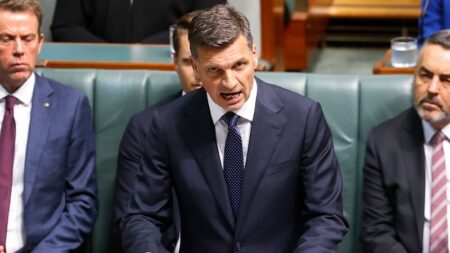





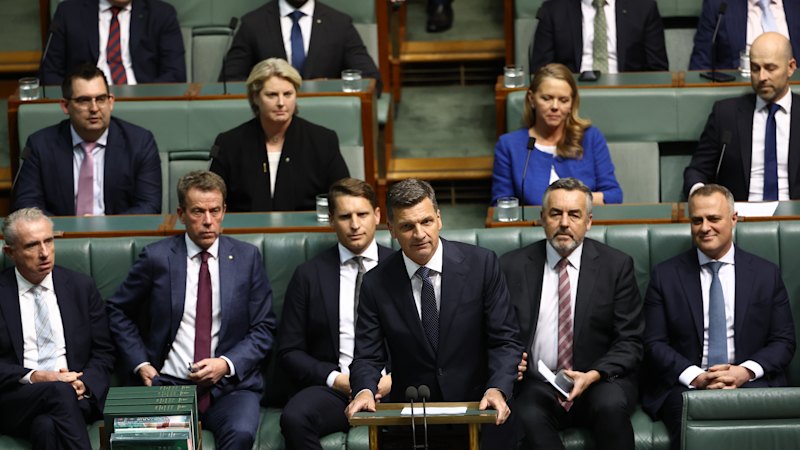
Opposition Leader Andrew Taylor’s budget reply subjected the electorate to a barrage of populist banalities about a freer society, intergenerational fraud, accountancy trickery and an assault on aspiration (“Angus Taylor delivers budget reply speech”, May 15). It was not so much devoid of proposals as of details about some of the policies. Taylor’s promise to index tax to inflation is a worthy one but also very costly, posing the question of how the billions will be found to implement it. Other proposals like the restriction of welfare benefits for non-citizens, abolishing Labor’s climate and housing agencies, making nuclear part of energy policy, massive cuts to immigration and linking housing to immigration will be met with strong opposition. Taylor will have a hard job convincing the electorate that his ideas have any merit, and that he is not just emulating Pauline Hanson. Ron Sinclair, Windradyne
Reading James Massola’s article on the budget reply, I was struck less by what was Taylor said than by what he left out (“If Angus Taylor can’t thread this political needle, his fate might be all sewn up”, May 15). Australians face sustained cost-of-living pressures, housing insecurity, workforce strain in health and education and deep economic uncertainty, so the response demanded not just critique but credible, detailed alternatives. Instead, the reply leaned heavily on rhetoric and broad assertions about government failure without sufficient clarity on how proposed alternatives would be funded and implemented. Simple assertions of future lower taxes and improved services are meaningless without a transparent fiscal pathway. Similarly, the transition to a low-emissions economy is inevitable, not optional. Taylor’s response was delusional in its denialism. Lastly, the tone of the response was unhelpful. Slogans and contemptuous divisiveness are unrepresentative, dangerous, ineffective and an insult to our collective better selves. Robyn Dalziell, Kellyville
James Massola’s opinion piece and several letters attacking the government’s reforms (Letters, May 15) reminded me of John F. Kennedy’s famous appeal: “Ask not what your country can do for you — ask what you can do for your country.” Too much of modern politics has become a defence of personal privilege dressed up as economic principle. The last election result showed that voters want a fairer society, not one where wealth and tax advantages continue flowing disproportionately to those already comfortable while younger and lower-paid Australians carry the load. Yet the Coalition still seems trapped in an outdated politics of obstruction and grievance. Taylor’s budget reply offered little evidence of a credible economic alternative or any recognition that Australians are demanding change. The government deserves credit for beginning the difficult task of rebalancing the economy and asking older and wealthier Australians to contribute more fairly. If the opposition continues fighting reforms the electorate increasingly supports, it risks political irrelevance – with the Nationals and One Nation likely to follow. Chris Rivers, Port Macquarie
Taylor’s speech to parliament was received with polite attention by those present, including the large number of Coalition troops who enthusiastically applauded him. Clearly buoyed by this reception, he then faced the formidable Sarah Ferguson on ABC TV’s 7.30. Obviously thinking he had made a significant mark on the electorate, Taylor was soon torn to pieces by her incisive and searching questioning and he clearly became more and more flustered by her ability to cut through “political speak” and bring the questioning back to the crux. The interview showed that Taylor was seriously under-prepared for the response to his speech. Rhodes scholar he may be, but if he cannot speak confidently about his policies and his party’s directions, he will never be able to restore the once great Liberal Party to any relevance. Terry Charleston, Cootamundra
Taylor chose to dust off the regressive policies of old Liberal culture warriors. His budget reply sadly seemed designed to oppose One Nation, not to improve our nation. Pauline Hanson’s strategists will be rubbing their hands at this “cry for help budget reply” aimed at them, rather than at the part of the voting public dissatisfied with Labor. It seals the fate of the once-proud conservative Coalition. Christopher Hill, Kensington
As I watched his budget reply speech followed by his interview on 7.30 last night, I came to recognise what a talented politician Angus Taylor is. It seems he managed to make his debut and his finale on the same night. Bravo! Bill Young, Killcare Heights
Pay tax, deserve benefit
I find it strange that the opposition would deny migrants and, even worse, permanent residents, access to benefits such as healthcare and NDIS when they pay taxes, sometimes even working two jobs (“Taylor vows ‘biggest migration cut in Australian history’”, May 15). New migrants already face waiting periods before becoming eligible for government services. They don’t just walk into Australia and immediately receive benefits without lifting a finger. But this is how the opposition and One Nation are portraying them. I know migrants who have lived in Australia more than four decades, who have businesses and who have employed a number of people, including disabled, and have never taken a cent from the government. Why should these people not be eligible for help should they develop a serious health problem? The opposition is going even lower than One Nation. What a shame that an alternative government has nothing substantial to offer except culture wars. Mukul Desai, Hunters Hill
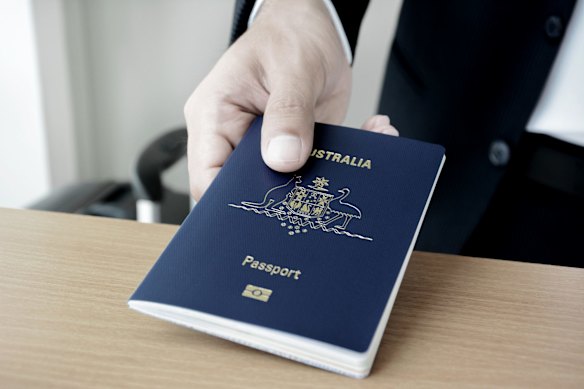
Taxed like Australians, treated like outsiders. That’s the Coalition’s idea of fairness. Can you actually believe Taylor plans to prevent any non-citizens from accessing the NDIS and 17 welfare programs that would affect hundreds of thousands of permanent residents in Australia who are taxed the same as Australian citizens. Who on earth thought this would be a good policy? Denise McHugh, Tamworth
How could Taylor even contemplate withdrawing support systems from permanent residents when hundreds of thousands of them have worked, contributed and spent a large part of their lives here? They married, raised children and apart from the fact that they are not naturalised Australians, to all intents and purposes they are model citizens. Taylor’s targeting of this cohort is thoughtless and clumsy, not to mention giving off a strong whiff of racism. Although most lack voting rights, they do not lack influence on younger relatives born here with the right to vote. Taylor has just cost the Liberal Party a lot of valuable votes from this demographic. Frederick Jansohn, Rose Bay
Debates around immigration often have a toxic subtext, but you know we are being dragged into a moral quagmire when you hear politicians and pundits talking about only welcoming “quality people”. What the hell does that actually mean? Resist such dog whistling newspeak. People are people. Australia earned a reputation for being an open and receptive society. Let’s keep it that way. Julian Wood, Marrickville
If Taylor’s immigration laws were in place now, a number of people from the Jewish community who were victims of the Bondi terror attack would not have been eligible for the social security safety net, and nor would their families. Clearly, in the Coalition’s view, these people did not have a commitment to Australia because they had not yet been granted citizenship. Barry Welch, Bridgeman Downs (Qld)
Budget punishes
The budget seems hell-bent on punishing those over 65 who have already left the workforce (“Here’s what the budget means for every generation”, May 13). Removing the private health insurance rebate will push more into the public health system, placing more pressure on waiting lists and government coffers. Disincentivising investment again encourages retirees not to be self-sufficient and to limit rental property availability. Again, more will look to a government pension. This is a budget wanting to punish hard work, sacrifice and self-sufficiency. John Roydhouse, South West Rocks
Nuclear folly
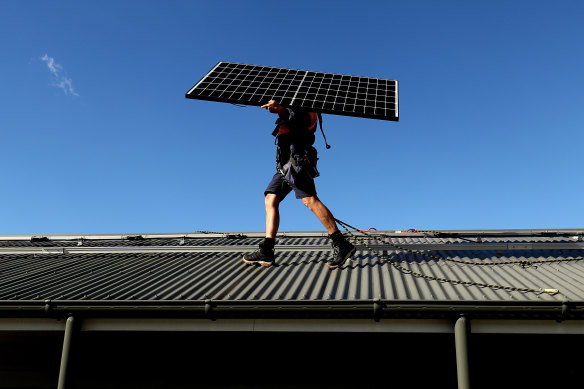
Angus Taylor, if elected, would lift the moratorium on nuclear energy (“Nuclear still part of Coalition plan, says Taylor”, May 15). In the current climate, where energy security is threatened once again by external forces, and where energy demands are increasing, nuclear might seem quite attractive. In reality, Taylor’s necessary commonwealth nuclear regulatory and safety frameworks, plus state-level compliance, would take years, and this would be but a small first step towards a hugely expensive and risky undertaking. A useful fact to keep in mind is that one nuclear reactor produces 1 gigawatt. Rooftop solar now accounts for 28.3GW of installed capacity (our coal-fired generators account for 22.5GW). Last year, rooftop solar contributed 14.2 per cent of electricity generation, nearly doubling since 2020 (7.2 per cent). In 2025, the Australian Energy Market Operator reported that the output of new generation and storage capacity reached 4.4GW. Why does the Coalition maintain its objection to renewables, and its support for nuclear? Fiona Colin, Malvern East (Vic)
Changes not courageous
I agree with Richard Abram’s letter rejecting the rationale for Labor breaking its election promise not to change property tax arrangements (Letters, May 15). The underlying problems have been evident for at least a decade, as growing numbers of younger Australians were priced out of the housing market by investors. While I applaud the changes, can we stop calling them “courageous” please? Real courage would have been making the argument for reform at the last election – much like the bete noire of Labor politics, John Howard, did with the GST in the 1998 election. Salvatore Sorbello, Campsie
I’m a Boomer, but perhaps not as entitled as some. Richard Abram, a “decades-long property investor”, complains about Albo’s broken promises and asks if he will get a refund to cover him for the budget CGT changes. What he seems to have missed is that the government, presumably because it was aware of the deluge of complaints it would generate, has grandfathered the changes. This means all existing investors can continue with their current favourable tax set-up on all current investments. So Richard, relax, there will be no need for Jim Chalmers to send you a refund unless, of course, you plan to increase your empire in the future. Ian Morris, Strathfield
The new tax rules are only part of the risks of buying homes off plan (“Off-plan investors fear tax rules will hit price growth”, May 14). More significantly, developers can go broke, constructions can be delayed and final products may be inferior to what was promised. My advice would be to buy an established property so you can physically check the quality, size and layout. Mustafa Erem, Terrigal
Tax equity
Waleed Aly writes “our tax system tells you that if you earn money by working, you’re a fool” (“Chalmers’ budget story still not finished”, May 15). The Chalmers budget seeks to level the tax playing field between wage-earners and those who legally avoid tax by investing in a trust. It’s no coincidence that those who take advantage of this are in the wealthy category and thus are least in need of financial help. If the government has decided to inject equity into the tax system, it should be applauded. Those who object obviously don’t believe in societal fairness, including Pauline Hanson, who has predictably described the new regime as “communist” in her typically misguided way. Max Redmayne, Drummoyne
Waleed Aly writes that a capital gains tax concession on shares is a good thing because “investing in businesses via shares … is also productive”. This is not the case at all. Investing in shares is merely a form of gambling, since the core business gains no benefit from share trading once the initial capital raising is complete, but it simply rewards those lucky enough to choose a winning share (horse) on the exchange (racecourse). Share trading is no more than professional gambling and should be treated in the same way taxwise. Bruce Hyland, Woy Woy
Ducking off
Anne Eagar, I agree with everything you say about Pauline Hanson, except for her not being a mother duck (Letters, May 15). Think of the children’s song Five Little Ducks, about a family of ducklings that go out, and every time they come back to mother duck, there is one fewer. With 28 defections from her party since its inception, this seems to me to fit perfectly with Hanson’s image as mother duck. Charmain Brinks, Newcastle
Your correspondent Jakob Gamertsfelder has every right to appeal against what he thinks (and what appears) to be an unjust decision by Centrelink (Letters, May 15). He, and others in such a position, can go to the Economic Justice Australia website to get good practical advice about exactly how he can appeal. This would be of more help than joining One Nation. Paul Parramore, Sawtell
It is delusional to think that a political party with no credible policies, and which is based on negativity and fear-mongering and linked to a mining billionaire who gifted its leader a private jet, is the solution for battling Australians (Letters, May 15). John Cotterill, Kingsford
Bluster v discretion
The Trump-Xi summit provides an interesting contrast between the two world leaders (“China gives Trump a grand welcome and a stern warning on Taiwan”, May 15). One depends on bluster, self-congratulation and the vile smearing of his critics. The other keeps his plans close to his chest and not only considers what is most effective for his side, but also ponders the lessons of history. Greek general and historian Thucydides wrote of the outcome when a dominant power was challenged by the growth of a competitor. The conclusion, even though one was victorious, was virtual ruination for both sides. One must doubt whether US President Donald Trump’s priorities make him fit to hold the future of the so-called free world in his hands. He is up against a challenger far more skilled in leadership and diplomacy than he will ever be. Derrick Mason, Boorowa
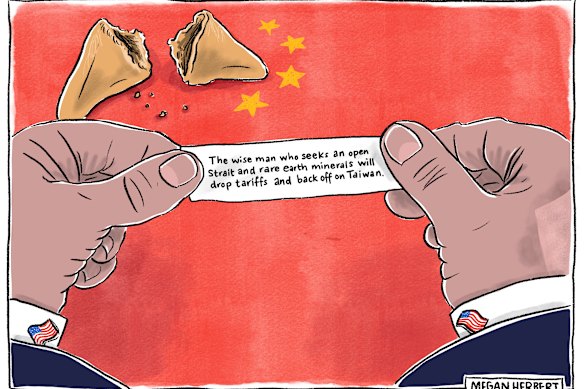
It’s great to see Donald Trump getting on so well with his “good friend” Xi Jinping, who joins the club with Vladimir and that bloke from North Korea, along with Bibi, of course. Such a pity Viktor is off the scene. With friends like that, who needs NATO? Steve Fortey, Avoca Beach
A fine mess
Hang on, what have the shareholders of Coles and (probably) Woolies done to deserve massive fines (“Coles faces fines in ‘hundreds of millions’ in discounts ruling”, May 15)? When poor, or even criminal, decisions are made by management of these and other companies, why should the shareholders be punished? It would be far more appropriate to fine and jail the decision-makers. Ellie Fitz-Gerald, Orange
As a permanent Coles shopper, mainly due to convenience of location rather than loyalty, I don’t feel particularly vindicated to read of my involuntary contribution to the government coffers through a fine of hundreds of millions imposed on Coles. Instead, I wonder how much the company will up, up, up prices to cover the fine, thus doubly penalising customers. Heather Johnson, West Pennant Hills
Multiplying ads subtract
Sydney’s civic spaces are increasingly dominated by digital advertising. Illuminated screens now line tollways, stations, streets and plazas, eroding the qualities the city claims to value. The operators of the M2 recently installed a large illuminated screen on a grass verge at Ryde, adding to its digital billboards on its many overpasses. Sydney Metro and Sydney Trains also appear to recognise few limits in monetising its public infrastructure. I witnessed this creeping takeover as Chatswood station gained multiple digital screens, video walls, platform advertising and now, the first advertising inside its Metro carriages. Central station’s recent refurbishment created a dignified and spacious transport environment, yet it, too, is being treated as premium advertising real estate, its elegant sandstone surfaces now wrapped in vinyl ads and its historic concourse dominated by a bright digital billboard. There is a clear difference between necessary signage and the saturation now overtaking Sydney’s public realm. Once such visual clutter becomes normalised, the city gradually loses not only a sense of restraint and civic dignity, but also the beauty that distinguishes its well-designed public spaces. David Grover, Chatswood
- To submit a letter to the Sydney Morning Herald, email [email protected]. Click here for tips on how to submit letters.
- The Opinion newsletter is a weekly wrap of views that will challenge, champion and inform. Sign up here.
Read the full article here