




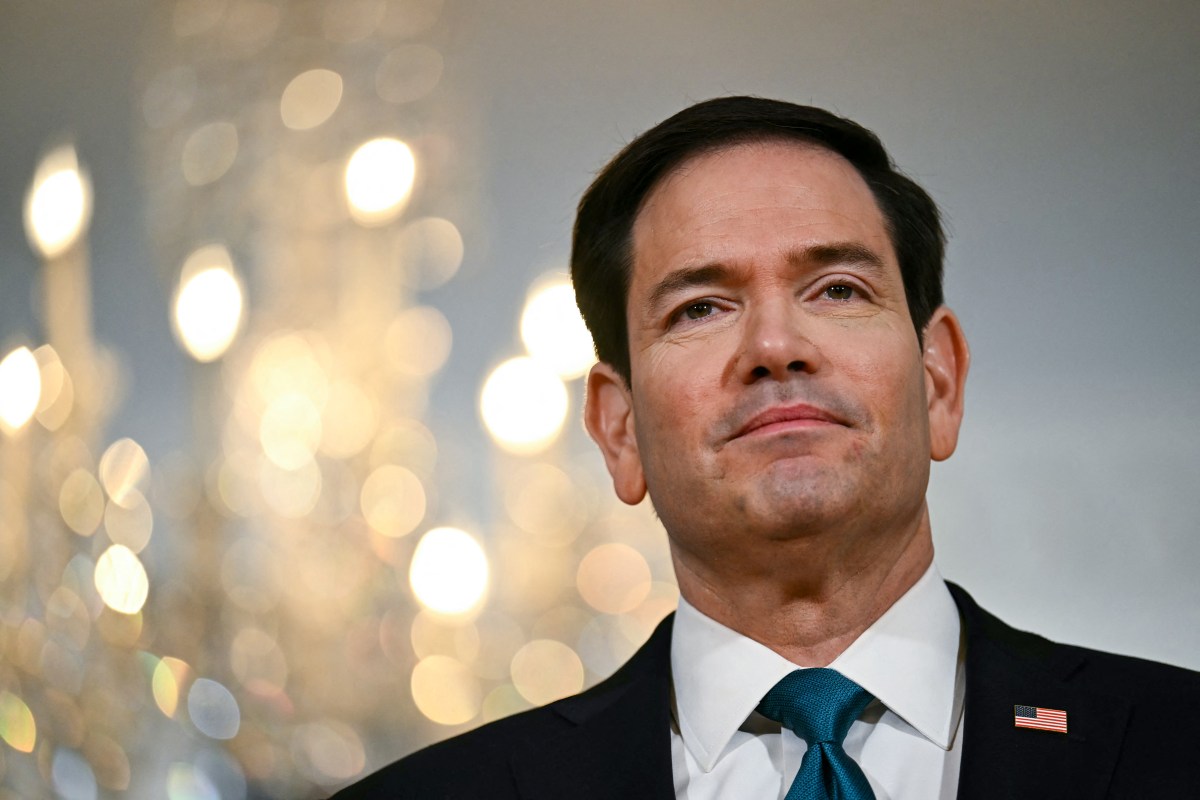
Secretary of State Marco Rubio has jumped ahead of Vice President JD Vance as the favorite to win the 2028 presidential election, according to prediction market Polymarket.
Speculation of early positioning by potential candidates has continued, as polling since 2025 has suggested close hypothetical contests between Vance and prominent Democrats while highlighting uncertainty within both parties.
Vance was asked about running on a potential ticket with Rubio by Newsweek during a White House news conference last month. Responding to President Donald Trump calling the pair a “dream team,” Vance said that Americans would likely unfavorably view “someone who’s barely been in one office for a year and a half angling for a job two and a half years down the road,” adding, “There are few topics I want to talk about less.”
No candidate has formally announced their candidacy.
Newsweek reached out to the White House via email on Monday for comment.
What To Know
According to prediction market site Polymarket, Rubio first surged past Vance on Saturday morning with 16.7 percent compared to 16 percent. California Democratic Governor Gavin Newsom had 14.8 percent and former Vice President Kamala Harris had 5.5 percent.
Rubio then dipped below Vance on Sunday, but on Monday, he regained his lead. As of 4:34 p.m. ET Monday, Rubio has 16.3 percent, Vance has 15.2 and Newsom has 14.2 percent. Harris remains in single digits with 5.1 percent.
On Kalshi, a regulated U.S. prediction market, Rubio took the lead over Vance and Newsom on May 7. He then dipped to second at the end of the month but regained the lead on May 22 and has not dipped again.
What Other 2028 Polls Show
Meanwhile, a survey of 432 likely Republican primary voters at the end of last month from Emerson College Polling shows that Vance and Rubio are neck and neck among potential 2028 Republican primary candidates:
- Rubio landed 34.6 percent of the vote versus Vance’s 35.5 percent.
- Florida Governor Ron DeSantis came in a distant third with 5.4 percent.
- Former South Carolina Governor Nikki Haley secured 4.6 percent.
- The poll also shows that 1 percent would pick someone else, and 15 percent are undecided.
The survey was taken on May 24 and May 25, and has a credibility interval of 4.7 percent.
“The President has assembled an all-star team that has achieved unprecedented success in just over one year. No amount of crazed media speculation about Vice President Vance and Secretary Rubio will deter this Administration’s mission of fighting for the American people,” White House Communications Director Steven Cheung told Newsweek in a previous statement last month when asked about the survey.
A survey from HarrisX/Harris Poll, taken from May 29 to May 31 of 1,725 registered voters, shows the following preferences for the Republican candidate for 2028’s presidential election:
- Vance with 45 percent of the hypothetical vote.
- Donald Trump Jr.’s 21 percent.
- Rubio’s 21 percent.
- 7 percent said someone else.
- 5 percent said Tucker Carlson.
The poll has a margin of error of 2.4 percent.
A Harvard/Harris poll taken from April 23 to April 26 surveyed 2,745 registered voters and shows:
- Vance had 48 percent.
- Trump Jr. had 18 percent.
- Rubio had 16 percent.
- DeSantis landed 9 percent.
- 4 percent said Carlson, and 4 percent were undecided.
The poll had a 1.87 percent margin of error.
What’s Next
- Lead could shift again quickly: Rubio’s edge over Vance in prediction markets remains narrow, meaning even small political developments—or shifts in trader sentiment—could flip the rankings again.
- Polling may challenge market odds: While betting markets now favor Rubio, recent voter surveys still show Vance performing strongly, suggesting a potential disconnect that could narrow or reverse the trend.
- No campaigns—yet: With no official 2028 candidates declared, early positioning remains fluid. Any move toward a formal run—such as travel to early-primary states or fundraising activity—could reshape the field.
- First real signals still ahead: Clearer indications of candidate strength are unlikely until after the 2026 midterms, when endorsements, campaign infrastructure, and sustained polling begin to take shape.
Read the full article here