




Hungary is running out of time to secure its students’ participation in the EU’s Erasmus+ exchange programme, despite earlier assurances from Prime Minister Péter Magyar and European Commission President Ursula von der Leyen that the process would be completed on schedule.
Following Magyar’s election victory in April, both the new Hungarian government and the Commission signalled their willingness to readmit Hungarian students to the scheme from the start of the next academic year in September. But without immediate administrative action from Budapest, the Commission will not be able to lift the suspension in time.
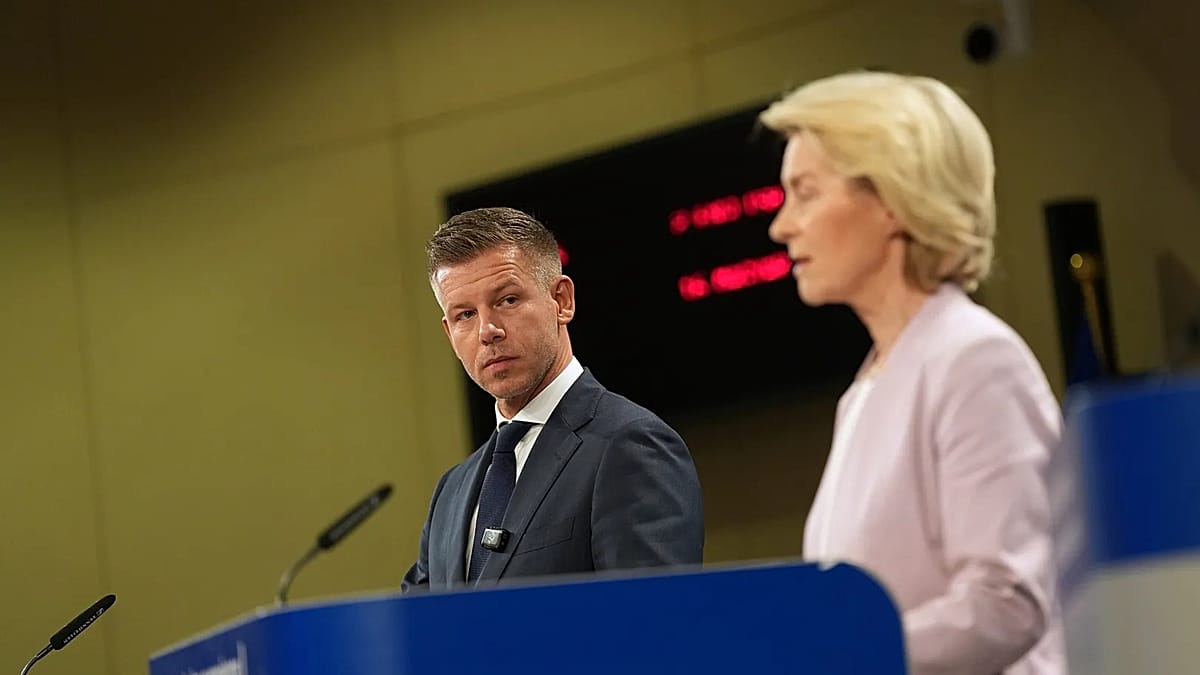
“As early as the next academic year – good news – Hungarian students can also be part of the Erasmus community again,” von der Leyen said in May, when striking a political deal with Magyar to unblock €16.4 billion in previously frozen EU funds for Hungary.
A large share of Hungarian universities was excluded from the programme in 2022 after Brussels suspended funding for 21 institutions run by government-linked public interest trusts, citing rule-of-law and transparency concerns.
After coming to power, Magyar’s government decided to renationalise those public interest trusts, meeting the EU’s demands for greater transparency in their governing boards and decision-making.
Milestones due in August
The Erasmus+ suspension could be lifted if Hungary meets the criteria of the Conditionality Mechanism, an EU tool that allows for the suspension of payments over rule-of-law concerns.
“We don’t see how Hungary will be back in Erasmus+ anytime soon if Budapest doesn’t submit measures related to the Conditionality Mechanism early this summer, to unblock the funds,” a Commission official told Euronews, speaking on condition of anonymity.
According to diplomatic sources, Hungary has already fulfilled this particular set of “super milestones” but will not submit them to Brussels until the end of August, as part of a broader package of 27 super milestones.
This means the Commission will almost certainly be unable to overturn the ban before September. The file currently sits with the Commission’s Directorate-General for Budget.
The Hungarian Ministry of Education and Children told Euronews that the universities concerned have submitted their Erasmus+ mobility applications for 2026 and therefore have valid applications.
“The grant amounts granted to them conditionally are available, but they can only be used after the Council’s restriction is lifted,” the ministry said.
Should Hungary submit the relevant milestones sooner than August, Brussels could unblock the Erasmus+ file over the summer.
A bridging solution
At the end of April, during his first visit to Brussels since his election victory, Magyar struck a confident tone on the Erasmus+ issue, while acknowledging the difficulties involved.
“We will find a solution, hopefully, so that from September onwards there will be Hungarian students who can take advantage of the opportunities offered by the Erasmus scholarship,” the prime minister said.
“Obviously not in full, as the application deadlines have already passed, but we will find a solution so that Hungarian students can study at the best universities in Europe through additional applications.”
Dr Loretta Huszák, a lecturer at Corvinus University, said EU financing for student exchanges under Erasmus+ for the 2026-27 academic year is now practically impossible to secure.
“The universities will have to organise the return to Erasmus in the autumn, and the conditions and funding for the next round of international mobility calls will come from the Erasmus fund,” she told Euronews. “This could affect the 2027-28 academic year at the earliest.”
Hungarian grants
In the meantime, Hungary has replaced Erasmus+ with its own Pannónia programme, financed from the national budget.
“The funds necessary for financing international student, faculty and staff mobility are currently available to the higher education institutions concerned under the Pannónia Scholarship Programme,” the Ministry for Education and Children said in a statement.
The ministry’s response also stated that administrative preparations can already begin before the EU’s approval.
“The technical and administrative preparations necessary for concluding the grant agreements can already be started during the restriction. However, the signing of the agreements and the provision of the grant funds can only take place after the restriction adopted by the Council of the European Union is lifted.”
The Ministry of Education said it is working together with the EU on the universities concerned to return to the Erasmus+ programme, and that the use of EU funds can be implemented as quickly as possible once the necessary EU decision is made.
Read the full article here