



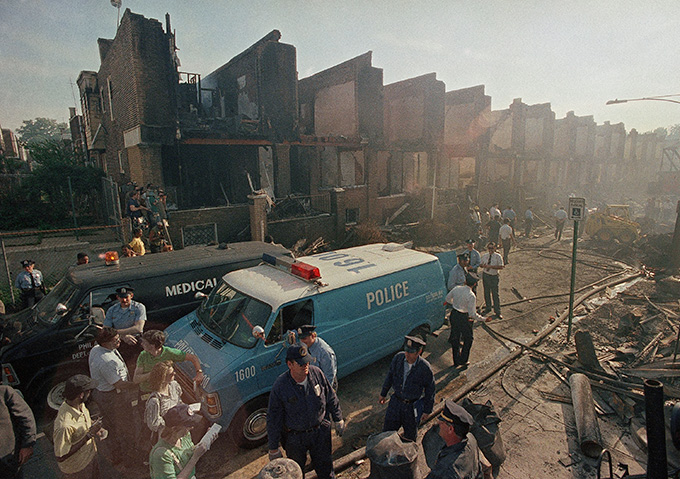
“Shock and awe.” That was Fatimah Jackson’s reaction when police dropped a makeshift bomb onto a residential building in Philadelphia on May 13, 1985. The brick-faced row house was the communal home of MOVE, an organization that advocated for Black liberation, natural living and animal rights. After a daylong standoff and shootout, during which MOVE members refused to leave the building, the city’s mayor gave police the go-ahead to drop an explosive device. In the ensuing inferno, 61 houses burned to the ground — and six adults and five children were killed.
The consequences of that day are still playing out. In 2021, local journalists reported that the University of Pennsylvania had been keeping human remains from the bombing — tentatively identified as 14-year-old Katricia “Tree” Africa and 12-year-old Delisha Africa — in a cardboard box on a shelf, without their relatives’ knowledge or consent. The remains, originally entrusted to the school by the Philadelphia Medical Examiner’s Office, had also been used as teaching materials.
Although the remains of Delisha and Tree have since been returned to their families — and the school and city apologized — the MOVE incident is one example in a long line of researchers keeping human remains without consent, says Jackson, a biological anthropologist who retired in 2024 from Howard University in Washington, D.C. “We’re the ones who are holding this material,” she says. “The scientists are the culprits here.”
Spurred by the MOVE revelations, the American Association of Biological Anthropologists in 2021 created a task force to craft new guidelines for the ethical study of human remains, with Jackson as cochair. It was an intimidatingly large project, she says, but too important not to take on. “Even after the Civil War, people in Black communities were talking about the grave robbers that would come and steal the bodies, and these bodies would show up in white medical schools,” she says. “We had a lot of pain, but we didn’t have any solutions for the pain.”
Other experts see Jackson as a natural choice for the project. “Across the course of my own career, I’ve seen major shifts in the ways that we talk about ancestors, the ways that we perceive their treatment, and the necessity for consultation with contemporary descendants or experts,” says Jennifer Raff, an anthropological geneticist at the University of Kansas in Lawrence. Jackson, she says, “was, and remains, one of the most influential voices in this movement.”
Research over remains
Anthropologists and anatomists have been studying human remains without consent for centuries. In the 1800s, physician Samuel George Morton infamously collected hundreds of human skulls, launching a new field of science — and propping up his views on white superiority in the process. The Smithsonian’s National Museum of Natural History alone holds the remains of about 30,700 individuals. Many come from paupers’ graves, slave cemeteries, Native American burial sites or countries formerly under Western colonization, most notably India.
“Especially in the early days of American physical anthropology, there was an expectation that science and scientific research was paramount and took precedence over any other consideration,” Raff says.
Those practices started to come under fire in the 1970s. Maria Pearson — a member of the Turtle Clan of the Yankton Sioux — challenged how research institutions handled Native American remains and demanded that they be returned to their communities. Her work led to the first state law protecting Native burial sites, in Iowa, in 1976 — and ultimately the passage of the Native American Graves Protection and Repatriation Act in 1990.
NAGPRA led to the repatriation of thousands of Native American remains. But it was not without controversy. After the 8,400-year-old nearly complete skeleton of an individual known as the Ancient One, or Kennewick Man, was discovered on the banks of the Columbia River in 1996, five Columbia Basin tribes requested the remains under the new law; researchers won a lawsuit to study them, instead. Years of legal battles and forensic testing ensued. In 2017, the remains were at last returned to the tribes and buried in a hidden location in the Pacific Northwest.
The disposition of other remains, including those of enslaved individuals, has been equally fraught. The country’s oldest — and largest — cemetery for people of African descent was unearthed in Manhattan during the construction of a government building in 1991. Only after sustained protests did officials decide to preserve the site, eventually creating the African Burial Ground National Monument.
Scientists’ traditional treatment of human remains has been “very much a free-for-all,” Jackson says. But that has started to change. By 2024, at least three major scientific organizations had published guidelines for the care of these remnants: the American Association for Anatomy, the American Anthropological Association and the Smithsonian Institution.
Contemporary anthropologists are still wrestling with their forebears’ legacy. “We have these collections that have been assembled by the early physical anthropologists,” Raff says. They contain a mixture of skeletons, artifacts and DNA. “We are struggling to figure out what is the most ethical way to care for them, to study them. In many cases, it’s not to study them. In many cases, it is to return them to contemporary descendants.”
African American anthropology
Jackson was born in 1950 and grew up in Denver. Her family had been among the first settlers of nearby Dearfield, an African American homesteading town that was abandoned after the Great Depression. In Denver’s Five Points neighborhood, Jackson lived among African Americans, Mexican Americans and Japanese Americans who had recently returned from World War II internment camps. In her redlined community, “a lot of people were getting the short end of the stick,” Jackson says.
In the late 1960s, Jackson enrolled at the University of Colorado Boulder — and found herself regularly in white company for the first time. It was an inspiration of sorts. “I was interested in biological anthropology because of the differences in morphology I saw in the people around me,” she says.
After two years, on the recommendation of a trusted professor, Jackson transferred to Cornell University to continue her education in anthropology. She studied genetics, nutrition and parasitology. She also met her future husband, nutrition scientist Robert Jackson. By coincidence, she had first seen his picture in the newspaper in Colorado: He had been one of several African American students who took over Cornell’s Willard Straight Hall in a 1969 protest demanding a Black Studies program.
The pair married, and Jackson graduated in 1972. They moved to Tanzania that same year, where Robert did postgraduate fieldwork and Jackson took a three-year leave of absence from her studies. She had the first two of their six children and worked as a teacher to support the family.
Then Jackson’s life changed irrevocably. She contracted malaria in 1974, and the infection was brutal: She temporarily lost her eyesight and could not walk or speak.
Close to death, Jackson made a promise to God that if she lived, she would study malaria. Her prayers were answered, and she recovered. In 1975, she began a Ph.D. at Cornell. But by the time she was ready to go back into the field, Tanzania and Uganda were at war. Reluctant to return to what was now a war zone, she moved to Liberia, where she wrote a dissertation on genetic adaptations to malaria in Liberian mothers and children.
When she finally returned to the United States in 1980, Jackson noted the racism — both overt and subtle — that was part of daily life. “People would refuse to get on the elevator with us,” she said. And her chosen field of anthropology had often dismissed the experiences of disenfranchised groups. “Race science was still very strong in anthropology at that time,” she says, with many authors still publishing pseudoscientific studies about racial differences in characteristics such as intelligence.
For Jackson, that bias came to a head in the groundbreaking Human Genome Project. The project, which ran from 1990 to 2003, used DNA from 20 people: one of blended ancestry and 19 of primarily European ancestry. Though Jackson supported the project, she also saw it as a continuation of 20th century practices in which African Americans were routinely excluded from research that collected baseline scientific and medical data.
The project’s leaders “wanted to characterize the human genome, but which genome?” Jackson asks. In 1994, she helped organize fellow academics to write a manifesto, in which they called for the project to include more samples from African Americans — and more African American researchers.
That experience inspired Jackson to develop a more inclusive approach to genomics. In 2009, while at the University of Maryland, College Park, she published a paper on a new technique she called ethnogenetic layering, which can identify the patterns of genetic variation within complex populations.
“African Americans are an amalgamation of a lot of different African groups, with admixture from certain Native American groups and specific European groups,” Jackson says. Her new method tried to figure out where different genetic variants had come from, how they interacted with environmental and cultural factors, and how they affected disease risk. Instead of treating African Americans as a single group, it helped reveal the richness of their genetic diversity, Jackson reported in the Annals of Human Biology.
“She’s made a lot of contributions, I think, in general to thinking more critically about groups of people in ways that aren’t focused on racial categorization,” says evolutionary biologist Benjamin Auerbach at the University of Tennessee in Knoxville.
In 2018, Jackson and her team at Howard University published a study detailing how institutionalized racism and enslavement may have affected African Americans’ biology via epigenetics. Previous studies had shown the process — in which environmental cues can change gene expression without altering the underlying DNA — can be triggered by elevated levels of the stress hormone cortisol. That work in the Journal of Clinical Epigenetics suggested potential epigenetic shifts in African American populations — and proposed that scientists start searching for them. Subsequent studies have found evidence of faster epigenetic aging among African Americans who have repeated exposure to racism.
Then in 2021, the MOVE bombing erupted back into the spotlight.
Caring for ancestors
The revelation that the MOVE victims’ remains had been kept without their relatives’ consent, stored carelessly in a box and used as teaching props caused widespread outrage.
The biological anthropologists’ association chose Auerbach to lead its new task force to systematize the ethical management of human remains; he immediately asked Jackson to be his cochair. As director of the Cobb Biological Anthropology Laboratory at Howard University, and with her decades of community engagement, Jackson was the ideal partner, Auerbach says. “She’s really good at thinking about nuance.”
Not that it was easy. In the wake of the MOVE revelations — and the racial reckoning inspired by the Black Lives Matter movement — some researchers publicly advocated for the end of all studies involving human remains. Jackson and her colleagues wanted to take a more thoughtful approach. “The goal was to broaden the discussion and not to trivialize what was done,” Jackson says. Instead, the task force sought to balance the value of scientific research with respect for the communities it affected. “The community has a right to be involved in the research,” she says.
First, the task force narrowed the scope of the project to focus on just one group. It chose African Americans, whom Jackson says are overrepresented in legacy human tissue collections. Then, it sought input from people in that community.
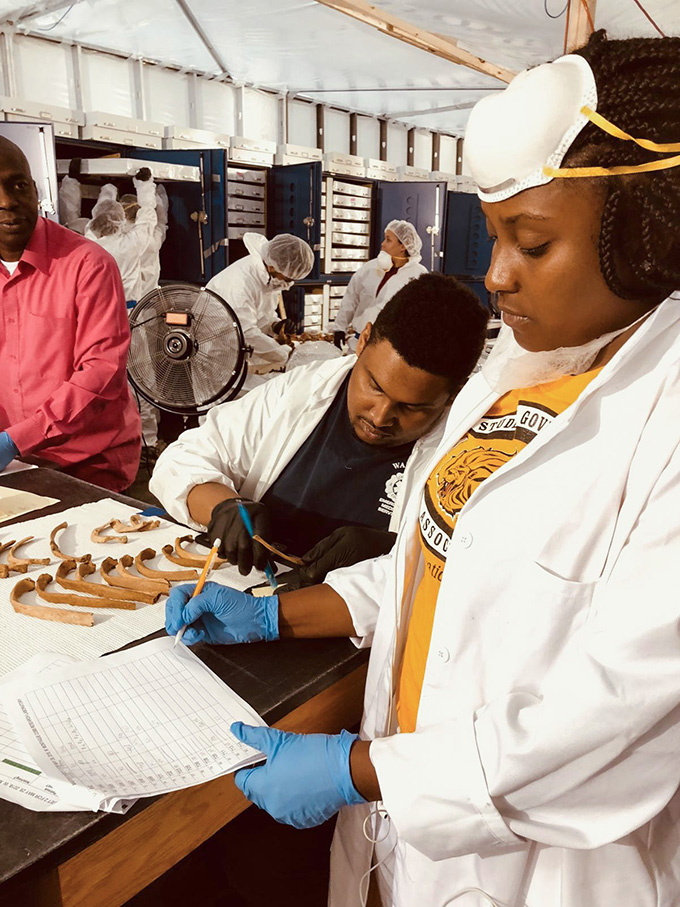
“Since we didn’t have any money for the task force, I had to use my students,” says Jackson. She taught 52 of them how to run focus groups and ask descendant communities how they wanted their ancestors’ remains treated. Over four years, her students spoke to more than 3,000 African Americans from 35 states.
“You need to ask me before you work on my grandmother’s bones,” said one respondent, a young man from Orange Mount, Tenn. Another, an older man from Chicago, said: “Once we give our approval [for the research], that is not the end of it. We need to be kept abreast of everything else.”
Auerbach also surveyed anthropologists across the United States to find out what skeletal materials they had — and what they hoped to do with them.
The result is a set of recommendations published in the American Journal of Biological Anthropology in March. In addition to requiring “explicit consent” from relevant communities, the guidelines call on institutions to inventory remains in their legacy collections, ascertain the identities of descendant communities and engage those groups in dialogue. Both researchers and community members said they wanted mutual formal partnerships to help them make decisions about ancestral remains.
Raff cautions that the next steps could be tough. Different communities will want different outcomes, she says. And the mistrust born of abuses such as the Tuskegee experiments — in which African Americans who had syphilis were not told of their disease status and left untreated — echo to this day.
“We’re lucky,” says Raff, “that we have very thoughtful researchers like Dr. Jackson, who are going out and doing the work of talking to communities and finding out what is it that they think we should be doing.”
But the current environment for scientific research in the United States is making that work harder, Jackson says. “The guidelines were created in a more progressive political situation.” She worries that the Trump administration’s slashing of research funding for social sciences and social justice could hamstring the work of her group and others.
“At least we provided the groundwork,” Jackson says of the project. She hopes others will build on what she’s done. “You’re starting to hear the voice of the people. It’s been a long time coming, but it’s the change we’ve been waiting for.”
Read the full article here