




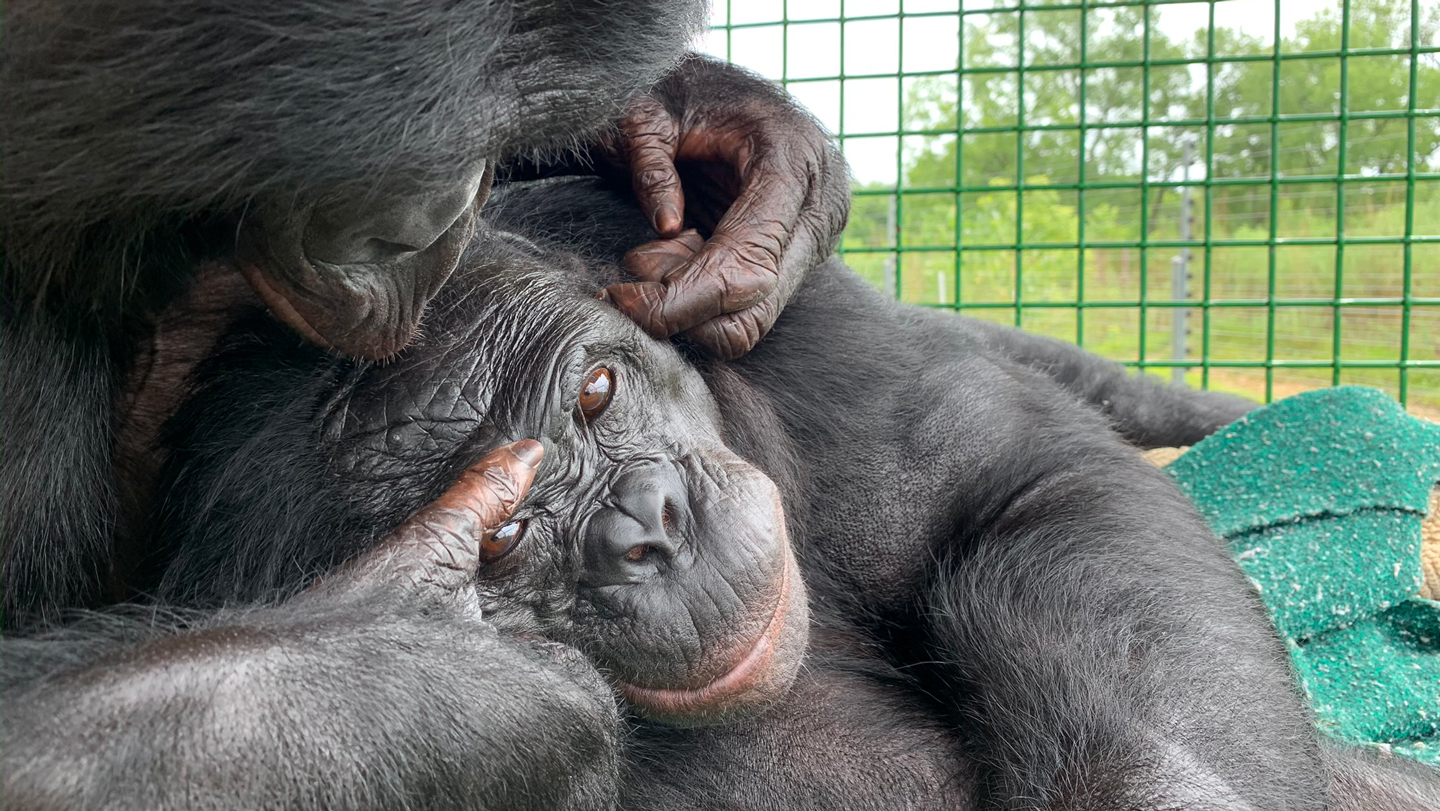
Humans may not be the only primates with the power to imagine. During a make-believe tea party, a bonobo named Kanzi kept track of invisible juice and imaginary grapes, researchers report February 5 in Science.
The findings add to a growing body of work suggesting that ape minds can imagine scenarios beyond the “here-and-now,” a skill once thought to be unique to humans. Human children begin playing pretend as early as 12 months old and master the ability to build imaginary worlds by age 3. Many high-level thinking tasks are possible only because we can imagine things that aren’t really there.
The study centered on Kanzi, a remarkable bonobo who could communicate using word-linked symbols called lexigrams. Amalia Bastos, a comparative psychologist at the University of St Andrews in Scotland, first met him in 2023. “We were starstruck by Kanzi,” she says.
During their first meeting, the bonobo used his lexigram-studded board to ask Bastos and a colleague to chase each other. Bastos noticed that even though they only pretended to play, Kanzi still enjoyed watching them. This kick-started a series of make-believe tests that Bastos and Christopher Krupenye, a psychologist at Johns Hopkins University, designed for Kanzi.
In the first of these tests, Kanzi sat at a table with two glasses. An experimenter pretended to pour a glass of “juice” — Kanzi’s tipple of choice — into both cups from a see-through empty jug. The experimenter then poured the nonexistent contents of one cup back into the jug, before asking Kanzi which cup still held the “juice.” Kanzi guessed correctly 68 percent of the time, significantly above chance, the researchers report.
The guesses, Bastos says, may not have been definitive evidence of Kanzi’s internal imagination. “Kanzi is an old bonobo. Maybe his vision isn’t very good. Maybe he thinks that there’s real juice in these things,” she says.
The researchers retested Kanzi to see if he could identify real from fake juice. They presented him with two cups: one containing orange juice and an empty one that they filled with pretend juice. When asked which cup he wanted, Kanzi picked the real juice nearly 80 percent of the time, suggesting he had little issue identifying his reward. A third test that mimicked the first, but with pretend grapes rather than juice, again suggested Kanzi understood where pretend food was located.
Inventive tool use in apes and other animals is often dismissed as a product of accidental discovery, says Cathal O’Madagain, a cognitive scientist at the University of Mohammad VI Polytechnic in Morocco who was not involved in the study. But scientists might need to reconsider: Human invention is tightly linked to imagination. “You can’t invent a bicycle if you can’t imagine one first,” O’Madagain says. If animals truly can imagine as humans do, it would cast their tool use in a new light, he says.
Bastos last saw Kanzi just two months before he died in March 2025. The bonobo was unique, one of the last remaining animals raised in a human environment from birth. Her next steps will be to explore whether apes without Kanzi’s background and training can also pass the imaginary juice test.
Read the full article here