



One year after leading the insurgent charge that swiftly ended generations of Baathist rule, Syrian Interim President Ahmad al-Sharaa is claiming victories on an even more unlikely front.
Sharaa’s transformation from Islamist rebel chief and key associate of the Islamic State militant group (ISIS) and Al-Qaeda to pragmatic statesman has in many ways proven even more stunning than his sudden ousting of longtime President Bashar al-Assad last December in an 11-day offensive that shattered the entrenched expectations surrounding a 13-year civil war.
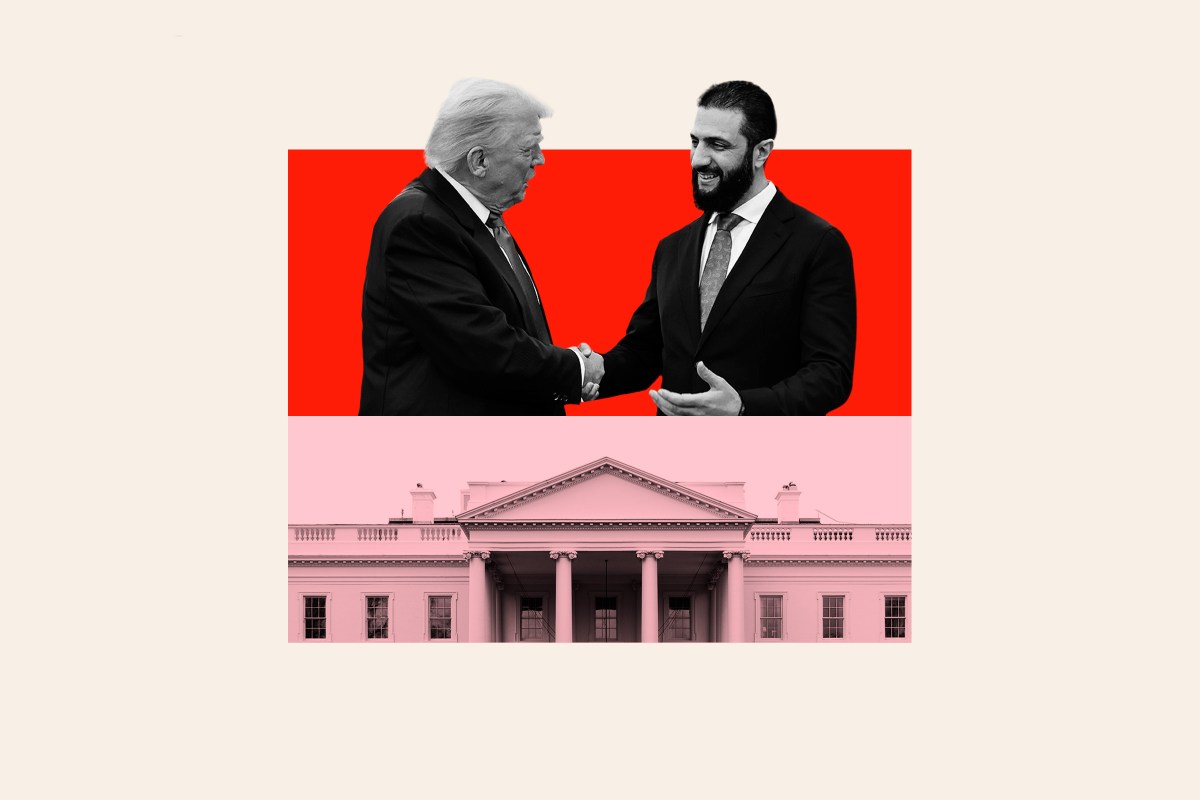
Further challenging long-held assumptions amid regional upheaval has been Sharaa’s growing partnership with President Donald Trump, who has embraced the Syrian leader, meeting him in Saudi Arabia in May and receiving him at the White House in November.
Once a U.S.-designated terrorist who joined the ranks of jihadis fighting U.S. troops in Iraq and subject to a $10 million bounty up until weeks after taking the reins in Damascus last year, Sharaa has even recently received Trump’s backing in the face of ongoing strikes by Washington’s closest ally in the Middle East, Israel, with whom Sharaa has further defied widespread conjecture in seeking direct engagement.
The swift pace and broad scope of the budding bond between the two leaders have even taken some of those around Sharaa by surprise.
“The rapid rapprochement between President Trump and President Sharaa represents one of the most unexpected diplomatic shifts in the region,” Mahmoud Toron, business and economic adviser to the Syrian government, told Newsweek. “Only a year ago, such a partnership would have seemed highly unlikely, particularly given Israel’s efforts to frame the Syrian leadership as a persistent threat.”
“Yet Washington now appears to have concluded that the current Syrian administration is the most viable actor to guide the country through its transitional phase and maintain regional stability,” Toron said, adding that “trust between the two leaders has grown at a remarkable pace.”
The Roots of a U.S.-Syria Reset
While undoubtedly an unexpected development even to most veteran observers, events surrounding Syria’s civil war have a history of challenging conventions of U.S. foreign policy, often to the frustration of leadership in Washington.
In weeks leading up to Assad’s downfall, he appeared to be on track for reclaiming his place in the region after most nations severed ties in the early years of the civil war that pitted his government against a variety of rebels and insurgent movements, including Islamist groups such as the Nusra Front, later rebranded to Hayat Tahrir al-Sham, that Sharaa, then known by his nom de guerre, Abu Mohammad al-Golani, commanded.
Washington had long forfeited its campaign of aiding opposition forces that had become overshadowed by more radical elements. And while sanctions remained in place, the incoming Trump administration’s appointment of figures known for promoting dialogue with Assad, particularly Director of National Intelligence Tulsi Gabbard, signaled that the new White House may look for a new deal with Damascus in line with the U.S. leader’s transactional approach to foreign policy.
The opportunity would never arise, however. On November 27, 2024, just weeks after Trump’s election victory and the same day that Lebanon’s Iran-aligned Hezbollah movement that aided Assad throughout the war signed a ceasefire in its ongoing confrontation with Israel over the conflict in Gaza, a rebel offensive led by Sharaa’s Hayat Tahrir al-Sham reignited the frozen frontlines of Syria’s civil war, securing lightning gains that forced Assad to flee to Russia by December 8.
Trump initially greeted the events with caution, warning outgoing President Joe Biden not to intervene and asserting that the U.S. “should have nothing to do” with the “mess” that was taking place in Syria. His soon-to-be vice president, JD Vance, even compared the Islamist-headed takeover to past scenes of jihadis executing Christians en masse.
But it wouldn’t be long before the new administration’s signature and often conventional outlook on dealmaking abroad would find roots in Damascus, aided by active campaigns from Turkish President Recep Tayyip Erdogan, who Trump openly credited with aiding the rebel win, and Saudi Crown Prince Mohammed bin Salman, who hosted their first fateful meeting.
Trump’s iconic handshake with Sharaa during a visit to Riyadh in May marked a pivotal point in Sharaa’s global rehabilitation. The move was accompanied by the White House announcing a lifting of Assad-era sanctions despite reports of deadly sectarian clashes that elicited new caution over the Syrian leader’s stated commitment to pursue a more inclusive and peaceful path for his war-torn nation.
Sharaa’s visit to the White House last month has since reaffirmed Trump’s dedication to working with the leadership in Damascus, where Toron said hopes lie for further cooperation on recalibrating Washington’s ongoing partnership with the Syrian Democratic Forces (SDF), the Kurdish-led group that controls much of northeastern Syria, and, particularly, in finding new business opportunities.
Rather than echo Assad’s calls for the expulsion of U.S. forces present in SDF-held territory and a southwestern desert garrison, Toron said the Syrian government was looking to forge an agreement that would legitimize their presence, advance a deadlocked integration deal reached in March between the SDF and Damascus and pave the way for investment by U.S. businesses, especially in Syria’s oil and gas sector that has been hindered by civil war-era conflict and territorial divisions.
“Such cooperation could unlock significant economic opportunities, strengthen bilateral trust, and—most importantly—improve living conditions in the areas most devastated by the war,” Toron said. “It would represent a rare win-win scenario: contributing to Syria’s economic recovery while allowing the United States to remain constructively engaged during a critical phase of the country’s stabilization.”
Toron also recognized that Trump’s “pragmatic” strategy thus far “aligns with a broader regional understanding that Syria’s collapse cannot be allowed to recur and that re-stabilizing the country is in the collective interest,” and that “the warming relationship also marks a tentative reintegration of Syria into the U.S.-led regional and international order.”
From the administration’s perspective, a White House official told Newsweek that “President Trump is committed to supporting a Syria that is stable, unified, and at peace with itself and its neighbors,” calling this “a key element of the President’s vision for a peaceful and prosperous Middle East.”
“A stable and sovereign Syria is critical for the region’s stability,” the White House official said. “Syria must not become a base for terrorism or pose a threat to its neighbors and the wider world.”
Reflecting on Sharaa’s performance just ahead of the one-year mark, the White House official cited Trump’s December 1 Truth Social statement, reading, “the United States is very satisfied with the results displayed, through hard work and determination, in the Country of Syria.
“We are doing everything within our power to make sure the Government of Syria continues to do what was intended, which is substantial, in order to build a true and prosperous Country,” the president wrote at the time. “One of the things that has helped them greatly was [President Trump’s] termination of very strong and biting sanctions.”
Maintaining the Makeover of the Century
Sharaa’s success in Washington has certainly afforded him greater legitimacy in his effort to usher Syria into a new era. Yet concerns continue to loom over his past extremist activities and his current capacity to both introduce a more democratic system while consolidating sufficient control to keep radical allies that propelled him to power at bay.
David Lesch, professor of Middle East History at Trinity University in San Antonio who has advised successive U.S. administrations, including that of Trump, has firsthand experience in witnessing how hopes for new leadership in Syria has previously devolved into disappointment.
Speaking at an event in New York City for his new book, Dodgers to Damascus, that recounts his personal meetings with Assad, Lesch recounted how the former Syrian leader’s own unlikely rise to power was met with initial expectations of reform and better ties with the West.
Back in 1994, Assad was studying ophthalmology in London when news broke that his eldest brother, Bassel, the anticipated heir to their father, Hafez, had died in a car accident during a high-speed drive to Damascus International Airport. Assad was quickly recalled home and promoted through the ranks of Syrian Arab Army, securing his path to the presidency that he ultimately took upon his father’s death in 2000.
To the world and many around him, the young Assad, then just 35 years old, came off as mild-mannered and cosmopolitan, an image that appeared to conflict with the rigid workings of the hard-line Baathist dynasty he suddenly inherited.
“I saw with Bashar al-Assad, over time, him becoming much more comfortable with power,” Lesch told Newsweek. “He was very self-deprecating, even in his early years, in a very refreshing way. And he was very normal. I know guys that met [former Iraqi President] Saddam Hussein and [former Libyan leader Muammer] Qaddafi and Bashar al-Assad, and they all said Bashar is a different cat. I mean, he’s a normal guy. These others, they’re eccentric and thugs, they could tell right away.”
“But he became much more comfortable with power, which is not necessarily a bad thing, but in an authoritarian system, if you become much more comfortable with power, you become much more comfortable being an authoritarian leader,” Lesch said.
Now Sharaa, having unseated Assad, faces his own reckoning with domestic and foreign expectations over his nascent leadership. And he does so without the benefit of a background of relative anonymity and rather the weight of having forged his path to power through appeals to some of the most hardcore elements of Syrian society, albeit in a tactful way that has thus far maintained the balance of power out of jihadi hands.
“Sharaa is faced with a not uncommon conundrum typically associated with a vigorous, if not extremist, revolutionary movement that is victorious and now has to rule over a settled population,” Lesch said. “How does he keep the hardcore jihadists who helped him come to power satisfied and under control while proclaiming he wants an inclusive society and integration into the global community, the latter two elements of which are in many ways in direct opposition to the former?”
“Despite the many economic and political challenges facing the new government, including recreating the state and establishing a new national identity, the biggest obstacle for Sharaa may be in establishing internal legitimacy,” Lesch added. “While his charm offensive internationally has won him a good deal of external legitimacy, necessary to relieve the country of the withering sanctions that have been in place for over a decade, the internal discord amid ongoing sectarian violence and questions about creeping authoritarianism and state capacity raise many questions about the future of Syria.”
Still, Lesch saw an opportunity for Sharaa to ultimately come out on top in this precarious equation, noting how “a war weary population, still hopeful in the aftermath of jettisoning 50 years of the Assads, will give Sharaa a long learning curve that will hopefully provide enough time for tangible economic development and reconstruction along with the inclusive politics he says he wants.”
Keeping the Wolves at Bay
Among the most serious challenges that Sharaa faces moving forward is answering that creeping question about the lingering presence of the local and foreign militant forces that aided his overthrow of Assad a year ago. Fighters from across the region and as far away as China fought on the front lines of the daring assault and have emerged as stakeholders in Syria’s future.
None have openly undermined Sharaa’s rule over the past year. But reports have emerged of militias with alleged ties to state-backed security forces acting independently, including during clashes with Alawites in the west coast, Druze in the southwest and Kurds in the north and east, in ways that prove potentially problematic to Sharaa’s national recovery efforts.
The Syrian leader has vowed to pursue independent investigations into these episodes and hold accountable all those found guilty of injustices. How he manages to maintain a handle on these factions in the long run remains to be seen.
“This may include at some point in the near future a reckoning with the more extreme elements in his coalition that could create the space for that inclusive future,” Lesch said. “It could also lead to further sectarian strife and discord amid divisions among the ruling class.”
This task is also referenced by another individual with direct experience in dealing with tumultuous events on the ground in Syria, Robert Ford, who served as the last U.S. ambassador to Syria from the months preceding the outbreak of Syria’s civil war in 2011 to his resignation over frustrations toward the policies pursued by then-President Barack Obama’s administrations toward the conflict in 2014.
“Sharaa does need to manage that part of his base which is harder-line Islamist, including elements, Syrian and foreign, who insist applying across society a literal interpretation of Sharia and are willing to fight for that vision,” Ford told Newsweek.
During his time in office, Ford personally witnessed Sharaa’s rise to power that came as a direct challenge to the U.S.’ effort to arm and train a moderate opposition, a campaign ultimately abandoned in favor of backing the SDF as an explicitly anti-ISIS force in 2015. Now he views Sharaa’s penchant for consolidating power as an asset to rein in his current rivals.
“Sharaa 10 years ago slowly dismantled and absorbed competing armed opposition elements in and around Idlib and put them under his authority,” Ford said. “Thus, he took apart, for example, Free Syrian Army elements that the CIA had backed. Sometimes he fought these competitors, but more often he cajoled, threatened and negotiated. I expect that over time he will approach controlling the harder-line fighters in his base the same way.”
Serving as the State Department’s point person on Syria, Ford also led the effort to designate Sharaa’s Nusra Front as a terrorist organization in 2012, a label revoked from its successor, Hayat Tahrir al-Sham, just this past July. Ford today saw this reversal as a reflection of real actions that Sharaa has taken to reshape his objectives even prior to the fateful offensive that brought him to power.
“From the vantage point of 13 years later, Shara is not employing tactics that would land on him on the list now: he has not employed terror tactics since 2017, and he has actively fought with ISIS and Al-Qaeda loyalists in Idlib,” Ford said. “He’s made no terror threats against the West since 2013 to my knowledge. Now, he cooperates with U.S. anti-terror elements.”
Ford has also claimed a firsthand role in advising on Sharaa’s evolution, recounting during a lecture in May two meetings with the Syrian leader—then still head of Hayat Tahrir al-Sham—in Idlib in 2023. The exact details of these encounters were later subject to some dispute by Sharaa’s administration, though the Syrian government confirmed Ford’s participation as part of large-scale gatherings.
Far from the besieged rebel outpost of Idlib once thought as the land stand for the insurgency against Assad, Sharaa appears just as comfortable during his triumphant trips to foreign capitals, from Washington to Moscow, which the Syrian leader visited in October despite Russia’s military intervention in support of Assad throughout the civil war.
Based on his observations, Ford felt the Syrian leader’s pragmatism made him well-equipped to reciprocate on the historic U.S.-led opportunity anchored in confidence that militants could be effectively sidelined from governance.
“The Trump-Sharaa relationship is interesting,” Ford said. “Trump likely hopes to get a Syria-Israel peace deal that has eluded presidents dating back to Nixon. Trump is not prejudiced against authoritarian figures, as we already knew and if DJT can claim Sharaa is a fully reformed terrorist he will take some credit for that (whether or not it’s appropriate).”
“Sharaa is calculating and shrewd but not bloodthirsty,” Ford added. “He is also modest, and I suspect in meetings with Trump, POTUS does most of the talking. Sharaa perceives there are interests the U.S. could help with: economic sanctions lifting/Syrian economic recovery, help perhaps with energy sector, restraining Israel. The role of Erdogan and MBS has been instrumental in getting the Trump-Sharaa relationship started.”
Pragmatists-in-Chief
For a U.S. leader who has publicly eschewed costly nation-building endeavors, the scale of Syria’s effort to rebuild after 14 years of conflict and half a century of Baathist leadership that molded institutions in nearly all sectors of life in its image is enormous.
“We have to put the context right,” Bassam Barabandi, a Syrian diplomat who defected from Assad’s government in 2013 and announced last month he had been granted the title of ambassador under Sharaa’s administration, told Newsweek. “Syria was ruled by the Baath Party from 1963, then Assad’s father came in 1970, then the son destroyed the rest.”
“My point is that all the coherent society has been destroyed during these 70 years of rule by the Baath Party and the Assad family, the sectarianism was created by them,” Barabandi said. “The economy was destroyed by them. The corruption everywhere for supporting terrorism groups all over the world, by them. So, today, with Sharaa, a new Syria, it’s an impossible mission to achieve the change that Syrians are looking for between one night and day.”
Thus, he said begins a “longer process,” one “that needs stability, that needs open minds that are coherent and cohesive from all the numbers [of elements] of society to participate.”
“That’s not easy, because we don’t have political parties, and we don’t know who represents what, who represents what for the community, from a Christian, from Druze, Alawite, Sunni, and so on and so forth,” Barabandi said. “Add to that, 60 percent of Syria has been destroyed, 90 percent of Syrians are under the poverty line. Still, we have around 13 million refugees and IDPs. So, you put all this all together, you can see how difficult it is to achieve a big breakthrough in short time.”
And yet, he pointed out, that the majority of Syrians felt Sharaa was on the right track to do so, with many willing to overlook his past in favor of his current achievements, beginning with his successful ousting of Assad.
“Syrians do understand the current situation. They are supporting Sharaa, maybe not because of his background. A lot of people are skeptical, but people are really happy that this is the guy who got rid of Assad, and, it looks like, more flexible, more pragmatic and smarter than people think,” Barabandi said. “So, it is difficult, but I think there is a hope, there is a willing to do. There is a tendency among the Syrian to move forward, and that’s, I think, the most important part.”
And on this matter, he saw Trump’s role as particularly crucial in boosting Sharaa’s chances for success, which could aid Washington’s own effort to finally score an elusive win in Syria after so many years of setbacks, pivots and paralysis.
Barabandi cited Trump’s stated campaign goals of establishing a legacy as global peacemaker, including in the Middle East, where the White House is currently striving to maintain a ceasefire agreement between Israel and Hamas over a conflict that produced the regional unrest that contributed to Assad’s fall.
“He doesn’t want more war. He doesn’t want the U.S. Army to be in the Middle East. He doesn’t want to spend money on the countries or change the regime or impose U.S. values on other regimes,” Barabandi said. “He needs peace in the region, the Middle East. He doesn’t want Iran to be there in the Middle East. He doesn’t want terrorist groups. All these components are in Syria.”
Barabandi felt these goals fit well with the objectives sought by Sharaa, producing a natural “chemistry” witnessed, for example, in meetings between Sharaa and Trump’s envoy to Syria and ambassador to Turkey, Thomas Barrack, who has proven an influential figure in the course of the White House charting a new approach to Damascus.
“Syria doesn’t need Iran, doesn’t need any terrorist groups,” Barabandi said. “They need stability. We are looking for peace with Israel. We need to rebuild our country. This is what Syrians think. The U.S., for its own strategy, it matches with Syria.”
“So, I think that’s the key reason why Trump is hosting Sharaa and supporting him, because they align in the end game,” Barabandi added, “and in the meantime, the U.S. is trying to facilitate for Sharaa to achieve what the United States wants him and the Syrian people want him to achieve inside Syria.”
Read the full article here