




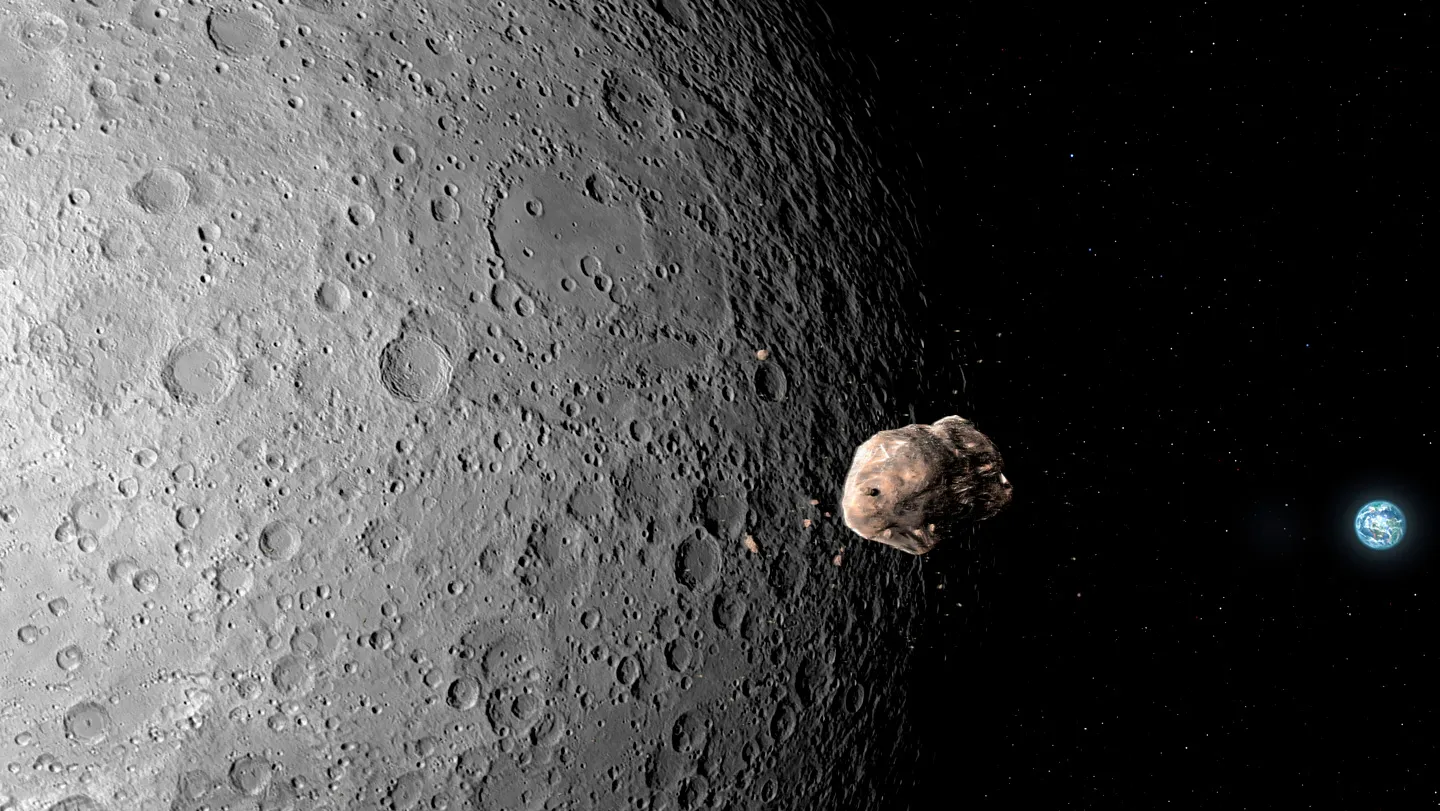
NEW ORLEANS — There’s about a 4 percent chance that a building-sized asteroid will hit the moon in 2032. Moreover, there’s about a 1 percent chance that the asteroid, dubbed 2024 YR4, will not only strike the moon but also scatter a multitude of tiny meteorites into near-Earth space, potentially harming satellites and astronauts.
“This could pose a lot of risks to Earth-orbiting assets,” said NASA aerospace engineer Brent Barbee on December 17 at the American Geophysical Union’s annual meeting.
Should YR4 hit the moon, the impact could release as much energy as the detonation of roughly 6 million metric tons of TNT, or about 400 times the energy released by the Hiroshima bomb.
Shortly after detecting YR4 in December 2024, scientists reported that it could hit Earth. The odds peaked at 3.1 percent on February 18; additional observations precluded that collision. Since then, the odds of a lunar impact have risen, if only slightly.
If YR4 hit the moon, there’s an 86 percent chance it would do so on the side facing Earth. If it did, the impact would generate a flash that “should probably be visible [from Earth] depending on the local viewing conditions,” said astronomer Patrick King, who simulated the impact’s brightness and presented his results at the meeting.
Based on the estimated collision date of December 22, 2032, Hawaii would have an excellent vantage point, while views from the western United States would be “fairly favorable,” said King, of the Johns Hopkins University Applied Physics Laboratory in Laurel, Md.
Scientists don’t know YR4’s size and mass precisely enough to safely deflect it, Barbee said, though they estimate it’s roughly 60 meters wide. What seems more practical is to intentionally break up YR4 using a fast-moving impactor or a nuclear blast, Barbee said. This should be done at least three months before a lunar impact so the resulting debris spreads far from Earth, he noted. Ideally, he added, we would send a reconnaissance mission in the next few years, too.
“If there are any missions to YR4, they would essentially need to start their development very, very soon,” said Barbee, of NASA’s Goddard Space Flight Center in Greenbelt, Md.
NASA’s James Webb Space Telescope might observe the asteroid in February 2026, which could help rule out a lunar impact or raise the odds to as high as 30 percent. But if JWST can’t observe the asteroid for any reason, Barbee said, “we may be confronted with the need to make some decisions about YR4 in the face of significant uncertainties.”
Read the full article here