




Updated ,first published
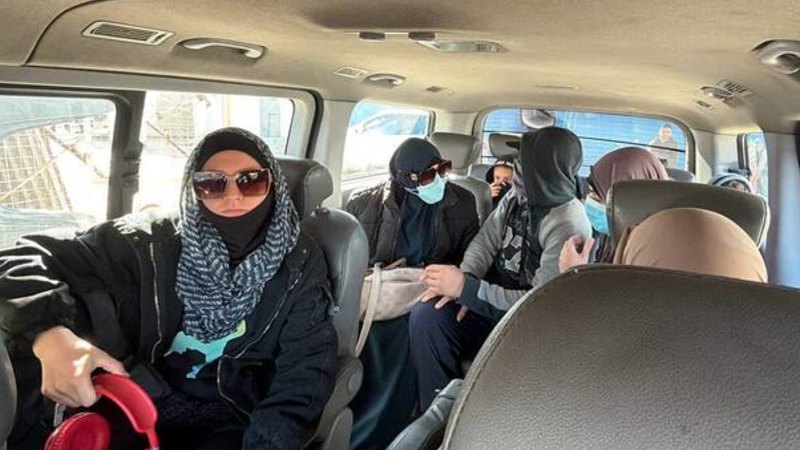
A large group of Australian Islamic State brides and their children left a Syrian camp late on Monday on their way back to Australia, but were turned around about 50 kilometres down the road and sent back to where they began.
It’s the latest frustration for 34 Australian women and children who have spent almost seven years in Syrian camps as the Australian government continues its refusal to repatriate them through official channels.
A camp official told this masthead their promised departure to the Syrian capital, Damascus, then Beirut, then Australia, had been paused for an unspecified period of time – possibly hours, possibly days.
It’s unclear why, but the official speculated that the three Australian men accompanying the women and children had not organised the correct permission between the factions governing the region.
The official insisted “it’s not cancelled, it’s postponed for a period of time”.
As the Australian government said it had done nothing to help facilitate the group’s departure, Syrian officials said the plan had been to travel from Damascus to Beirut, and then home to Australia, where all are citizens.
The Kurdish local authorities who control the camp revealed late on Monday that 11 Australian families, comprising 34 women and children, had left the camp for the Syrian capital. An earlier statement said 24 Australians had departed.
A local journalist working for this masthead said some Australians remained in the camp, but it was unclear on Monday night how many were left behind.
One woman told the journalist she could not return with the others. Though her former husband had been Australian, and her two children were citizens, she was only a permanent resident. As a citizen of Lebanon, she was unable to get the papers to travel, she said.
“Three years ago they promised me they would take me to Lebanon and get my papers. Who will do the papers now?” the woman said in Arabic.
The families have been living in one or another internment camp in north-eastern Syria since March 2019, when the so-called Islamic caliphate fell. They were approaching their seventh anniversary in the camps.
The camp’s director, Hakamia Ibrahim, confirmed the Australians had planned to move from Damascus to Beirut, where they would approach the Australian embassy to seek passports to return home.
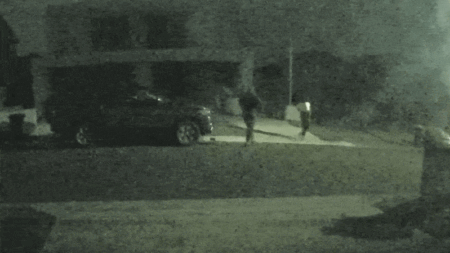
Video shot during the women and children’s departure shows three Australian men coordinating and organising the women and children into three vans. Guards at the camp, who wore the insignia of Kurdish forces, were facilitating the exit, confirming it was done with the agreement of local authorities.
It is unclear, however, who organised it.
The Albanese government denied any involvement. In a statement, a spokesman for Home Affairs Minister Tony Burke said the Australian government “is not and will not repatriate people from Syria”.
The government has previously taken the position that if any citizen gets themselves to an Australian embassy, the government is legally obliged to issue them with a passport.
“Our security agencies have been monitoring – and continue to monitor – the situation in Syria to ensure they are prepared for any Australians seeking to return to Australia,” the spokesman said.
“People in this cohort need to know that if they have committed a crime and if they return to Australia they will be met with the full force of the law. The safety of Australians and the protection of Australia’s national interests remain the overriding priority.”
Save The Children, a charity that has maintained a deep interest in the welfare of the Australians, also denied it had anything to do with the operation.
Chief executive Mat Tinkler said late on Monday: “Save the Children does not fund or conduct repatriations, nor do we ever intend to play such a role.
“We have not been involved in any extraction of Australians from camps in north-eastern Syria. These reports underscore what national security experts have repeatedly said: that the unmanaged return of Australian citizens would inevitably happen in the absence of federal government action to repatriate them.”
Under both the Coalition and Labor, the government has refused to repatriate the bulk of the families, saying it was too dangerous to send Australian public servants to the region.
The women and children are the remnants of dozens of people who travelled to Syria and Iraq during the rule of Islamic State. They were captured after the so-called caliphate was defeated.
Since then, a number have been repatriated. In 2019, the Morrison government brought back eight orphans and one newborn baby.
Then, in October 2022 – early in Anthony Albanese’s first term – four Australian women and their 13 children were brought back to Sydney under former home affairs minister Clare O’Neil, prompting a minor backlash.
None were returned to Victoria. Asked about this in 2022, former secretary of the Department of Home Affairs Mike Pezzullo told an estimates committee hearing that, “If a state government chose to say, ‘We don’t want to proceed,’ then I would have thought the Commonwealth would take that pretty seriously … they’ll give us the authority to proceed or otherwise.” In 2022 the Labor government was facing an election.
It is likely, therefore, that most of the people returning in this group will go to Victoria.
In September last year, two women and four children escaped a different camp, al-Hawl, after paying people smugglers, and made their way home to Australia via Lebanon. They were also Victorians.
Camp director Ibrahim said more than 2000 wives and children of 40 different nationalities of former IS fighters were still held in the camp after the Islamic State in Syria collapsed in March 2019.
Start the day with a summary of the day’s most important and interesting stories, analysis and insights. Sign up for our Morning Edition newsletter.


From our partners
Read the full article here