





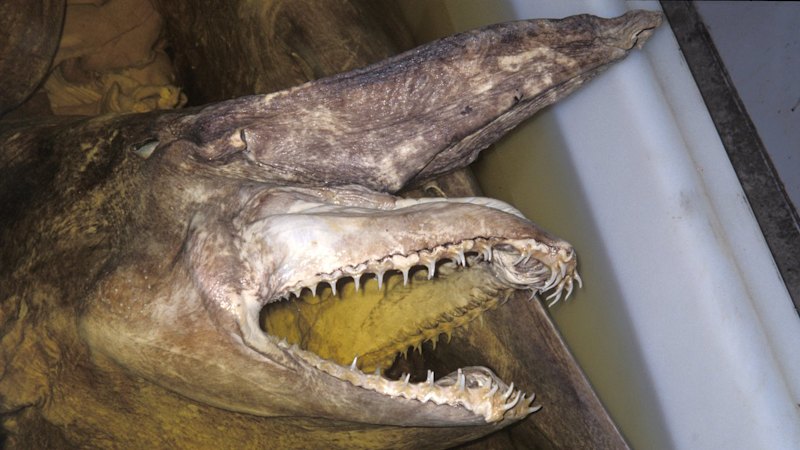
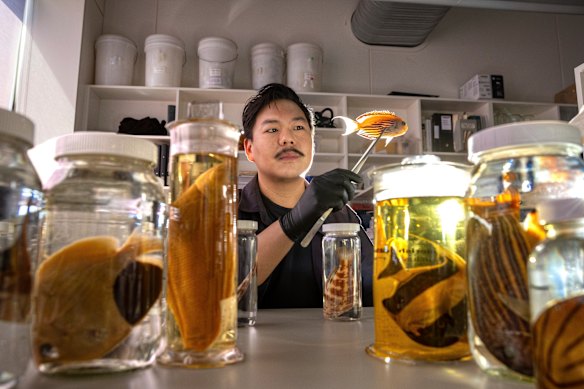
The room hosts the fumes of an absinthe bar, and the hallucinations, it seems, are upon us. Dr Yi-Kai Tea, a mustachioed young fish scientist, has just plunged two gloved hands into a vat of filmy ethanol and hauled up the decapitated head of a goblin shark. In its hulk and heft, I feel I’ve come face to muzzle with a slain grizzly bear, except this creature’s maw can detach from its horrid head and strike like the second mouth of a xenomorph from Alien.
From which monster-stalked corner of a pirate’s map did this beast hail? “Just off the coast of Sydney, actually!” Tea says brightly, and lets the black-eyed leviathan slide back below the greeny depths.
We’re in one of the Australian Museum’s underground collection caverns, which together house 1.75 million fish specimens. While Sydney’s proximity to an underwater wilderness was thrown into sharp relief this week by a rare spate of shark attacks, down here the full gamut of otherworldly beasties we live alongside is always on full display.
This room hosts everything that can’t fit in a jar, and from chunky blue tanks Tea shows off fur seals with teeth frozen in doggish grins, pickled lungfish, wobbegongs, a planktivorous basking shark, a dragonlike ribbonfish, a tiger shark pulled from the Parramatta River and a tank slick with tawny oil leaching from a great white’s liver.
“Going from not knowing to, like, knowing something exists is such a powerful thing,” Tea, 33, says, holding up a prehistoric frilled shark. In his work as a taxonomist, Tea has added scores of new fish species to science and engaged people with his discoveries through his Instagram persona, Kai the Fish Guy.
Now as a curator of the museum’s fish collection, Tea has set a revolution afoot for an antique science. Here, taxonomy is no longer old, dusty and fusty. It’s pop-culture. Guyliner. Goblin sharks.

A deep-sea fish in a childhood bedroom
Most of the fish Tea has dragged out of obscurity live in one of the most mysterious realms of the ocean: the mesophotic reefs. These are a coral reef’s Upside Down; a twilight zone between 50 and 150 metres deep of purples, reds and oranges displayed by encrusting algae, soft corals, sponges and gorgonians that branch like networks of veins.
“Meso means middle in Latin, and photic means light,” Tea says. “It’s not completely dark. It’s like having all the lights off in your apartment at night, just lit by ambient moonlight and streetlight.
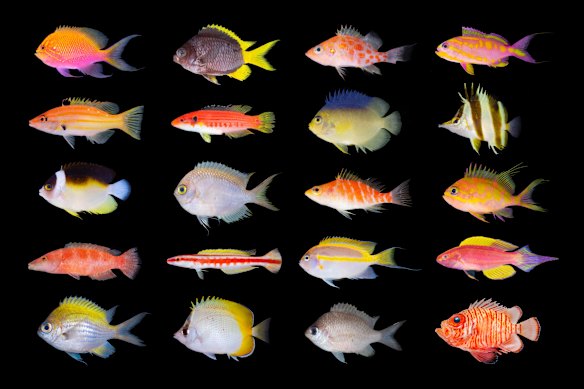
“A lot of the mesophotic species are actually more colourful than the shallow water stuff. You see things like the anthias and angels and they’re like brilliant red, brilliant purple, brilliant yellow.”

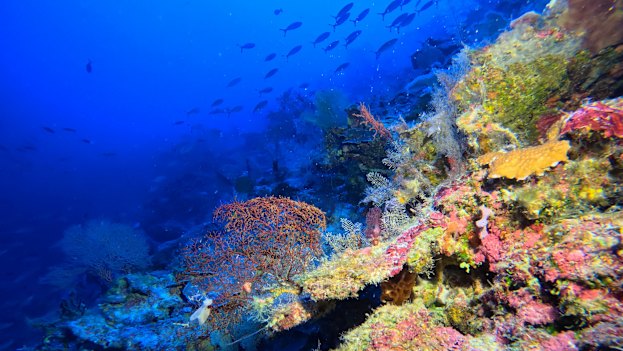
Red is the first wavelength of light to disappear in darkness; at a depth of 100 metres, a scarlet fish looks black and camouflaged. Many of the creatures in this shadow realm are undescribed because it’s too deep for traditional scuba diving and too shallow for bottom trawling. But Tea first encountered a mesophotic fish in an unlikely place: his childhood bedroom in Singapore.
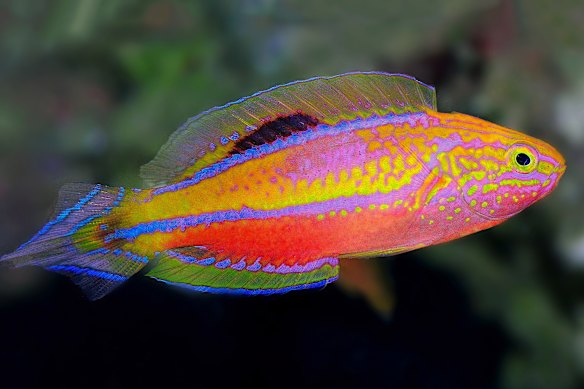
“I had it in my aquarium as a pet, and back then when I was in high school, it didn’t have a name yet,” Tea says. He pored through his guidebooks, and none could put a species name to the spectacular assemblage of mandarin scales and neon stripes rippling through his tank.
“I remember thinking to myself, how can a species so stunning be available in the pet trade but still be a new species and not have a name? Like, what? What are scientists doing?”

Skip forward a few years and degrees and Tea began working with colleagues to name his former pet: Cirrhilabrus isosceles, or the pintail fairy wrasse, became the first species he ever described. “That was how I got started with my career.”
Now he’s named more than 20: a cave-dwelling pink anthia named Pseudanthias tequila because it mirrors the boozy balayage of tequila sunrise. A fairy wrasse found in the mesophotic reefs off Tanzania dubbed Cirrhilabrus wakanda for the setting of Marvel movie Black Panther. A silver damelfish with highlighter-yellow spines named Chromis tingting for Tea’s mother, Ting. Other fish in his papers are named for alien warriors from Dr Who and underworld gods – all designed to ignite the imagination rather than glaze the eyes.
“My outlook on my job and my career has always been the science first, obviously,” he says. “But there’s nothing to say that I need to stop there. It’s not just boring and intractable, it’s meant to be exciting and engaging.
“I want to make sure that the science that I do is accessible and interesting to people who may not be aware of it. We’re working in a field where some of the early pioneers were literally Charles Darwin, [Carl] Linnaeus, Alfred Russel Wallace, and to continue in their legacy is a noble thing to do, in my opinion.”
Record-breaking dives unearth creatures of the deep
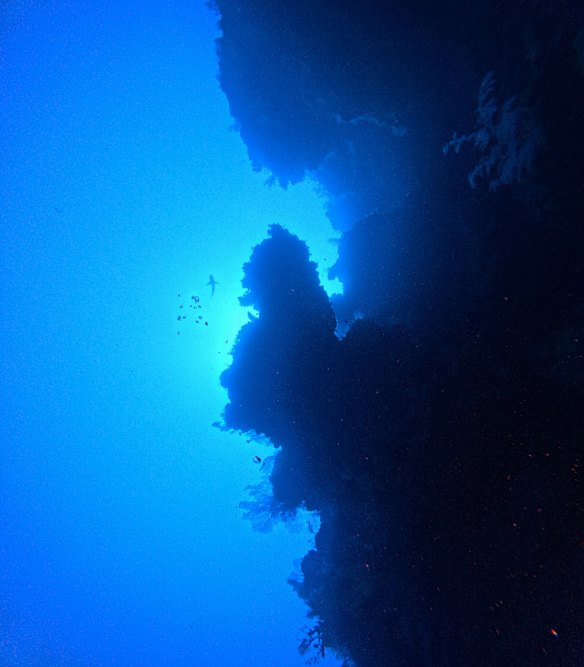
Tea has assembled a crack team made up of some of the only people in the world who can dive 150 metres to directly explore the mesophotic reefs. The divers use rebreathers, which scrub carbon dioxide from breath to recycle exhaled air, and use a mix of helium rather than traditional nitrogen, which at those depths turns toxic and induces deadly narcosis.
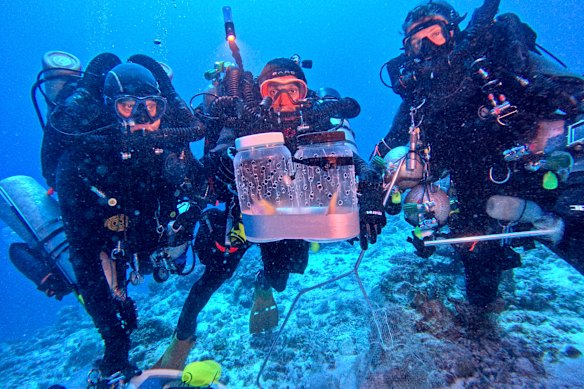
The use of rebreathers has kicked off a surge of fish science, following the explosion of discovery in the 1950s with the advent of scuba gear.
“Imagine being underwater for the first time and everything’s a new species. That was really ichthyology’s Golden Age,” Tea says of the ’50s. “And now we’ve come to a second, smaller repeat of that where we’re realising that we can use rebreathers to do the same thing – go deeper than we’ve gone before.”
An expedition he led last year saw the deepest ever in-person collection of specimens in Australia, with diver Timothy Bennett catching a fairy basslet at 152 metres. Despite the rebreathers, every dive is a sprint; the longer you spend at that pressure, the longer you must spend decompressing on the way up. For every seven or eight minutes snatching specimens in nets, divers must spend six hours inching back to the surface.
In a new study combining data from these extreme dives, images and videos captured by remotely operated underwater vehicles, and historical museum specimen data, Tea and his colleagues reported 62 species previously unrecorded in the Coral Sea Marine Park. Forty-five are new to Australia, and 21 are potentially new to science.

Among those recorded in Australian waters for the first time was the freakish wolf-trap anglerfish, a deep sea dweller with a bioluminescent lure that “dangles from the roof of its upper jaw like a chandelier” and has sideways-closing jaws that snap shut like the doors of a sports car.
This work is the crucial first step of conservation: you can’t protect what you don’t know. Even the deeper reefs are copping bleaching from climate change – even 140 metres down, it’s a balmy 21 degrees. Tea has just led another expedition to the Coral Sea in the hopes of bagging more specimens, alongside collaborator California Academy of Sciences fish curator Dr Luiz Rocha, in an effort partly funded by the Minderoo Foundation. Fully exploring the creatures of the Coral Sea is more than a lifetime’s work, and a pursuit he hopes future taxonomists take up.
“People often talk of taxonomy as a dying art, and that it’s really old people working in dusty museums that do it. I want to really just not perpetuate that stereotype, because taxonomy is super important.” The specimens Tea and his team collect are time capsules to be scrutinised by the next generation.
“They act as reference for future scientists. A lot of my work’s based on stuff that was collected in the 1800s. So we’re just passing that legacy on.”
The Examine newsletter explains and analyses science with a rigorous focus on the evidence. Sign up to get it each week.
Read the full article here