





To help inform our air purifier picks, we gathered 12 of the newest and most popular models at the CNET Labs product testing facility in Louisville, Kentucky, where we put them through a rigorous set of tests.
When evaluating our scores for air purifiers, we took into account particle removal ability, energy efficiency, loudness, price and features. Each unit is given a score out of 10 for each criteria, and then receives a weighted final score out of 10.
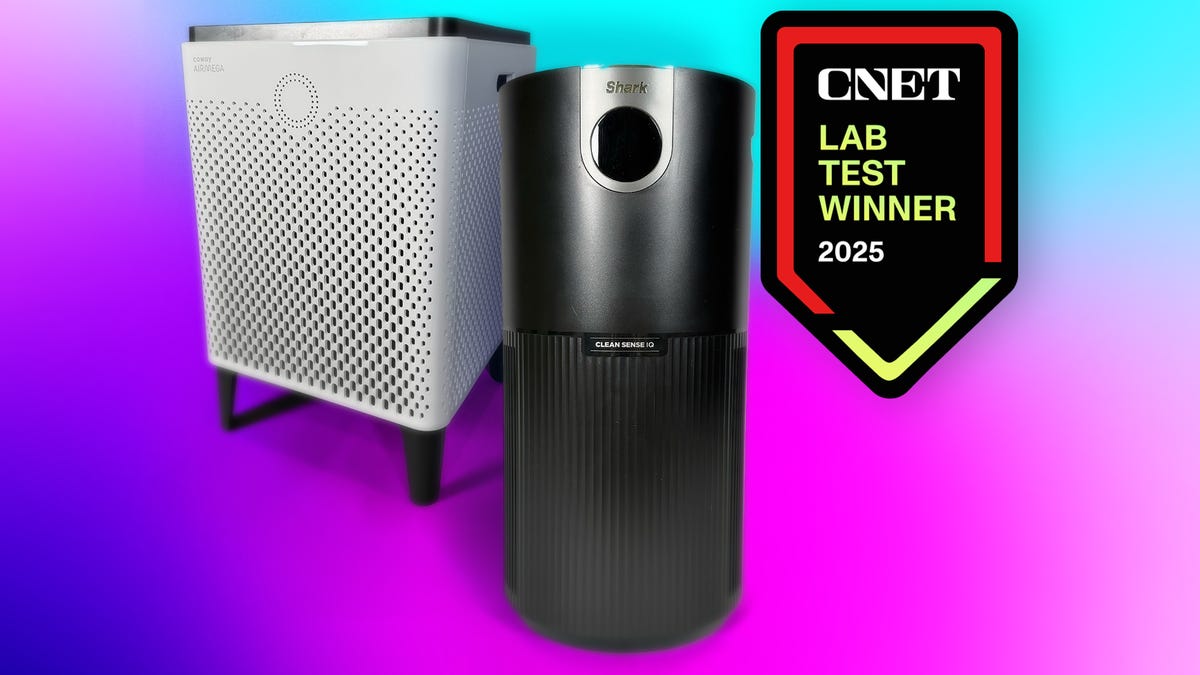
After we test air purifiers, we also evaluate the top performers for an Editors’ Choice award as the best purchases for most consumers, based on quantitative and qualitative factors like particle removal, energy efficiency, noise level, price and unique features. We also evaluate pure quantitative test results from our rigorous methodology to distinguish a Lab Award winner. In this case, we have two lab award winners for particle removal at different fan speeds.
How we evaluate air purifiers:
- Particle Removal (30%): The average amount of time it takes for an air purifier to remove 90% of the particles from our test chamber.
- Energy Efficiency (20%): The average energy measured in kilowatt hours used by the air purifier, we also calculate it over the course of a month.
- Overall Loudness (20%): The average noise level across low, medium and high fan settings.
- Price (20%): We consider how affordable or expensive an air purifier is. Most of our recommendations range between $300 $800, depending on size.
- Features (10%): We consider features like app control, remotes and design elements that help it fit into a room.
The particle-removal test
The air we breathe isn’t just air. In truth, it’s a combination of human-generated and naturally occurring particles. The former is composed mostly of urban, industrial and automotive emissions of hydrocarbons, nitrogen oxides and combustion byproducts, and the latter is mostly represented by smoke from forest fires, sulfates, soot and matter from volcanic activity around the globe.
According to the EPA, some of these microscopic solids and liquid droplets, which can be made up of hundreds of different chemicals, are so tiny that it’s almost inevitable to inhale them.
Fine vs. coarse particles
In terms of smoke, seasonal allergens and dust, an important consideration in buying an air purifier is whether it has an automatic mode. Certain air particles do not remain consistent throughout the year or even throughout the day. “Auto-mode purifiers can automatically ramp up the speed when the pollution is higher,” says Jie Zhao, head of Delos Labs, a human health tech company.
While different kinds of particulate matter are indistinguishable to the air purifier itself, according to the experts we spoke to, an important consideration for particles such as pet dander is energy draw, since that type of pollutant theoretically remains consistent in your home and necessitates constant use of an air purifier.
“It’s more on the consumer experience and user interaction, having it running all of the time, versus the fundamental scientific principle,” says Zhao, when it comes to what makes an air purifier most suitable for pets.
We test our air purifiers against both fine and coarse particle. Coarse particles, PM10 and PM2.5, which are particles of less than 10 and 2.5 micrometers in diameter, respectively, pose the greatest risk to human health since once inhaled. They allocate deep into the lungs and even into the bloodstream, impairing the proper functionality of the lungs and heart. At PM2.5, these include combustion particles, organic compounds and metals.
“That’s the size that can go into our body, into our lungs and go into our bloodstream,” said Zhao. “That is the number one environmental risk factor globally. It kills about 6 million to 7 million people a year,” he said, due to cardiovascular or respiratory problems brought on by particulate pollutants.
At PM10, these include dust, pollen and old. Large coarse particles are greater than PM10 and include fine beach sand (PM90), which i less of a concern since it doesn’t usually enter the lungs, but they can still irritate your eyes, nose and throat.
Fine particles are 2.5 micrometers in diameter and smaller, these include ultrafine and nanoparticles, which have diameters of less than 0.1 micrometers.
Combined average particle removal (low and high fan settings)
- Shark HP232: 1 minute, 17 seconds.
- Coway Airmega 400S: 1 minute, 26 seconds.
- BlueAir 311i: 1 minute, 28 seconds.
- Oransi Mod Plus: 1 minute, 29 seconds.
- Levoit Core 400S: 1 minute, 49 seconds.
- Rabbit Air: 2 minutes, 1 second.
- Morento: 2 minutes, 11 seconds.
- Coway Airmega AP-1512HH(W): 2 minutes, 13 seconds.
- Windmill 3-in-1: 2 minutes, 13 seconds.
- Shark HP102: 2 minutes, 40 seconds.
- Airdog AirPurifier X5: 3 minutes, 6 seconds.
- Dyson Formaldehyde TP09: 4 minutes, 41 seconds.
Smoke chamber test
Our custom air purifier test chamber uses a clear-view front panel made of plexiglass and gloved hand access, which allows us to manipulate the air purifiers, a particle counter holder for our control device, two fans that ensure proper mixing of the air and smoke inside the chamber, vent ports that ensure there is a small amount of fresh air at all times, an ignition port to light up the smoke bombs from outside the rig, and an exhaust port that removes the remaining smoke safely from the chamber and the building after each test.
The chamber isn’t hermetically sealed, but it’s tight enough to ensure that no hazardous amount of smoke escapes to the surroundings. Our mission was to create an environment in which we exposed each air purifier unit to particle-saturated air of roughly the same concentration to assess how quickly and efficiently they get the air back to breathable conditions.
We made custom smoke bombs, which are made of 50% potassium nitrate (KNO3), 40% sucrose (sugar) and 10% sodium bicarbonate (baking soda) and included a safety fuse for igniting it at a distance. The sugar acts as our fuel source, while the potassium nitrate acts as an oxidizing agent and the baking soda ensures that our dry mixture sustains a slow and even burn.
Using the GreyWolf PC3500 Particle Counter, we were able to verify that 0.5 grams of our smoke bomb dry mixture produces roughly between 590 million and 610 million particles per meter cubed. The device is able to count particles of different sizes, including PM2.5 and PM10, and it logs this data once every 15 seconds. Although we’re able to count particles of different sizes individually, it’s the total number of particles we care about, which is the sum of all particles of different sizes.
We prepared a 0.5-gram smoke bomb, which is ignited via the ignition port after installing the air purifier and ensuring proper sealing. Once the air in the chamber becomes particle-saturated (greater than 580 million particles/m3) we turn on the air purifier in question. The data extracted from the Temtop allows us to accurately track the impact that the air purifier has on the particle count in real time.
Noise level
Using a decibel meter, we measured how loud the air purifiers are at their low, medium and high fan settings. This is particularly important if you plan on having your air purifier on in your bedroom overnight and you don’t want it to disrupt your sleep. We performed this test in our sound-enhancing studio to make sure that the decibel meter picked up only soundwave stimuli from the air purifiers, excluding other possible sources.
To give you a frame of reference, a quiet whisper is around 25 decibels. A normal conversation can range from 60 to 70 decibels. A vacuum cleaner is 75 decibels. A subway train at 200 feet away is as high as 95 decibels. With most of our air purifiers no louder than 65 decibels even at maximum fan setting, you’re typically looking at a noise level that’s on par with a normal conversation.
Noise level by average decibel
|
Rank |
Air Purifier Model |
Average Loudness (dBA) |
|
1 (Quietest) |
Shark Small Air Purifier Combo HP102 |
41.48 |
|
2 |
Blueair Blue Pure 311i Max |
43.31 |
|
3 |
Windmill 3-in-1 Air Purifier |
43.87 |
|
4 |
Shark Large Air Purifier HP232 |
44.13 |
|
5 |
Coway Airmega AP-1512HH(W) |
45.19 |
|
6 |
Dyson Purifier Cool Formaldehyde – TP09 |
45.49 |
|
7 |
Coway Airmega 400S |
45.64 |
|
8 |
Levoit Core 400S-P Series Smart |
46.76 |
|
9 |
Morento Indoor AP; Model HY4866-WF |
46.85 |
|
10 |
RabbitAir MinusA3 SPA-1000N |
47.82 |
|
11 |
Airdog Green Technology Air Purifier X5 |
48.19 |
|
12 (Loudest) |
Oransi Mod+ Air Purifier MD02 |
49.65 |
Energy consumption
To answer this question, we used a device called Kill-a-Watt and measured how much power each air purifier consumed at different fan settings. Knowing the energy draw for your air purifier could make a difference to your energy bill.
Energy efficency rankings measured by average kWh
- Shark Small Air Purifier Combo HP102: 7.67kWh
- Windmill 3-in-1 Air Purifier: 9.61kWh
- Dyson Purifier Cool Formaldehyde – TP09: 10.99kWh
- Shark Large Air Purifier HP232: 11.50kWh
- Blueair Blue Pure 311i Max: 11.65kWh
- Levoit Core 400S-P Series Smart: 13.36kWh
- Airdog Green Technology Air Purifier X5: 16.06kWh
- RabbitAir MinusA3 SPA-1000N: 18.62kWh
- Morento Indoor AP; Model HY4866-WF: 18.77kWh
- Coway Airmega AP-1512HH(W): 21.84kWh
- Coway Airmega 400S: 24.12kWh
- Oransi Mod+ Air Purifier MD02: 28.32kWh
Read the full article here