






The masthead also reported that another official said Akram’s immediate family still lived in Hyderabad, and his elder brother was a doctor. His late father worked in the United Arab Emirates.
Indian police said in their statement Akram went back to India six times for family-related reasons, such as property matters and to visit his parents, but did not return when his father died in 2017.
Police said they had no “adverse record” of him before he migrated to Australia, and his relatives said he had limited contact with his family in Hyderabad in the past 27 years.
“The family members have expressed no knowledge of his radical mindset or activities, nor of the circumstances that led to his radicalisation.
“The factors that led to the radicalisation of Sajid Akram and his son, Naveed, appear to have no connection with India or any local influence in Telangana,” the police statement said.
Responding to the pair’s alleged connections to the Islamic State terrorist group, the Indian police statement said that “further investigation in this regard is being carried out by Australian authorities”.
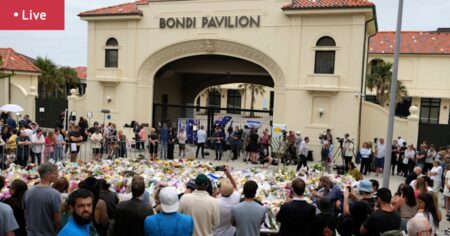
NSW Police confirmed on Tuesday they had found two homemade Islamic State flags – along with improvised explosive devices – in the pair’s car at the scene of the massacre. Police sources said the Akrams had prepared a manifesto before the massacre.
Authorities are also investigating why in November the father and son travelled to the Philippines, one of the few nations with an enduring Islamic State terrorist group presence.
They are also probing how Sajid Akram – who had six firearms registered to him – had legally secured high-powered weapons despite his son’s long-known links to extremist circles.
Loading
Naveed Akram was a volunteer member of a street preaching group in Sydney’s west, which has links to multiple Islamic State devotees, including self-declared martyrs and would-be soldiers, before he and his father carried out the country’s worst terror attack.
Prime Minister Anthony Albanese on Monday confirmed domestic spy agency ASIO had taken an interest in Naveed Akram in 2019.
“He was examined on the basis of being associated with others, and the assessment was made that there was no indication of any ongoing threat or threat of him engaging in violence,” Albanese said.
“The assessment was made because of the son’s associations that he had at that time, and the investigation went for a period of six months.”
Read the full article here