





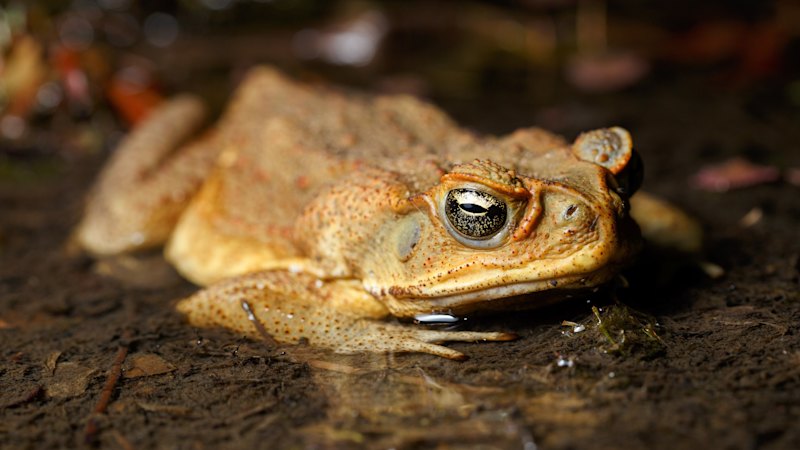
They’re an invasive pest that are so widespread, our State of Origin team is named after them. Now, the community is being urged to collect cane toads and hand them in for science.
Watergum’s annual Great Cane Toad Bust is a national campaign running until January 25, with multiple events planned for Brisbane and the south-east.
Locals are encouraged to collect and humanely euthanise cane toads, then drop them off at a collection point. Alternatively, they can be euthanised at some collection points, though participants are asked to check first.
“For both cane toad adults and tadpoles, we recommend the RSPCA-approved humane euthanasia method of ‘stepped hypothermia’, or the fridge and freezer method,” Watergum invasive species manager Emily Straton said.
“This involves placing cane toads in the fridge for 24 to 48 hours, which puts them in a state like hibernation, then placing them in the freezer for a further 24 to 48 hours for humane euthanasia.
“Watergum has cane toad collection points, where these humanely frozen toads can be collected and put to good use in the production of cane toad tadpole lures.”
The lure was designed at the University of Queensland after scientists noticed that when a dead adult toad was in a body of water, cane toad tadpoles would swarm the area and feed on it, Professor Rob Capon said.
Further observation found that when two females laid eggs in the same body of water, the tadpoles that hatched first would eat the second batch of eggs.
It was this ability to locate other cane toads in various forms that intrigued scientists, Capon said.
“Eventually, we worked out what the chemical was. It turns out, perhaps unsurprisingly, that it’s the toxin itself – they smell the toxin,” he said. “We figured out that we could take dead adult toads and take the thyroid secretion and treat it in a particular way that would make a pheromonal attractant.
“You can actually do this by just taking a dead toad off the road and chucking it into the trap, and you’ll get the same effect.”
The attractant has been used to create a submersible lure patented by Watergum, an environmental not-for-profit.
The lures make it easy to responsibly catch thousands of tadpoles before they grow up to repeat the cycle of environmental damage, Capon said. Native frogs are not attracted to the lure.
Cane toads, whose numbers are currently high due to recent warm and wet conditions, are opportunistic and will lay eggs in any available body of water, Capon said.
Toads in every life stage are being collected in the bust, as they are toxic during their whole life span.
Most Queenslanders think of cane toads as a threat to their dog. And rightfully so, with an adult toad able to kill an average-sized dog in 15 minutes.
However, cane toads also pose a threat to native wildlife, both in their toxicity and competition within the ecosystem. The toads lay up to 35,000 eggs a year, in comparison to a native frog’s maximum of 5000, and have a huge appetite for beneficial insects, bird eggs, and small mammals.
More than 230 people have registered in Brisbane to take part in the bust, with 14 groups hosting public events. Ipswich is also holding a Cane Toad Challenge, with yet-to-be-announced prizes available to those who contribute.
Local groups that have held or will hold public events include Gilbert Road Bushcare Group, Corbie Park, Davidson Street & Tennis Avenue Bushcare Groups, Virginia Bushcare Group, Cubberla-Witton Catchments Network, Oxley Creek Catchment Association, Mandalay Progress Association, and Mount Gravatt Environment Group.
Watergum has a guide on its website on how to tell the difference between a native frog and a cane toad, pictured through every stage of its life cycle.
From our partners
Read the full article here