





Life in the ’burbs is a series that highlights the good, bad and beautiful of Brisbane suburbs. Writers from around the city are penning love letters (mostly) to their suburbs every week.
“Is that a bloody platypus?”
It was nearly midnight, and while Sarah was used to me bringing injured wildlife home, she was finding it hard to come to grips with the monotreme wrapped in a towel and blinking sheepishly on the couch.
It was badly injured and I wasn’t confident it would make it through the night. I’d picked it up off the side of a flooded causeway along our street on my way home. It moved as I scooped it up, then blinked its small, dark, round eyes. It didn’t try to get away.
Sadly, instead of taking it to the vet the next morning, I handed its lifeless body to a University of Queensland researcher. The autopsy showed it had been hit by a car. There are quite a few platypuses in the creeks around Brookfield, the researcher told me – more than people think.
I first moved to Brookfield in 1990, when I was eight. Compared with the suburb I’d moved from – The Gap – Brookfield was the back of beyond. Despite being just 12 kilometres from Brisbane’s CBD, Brookfield was a mix of acreage and working farms.
Our new house was at the end of a dirt driveway surrounded by cow paddocks. The old lady on the dairy farm down the road lived without electricity in the house where she was born. She scratched her way along the roadside every afternoon collecting sticks to fuel her cooker. There were just two buses on Saturdays, one on Sundays, and some kids rode horses to school.
Thirty-five years later, I’m back in Brookfield raising kids of my own. And I’m relieved to find not much has changed.
European history in Brookfield began in the mid-1800s. Timber getters came for the prized hoop pine and red cedar giants that towered over the hillsides, which they felled and rafted down Moggill Creek to mill. Farmers moved in not long after to graze cattle and plant the denuded slopes with paw paw, pineapple, custard apple and bananas.
A school opened in 1872, but despite gold being discovered in the hard, rocky soils under the ironbark scrub, there was no rush to settle the area. By the early 1930s, the school consisted merely of a teacher and nine students.
He told us of the wild swingers’ parties up in the hills of Upper Brookfield, and the hippies who moved out there in the ’70s.
By the time I arrived in 1990, there were about 150 kids at the school, but to me, it still felt like a country town. One of the first people I met was our neighbour, Vic – a half-blind Jewish man who had lived there forever. He’d get a twinkle in his one good eye as he told us of his younger-day antics.
Rumour had it, he’d won and lost half of Brookfield around card tables. He didn’t tell us about that though. Instead, he told us of the wild swingers’ parties up in the hills of Upper Brookfield, and of the hippies who moved out there in the ’70s and were likely still up there growing pot in the lantana-choked valleys.
A few years later, aged 19, I left. My parents stayed, so I came back regularly, but didn’t take much notice of the place. That was until 2015 when my partner and I were looking for somewhere to get married.
Friends mentioned the Upper Brookfield Hall: a tiny community venue on Upper Brookfield Road – a narrow, dead-end road that winds up the valley, framed on either side by dense forest. Alan, the caretaker, explained to us that his dad had built the hall before succumbing to sepsis.
“A few years later, they started making penicillin,” he said.
We yelled into his good ear that the asking price for renting the old hall, about $300 for the weekend, was very reasonable, and it was settled.
At the time, we were living in Red Hill. We could open our window and touch the neighbour’s house. In Brookfield, block sizes started at 2.5 acres. Descending the hill from neighbouring Kenmore, concrete gives way to green space and rolling paddocks, and there’s a loud silence where the traffic hum should be.
We moved into a little timber bush-house with chickens, a dog, lots of snakes, and a one-year-old daughter. Today she’s eight and attends the local school with her younger brother and about 500 other kids.
Brookfield’s a lot busier now than it was in 1990. There are more houses, more real estate agents, more luxury cars. The Brookfield Show, once a gold-coin entry, now charges Brisbane Ekka prices. Thankfully though, the important things haven’t changed.
Neighbours help each other out when the roads are cut off by floodwater or the power goes down, as it does at the mere hint of a storm. We still share the place with wallabies, king parrots, echidnas, platypuses, koalas, gliders and wedge-tailed eagles.
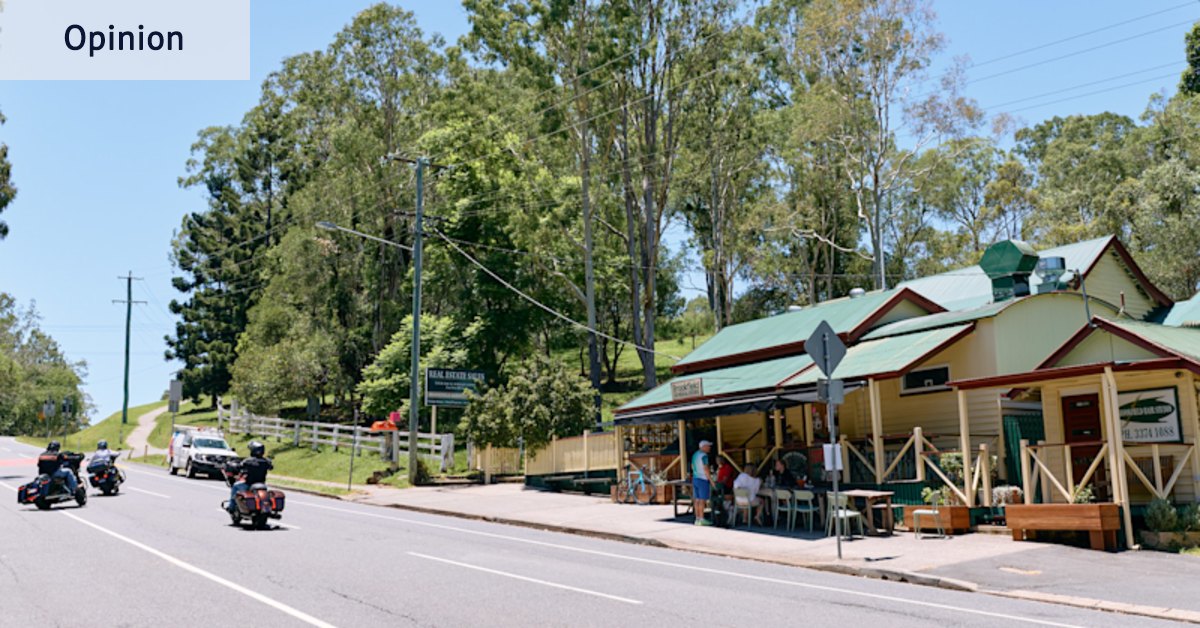
Driving home on our street, we pass sheep, goats, cows, horses, and on weekends, a lot of cyclists in a lot of Lycra. The car park of the local bar still has the odd beat-up farm ute nestled among the shiny LandCruisers. And at school drop-off a few weeks ago, a pair of kids even turned up on horseback.
Brookfield is stuck in the past. I hope it stays that way.
Get alerts on significant breaking news as happens. Sign up for our Breaking News Alert.


From our partners
Read the full article here