





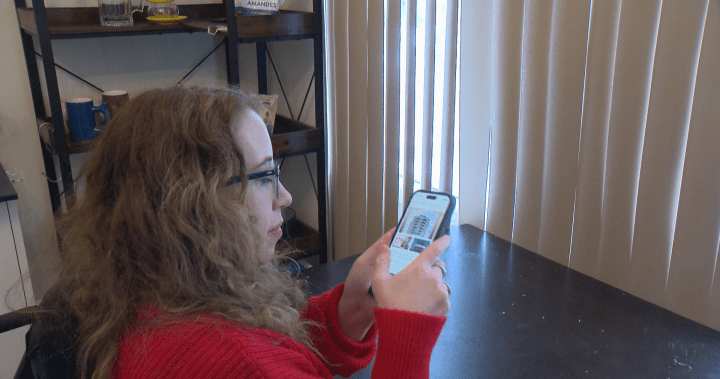
Finding the right place to live in any city can be challenging at the best of times. But for Jocelyn Dennis, finding somewhere where she and her young son can live that can also accommodate her mobility needs has been almost impossible.
“You want to be able to find a place that suits your practical needs,” Dennis told Global News. “For me, it’s more of finding a place where I can just do the basic things that everyone should be able to do, like shower and cook.”
Dennis lost the ability to walk back in 2007 due to a rare autoimmune disorder called Acute Disseminated Encephalo Myelitis. Apart from the basic requirements of a two-bedroom home or unfurnished apartment that allows cats, she needs a zero-barrier shower in order to be independent. Dennis says there are currently fewer than five properties that fit that bill across all of Calgary. And while some of those few postings do claim to be accessible, the reality is they aren’t.
“There was one guy, he advertised his condo as wheelchair accessible,” Dennis said. “I go there, and there’s a three-inch, four-inch lip to get into the shower, and the shower’s not even big enough.”
Dennis says she’s exhausted every option, looking at all the potential rental sites, contacting Calgary Housing, as well as other charities and non-profits that help individuals with mobility issues like her. And with the number of days she’s allowed to remain in her home running out, she’s getting worried.


Get breaking National news
For news impacting Canada and around the world, sign up for breaking news alerts delivered directly to you when they happen.
“I’ve come as far as I can go, and now what? I have to just throw in the towel and go live in the hospital? Give my son up?” Dennis said, stifling tears. “I’m in university right now. I’m one practicum away from becoming a social worker… I moved to Calgary to have a better life.”
The provincial government offers grants to assist homeowners and landlords with some of the costs of making homes more accessible, but they tend to not go far enough.
“The problem we have is that the RAMP funds are not really enough to create meaningful change, architectural change in folk’s homes,” said Krista Davidson Flint CEO with Accessible Housing Calgary. “But it (funding) has increased over the last year.”
Davidson Flint continues, saying the overall low supply of homes that meet the needs of those with disabilities is another challenge. “We (Alberta) are also only one of two provinces in Canada that don’t have a current accessibility legislation in our building code… It is a huge need to combine accessibility and affordability.”
Accessible Housing Calgary operates Inclusio, a 45-unit supportive living complex designed for those who need accessible accommodation. From wider hallways to voice activated switches, the four-storey complex overlooking Confederation Park has been serving Calgarians for a number of years. But there are limits, Inclusio only has studio suites, and even if they didn’t have a wait-list, Dennis and her son wouldn’t be eligible.
Dennis isn’t giving up though, and she is speaking up, in part, because she knows she’s not the only one struggling. She hopes her story will serve as a catalyst to start conversations and inspire change.
“Start reaching out, and start opening up of what accessibility looks like,” Dennis said. “I do think we’re doing a lot better when it comes to accessibility, and I think there’s definitely a lot further to go.”
Read the full article here