





Opinion
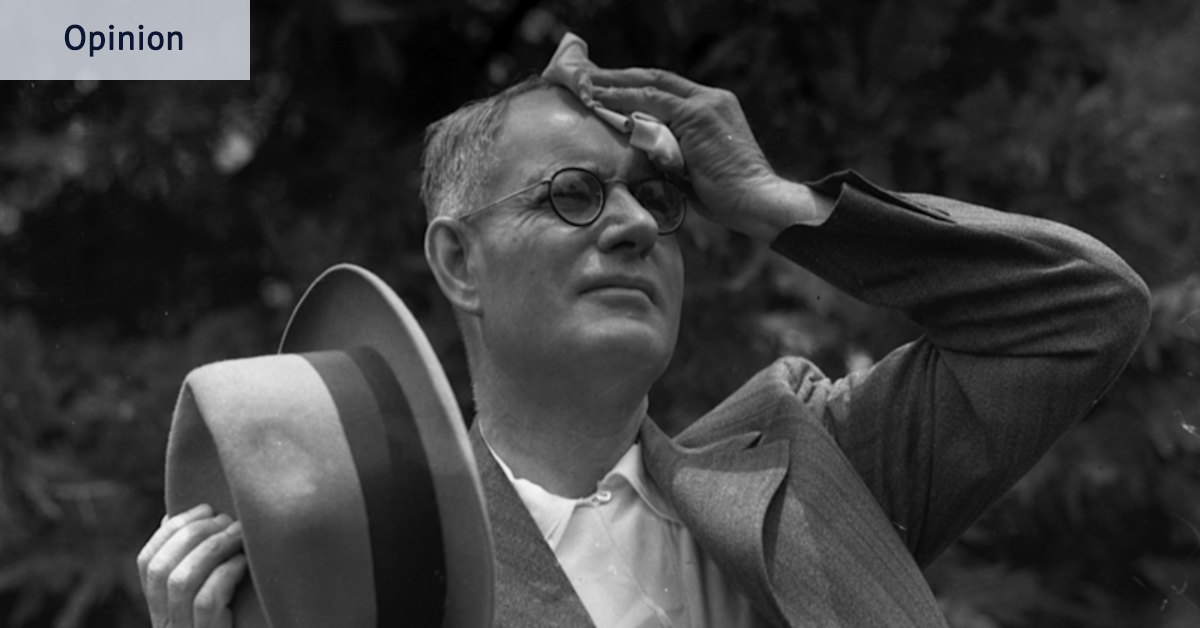
John Curtin spent the Easter weekend of 1945 at The Lodge. He had just three months to live. His health had been in sharp decline since the heart attack he had suffered the previous November. When he died on July 5 at the age of only 60, his death would be attributed to the strains of wartime leadership.
Most Australians would have gone to church that Easter Sunday morning. Curtin’s Labor colleagues were mainly Catholics, for whom Sunday Mass was a religious obligation; Protestant Australia was scarcely less devout.
The prime minister did not. Curtin had ceased to practice his Catholic faith as a young man. However, he did observe the Sabbath in his own private way. It was his custom to spend Sunday mornings reading poetry. For Curtin – a man of deep spirituality – this was his secular equivalent to going to church. While we cannot be certain, it is likely that that is how he spent his last Easter Sunday on earth.
Although glimpsed by some of his biographers, the depth of Curtin’s devotion to poetry was unappreciated until 2021, when Toby Davidson – not a political historian but a scholar of Australian literature – published Good for the Soul: John Curtin’s Life with Poetry. Dr Davidson reveals to us Curtin’s library; it included many volumes of poetry, including that of the Australians Mary Gilmore, C J Dennis, Adam Lindsay Gordon, Walter Murdoch, Bernard O’Dowd and Vance Palmer, as well as such American and English poets as Walt Whitman, Henry Wadsworth Longfellow, Oliver Wendell Holmes, Matthew Arnold, Byron, Shelley, Milton and Tennyson. It also included a translation of Dante’s Divine Comedy, heavily annotated in Curtin’s handwriting.
His collection also included a volume of poetry by his fellow Western Australian Paul Hasluck, who would be elected to the House of Representatives in 1949 in the seat named in Curtin’s honour, and become one of the most intellectually distinguished members of any Australian cabinet. As a young man, Hasluck published several volumes of poetry, which reveal a lover of nature and something of a tortured soul.
Curtin’s political rival Robert Menzies was also devoted to poetry; there is a remarkable similarity between their respective collections. Like Curtin, reading poetry was one of Menzies’ main relaxations. His daughter Heather recalls that it was his habit, on evenings before an important speech, to read poetry – to get the rhythms running through his mind, the better to find the right cadence on the morrow.
Menzies’ speeches contain frequent poetic references – for instance, his famous “Forgotten People” speech draws on the poetry of Robbie Burns to evoke “homes spiritual”. Remarkably, his budget reply speech in 1947 was partly in verse, quoting several stanzas from A P Herbert’s poem What Used to Be, satirising the planned economy.
The young Menzies also wrote a good deal of poetry although, unlike Hasluck’s, his did not aspire to deep literary seriousness. It is, for the most part, cheerful doggerel, although there are some touching poems which memorialise friends lost in the Great War. Last year, it was published for the first time by the Robert Menzies Institute in a collection entitled Fancies I Dare Not Speak.
While Curtin, Menzies and Hasluck were undoubtedly civilised men of cultivated taste, the devotion to poetry of an earlier generation of political leaders was deeper still. The acknowledged father of Federation, Sir Henry Parkes, published no fewer than six volumes of poetry in the course of his long life, from Stolen Moments, published in 1842 when he was just 27, to Sonnets and Other Verses, which appeared in 1895, the year before his death.
Alfred Deakin, our second prime minister and progenitor of Australian liberalism, at the age of just 21 wrote the first half of a planned monumental treatise entitled The History, Philosophy and Principles of Poetry. He embarked on this enterprise shortly after his admission to the Bar – a more creative use of his time than that of most young barristers waiting for the briefs to come in. Deakin’s friend Walter Murdoch – himself an important poet and essayist – described the unfinished treatise as “a remarkable performance; had he died before reaching the age of twenty-two, he would have left behind him in this manuscript convincing evidence of his extraordinary powers … [F]ew indeed were the masterpieces of poetry with which he had not made himself familiar”.
The most daring poetical feat of colonial era politicians was surely that of Sir Samuel Griffith, principal draftsman of the Constitution, leading colonial liberal and twice premier of Queensland. A man of extravagant learning, he translated Dante’s Divine Comedy from the 14th century Italian. This was largely done after Griffith, his political days behind him, had become Australia’s first chief justice. In those days, the High Court travelled between the state capitals; it was said by one wit – probably a Sydney barrister – that he translated Inferno in Brisbane, Purgatory in Melbourne and Paradise in Sydney.
Unfortunately, Griffith’s Dante – which was published by Oxford University Press – did not find favour with most critics. One – evidently a lawyer, aware that Griffith was also the draftsman of both the Queensland Criminal Code and the Supreme Court Rules – claimed to detect a stylistic similarity between them. “Sir Samuel has succeeded in rendering the poetry of Dante into the language of a parliamentary enactment,” he waspishly remarked. Well, at least he tried. It was not the Griffith translation of Dante that graced Curtin’s bookshelves.
Shelley famously wrote that “Poets are the unacknowledged legislators of the world.” There was a time in Australia when legislators were poets too.
George Brandis is a former high commissioner to the UK, and a former Liberal senator and federal attorney-general. He is now a professor at the ANU’s National Security College.


From our partners
Read the full article here