



U.S. President Donald Trump’s global trade war has a new target: Canada’s aviation sector — specifically Bombardier jets.
Late Thursday, Trump posted on his social media platform that he plans to impose a 50 per cent tariff on all Canadian-made aircraft sold to the U.S. and “decertify” some Bombardier planes unless Canada’s aviation authority, Transport Canada, certifies several business jets made by Gulfstream, a U.S. company and direct competitor to Bombardier.
“Based on the fact that Canada has wrongfully, illegally, and steadfastly refused to certify the Gulfstream 500, 600, 700, and 800 Jets, one of the greatest, most technologically advanced airplanes ever made, we are hereby decertifying their Bombardier Global Expresses, and all Aircraft made in Canada, until such time as Gulfstream, a Great American Company, is fully certified, as it should have been many years ago,” Trump wrote.
“Further, Canada is effectively prohibiting the sale of Gulfstream products in Canada through this very same certification process. If, for any reason, this situation is not immediately corrected, I am going to charge Canada a 50 per cent Tariff on any and all Aircraft sold into the United States of America. Thank you for your attention to this matter!”
If aircraft is decertified, that means they are not approved to fly within any control airspace monitored by the local authority. The White House told Global News on background that the threats would only apply to new planes and not existing planes.
But can the president actually make a decision on certification and decertification of aircraft, which are normally handled through independent authorities at the Federal Aviation Administration?
Experts have doubts.
“Him stating he’s going to decertify all Bombardier or Canadian aircraft in the U.S., I mean that’s just ridiculous. The FAA don’t decertify airplanes unless there is an extremely high-risk flight safety issue,” says Nigel Waterhouse, an aircraft certification expert at Can-Am Aerospace.
” The only time I actually know of that ever happening is with the Robinson Helicopter, where there was a whole bunch of accidents with the R-22 and the FAA actually suspended the type certificate for the aircraft until Robinson introduced some new training practices to prevent this from happening.”
Waterhouse says the issue Trump is focused on with the Gulfstream jets relates to a fuel system that mitigates the risk of icing, and although the company’s aircraft has been certified by many other aviation authorities, including the Federal Aviation Administration and the European Union Aviation Safety Agency, Transport Canada has not.
“I don’t believe Transport Canada is going to issue a type certificate when it hasn’t been completed. So they’re not refusing to do it. It’s just they’re waiting for the FAA and Gulfstream to finish the job, which they have yet to do.”
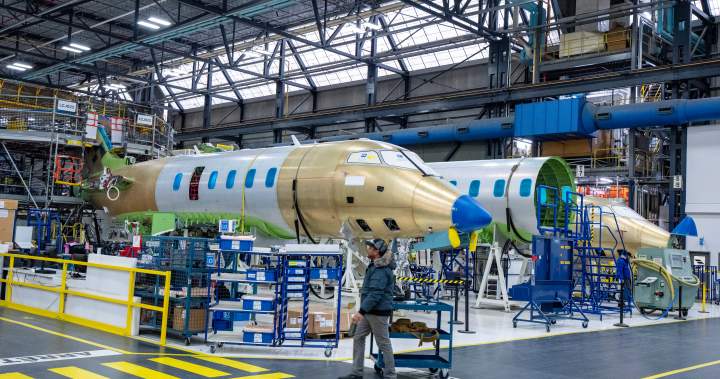
Bombardier’s Global Express business jet line is one of the most popular in the world for private jet clients, and is one of the main revenue sources for the Quebec-based aviation giant.
“It’s not illegal for Canada to look at certifying these airplanes on its own merit. It’s … not that we don’t trust the FAA that certifies these airplanes. We just want to make sure that Transport Canada has enough time to make sure that these airplanes are safe to operate and carry Canadian passengers,” says John Gradek, a faculty lecturer in Supply Networks and Aviation Management at McGill University.

Get daily National news
Get the day’s top news, political, economic, and current affairs headlines, delivered to your inbox once a day.
“I think Canadians appreciate the fact that Transport Canada’s very diligent in certifying these airplanes and let them do their work.”
According to Statistics Canada, the balance of trade swung to a surplus in September 2025, meaning Canada exported more than it imported. It also said in the same period, there was a 72.3 per cent spike in sales of Canadian-made private jets to other countries, with the U.S. being the biggest customer.
This means these new tariff threats would potentially slow, if not halt those U.S. sales because customers may find the Bombardier jets too expensive with the added duties.
“A 50 per cent tariff on a $70 million airplane is a big pill to swallow, right? So sure, it’s going to make companies think twice before they purchase or agree to purchase a Canadian airplane. But I highly doubt that this is going to actually go through,” says Waterhouse.
Bombardier issued a statement on Friday morning in response to the threats.
“We have taken note of the post from the President of the United States to social media and are in contact with the Canadian government,” Bombardier said in a statement.
“Thousands of private and civilian jets built in Canada fly in the U.S. every day. We hope this is quickly resolved to avoid a significant impact to air traffic and the flying public.”
Although Trump has walked back some threats during the trade war of the past year, he has imposed tariffs on virtually all countries, including on Canada’s steel and aluminum sectors, as well as those of lumber, autos and auto parts.
It’s part of what he calls his “America-first” goal. This includes having U.S. companies produce more goods domestically rather than abroad.
When it comes to aviation, the idea that the U.S. is one of Canada’s — and more specifically, Bombardier’s —main customers, means U.S. companies like Gulfstream face more competition.
“Bombardier is outselling Gulfstream in the U.S on aircraft, and Gulfstream is feeling the heat,” says Gradek.
Waterhouse also says demand for Bombardier jets in Canada tends to dictate how Transport Canada may respond when it comes to their safety standards and regulation.
It remains unclear what will happen next, but Bombardier’s stock opened trading on Friday sharply lower after the news Thursday night from Trump.
Gulfstream is part of the General Dynamics group of companies.
Their stock is up from where it started Friday morning as of publication.
Read the full article here