


Published on •Updated
Canadian Prime Minister Mark Carney has welcomed Commission President Ursula von der Leyen’s invitation to become the EU’s first “associate member”, with some caveats.
In her State of the Union address on Wednesday, von der Leyen floated the idea of the unprecedented arrangement, which has yet to be fully defined.
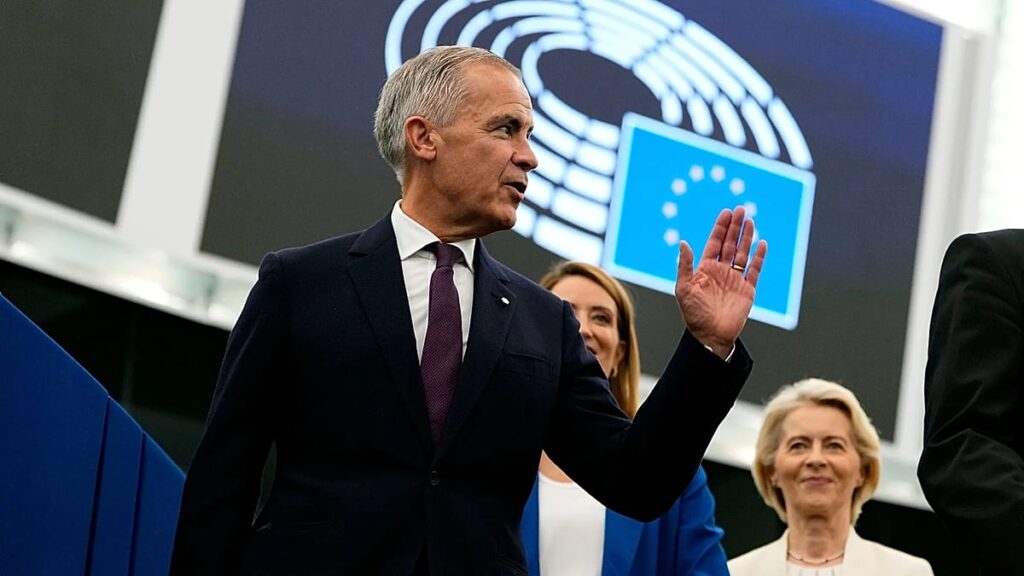
In his own speech before the European Parliament, Carney welcomed the move, pointing to opinion polls showing an overwhelming majority of Canadians favour much closer ties with Brussels. At the same time, he spelled out some limits in how far Ottawa is willing to go.
“Canada is not in a position nor seeking to become a full member of the European Union,” he said. “Therefore, it’s a different framework. It’s a framework that is relevant for a country that shares deep bonds with Europe.”
Asked after the speech whether he felt comfortable with that precise connotation, he noted that “the precise nomenclature is a question for Europe,” arguing that what mattered was the substance.
At the same time, Carney also seemed to trace a line for any potential relinquishment of sovereignty from Canada’s side, insisting that “we are looking for partnerships that are complementary, that reinforce our sovereignty”.
Canada is locked in a trade war with the US after talks on a bilateral agreement collapsed. In response, Carney has been seeking closer ties with Brussels, which he sees as a blueprint for other democracies to follow.
During his speech before MEPs in Strasbourg, he pointed out what he sees as the potential areas of deepening collaboration with the EU, such as critical minerals, defence industrial capacity, AI and compute, energy security, space, and payments.
“An alliance is not defined by what we oppose, but by what we are for: freedom, solidarity, prosperity, sustainability. An alliance that builds resilience for what it allows us to do for our citizens, and our citizens to do for themselves,” he added.
At the same time, he stressed that he did not intend to form a third bloc “with better manners” to enter the great power rivalry.
“We do not seek power to dominate others. On the contrary, we are pursuing resilience so that no one can control our open markets, impair our sovereignty, threaten our territorial integrity, or undermine our freedoms, our democracies, our rule of law.”
Read the full article here