



WASHINGTON — The month-long Department of Homeland Security shutdown has dealt a $2.5 billion blow to the economy so far, White House economists have forecasted — on top of an over $90 billion loss from last year’s record-breaking stoppage.
That current $2.5 billion damage estimate from the White House Council of Economic Advisers is a very “conservative figure that only includes the ‘direct’ effects of reduced government expenditures” and doesn’t account for the adverse ripple effects of the partial DHS shutdown, The Post has learned.
“With each passing day, more Americans are feeling the economic impacts of the Democrats’ DHS shutdown,” White House spokeswoman Abigail Jackson told The Post.
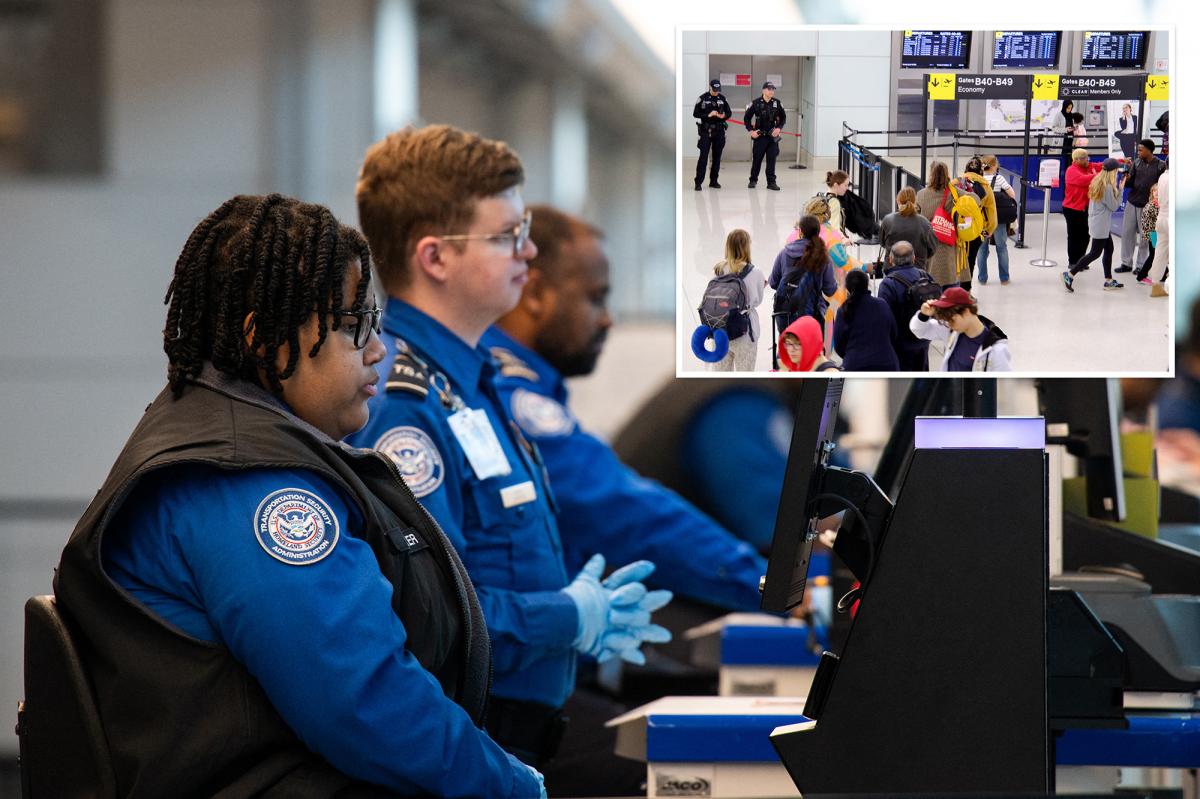
“Whether it be the 100,000 DHS employees – including TSA officers – missing their paychecks or the countless Americans missing flights due to long airport lines, the Democrats’ partisan games have consequences.”
The $2.5 billion annualized quarterly gross domestic product loss only reflects the cost of government employees and contractors losing paychecks — rather than the broader economic impact of travel delays and the loss of consumer spending.
But the fuller consequences will eventually come to light.
“Airport delays and inspection delays from the Coast Guard are slowing down the movement of goods and people across the country,” Jessica Riedl, a budget and tax fellow at the Brookings Institution, said. “It is difficult to estimate how much that will affect the economy.”
“But as the shutdown drags on, if people and goods have a harder time traveling to their destination, clearly that’s going to have downstream effects on businesses and on spending.”
For comparison, the 43-day-long, full-fledged government shutdown last year, cost about $15 billion a week, according to Director of the National Economic Council Kevin Hassett. That adds up to more than $90 billion in direct and indirect costs to the economy — and reflects a more comprehensive estimate of the economic damage than the $2.5 billion estimate for the current DHS funding lapse.
Combined with the current shutdown chaos, that’s roughly a $93 billion gut punch to the US economy caused by unnecessary political games.
The record-breaking shutdown also hurt fourth-quarter GDP growth by as much as 1.5 percentage points, per an analysis from the Congressional Budget Office.
Between $7 billion and $14 billion of the damage from a six-week shutdown is likely to be permanent, the CBO forecasted. The CBO has not released an estimate on the current blow to GDP from the DHS funding lapse.
Riedl believes that much of the economic damage will show up in “local economies that have their airports paralyzed” and result in a dip in tourism as well as businesses’ ability to travel, rather than a dramatic impact on “broader economic measures.”
The havoc from the current DHS lapse is particularly concentrated in the travel economy and is expected to get much worse over time — with no end in sight to the current impasse.
“We estimate that previous shutdowns have cost the travel industry in excess of a billion dollars per week,” Erik Hansen, the US Travel Association’s head of government relations, told The Post, suggesting that figure applies to this one as well.
“The last government-wide shutdown impacted more than 6 million travelers. So this is not a record that Congress should be trying to set again.”
This is the third time in the past six months the government has been in at least a partial shutdown, including the four-day period in late January. Security line waits have surged close to 3 to 4 hours in some cases, and airports have been forced to make delays and cancellations as well.
A considerable 10% of Transportation Security Administration screeners — who make an average of $45,000 per year — called out of work on Sunday, up from around 2% daily before the shutdown. Meanwhile, some 370 TSA workers have quit their jobs within the past month, according to the DHS.
“TSA officers are the front line of national security for our aviation system; they found more than 6,000 guns and weapons last year,” Hansen pointed out.
“For them to be under an incredible amount of stress, for fewer workers to be screening increasingly more travelers, [that’s], of course, adding an additional element of risk to the system, and it’s a self-imposed.”
The stress on staffing has raised the possibility that smaller airports may have to be closed if the shutdown drags on much longer, acting Deputy TSA Administrator Adam Stahl warned.
Critically, the DHS funding lapse comes against the backdrop of elevated national security concerns due to the ongoing war in Iran.
“[It impacts] the US Coast Guard, which is part military, as we are in conflict with Iran, CISA — cyber security and infrastructure security — are always vulnerable, but particularly again, when we’re in conflict with Iran,” Lora Ries, director of the Border Security and Immigration Center at The Heritage Foundation, said.
“Democrats are playing chicken with terrorists right now, and we’ve already had four attacks in the last two weeks,” she added.
There are also long-term concerns that the DHS will struggle to retain and hire employees in the future.
“100,000 DHS employees have missed their first full paycheck,” a DHS spokesperson told The Post. “This amounts to $1 BILLION in unpaid wages each month. Thanks to the Democrats’ DHS shutdown, these men and women are being forced to work without pay and many cannot pay their rent, buy food or gas.”
A recent study from the University of Virginia Darden School of Business found that government workers subject to a shutdown-induced pay lapse feel a blow to morale “that’s equivalent to a 10% salary cut.”
DHS has been in a partial shutdown since Feb. 14 amid Senate Democrats’ filibustering of a funding bill due to their demands that Republicans make concessions on immigration enforcement policy, such as barring officers from wearing masks and tighter judicial warrant requirements, dealbreakers for the GOP.
Earlier this week, Democrats made their first counteroffer to the White House in about 18 days, but that “didn’t change much from where we were,” according to Senate Majority Leader John Thune (R-SD).
“They’re just things that, in my view, have been significant ‘gives’ on the part of the White House, but the Democrats seem intent on dragging out this political issue,” Thune later lamented to reporters.
Read the full article here