



The European Commission has framed the removal of Venezuelan President Nicolás Maduro as an “opportunity for a democratic transition” that should be led by the Venezuelan people, rather than by Maduro’s immediate successor, Delcy Rodríguez.
That stance puts the bloc at odds with United States President Donald Trump, who has claimed he is “in charge” of Venezuela and wants “total access” to the country’s valuable oil reserves following Saturday’s military intervention.
Trump has also called on Rodríguez to acquiesce to the US’s demands or pay a “very big price”.
Having first accused the US of illegally invading Venezuela, Rodríguez has since softened her public posture and extended an “invitation” to the White House to “work together on a cooperative agenda, oriented toward shared development”.
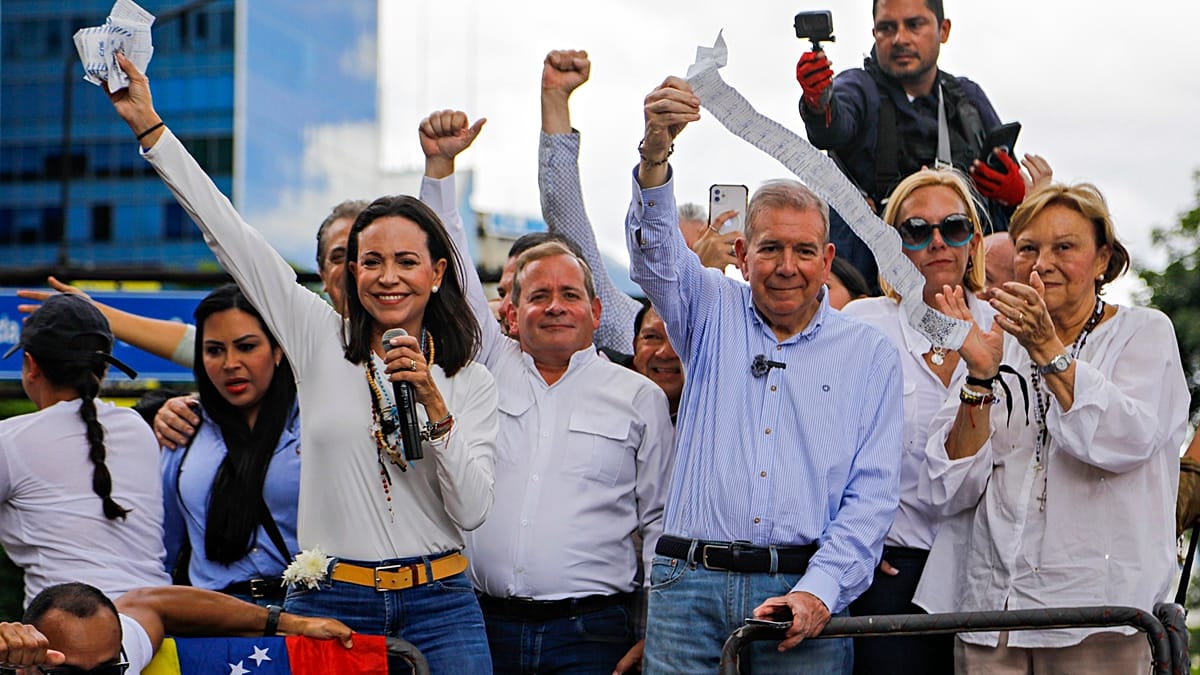
On Monday, the European Commission ruled out recognising Rodríguez as a legitimate head of state, pointing to the 2024 presidential elections that saw opposition leader Edmundo González win by a large margin, according to tally sheets. González was backed by María Corina Machado, the Nobel Peace Prize winner, whom Trump has already dismissed as a potential replacement.
Both González and Machado currently live in exile.
“It’s worth recalling that Nicolás Maduro lacked the legitimacy of a democratically elected leader, and therefore the events over the weekend provide the opportunity for a democratic transition led by the Venezuelan people,” Paula Pinho, the Commission’s chief spokesperson, said on Monday afternoon.
“We also recall, in this very same context, the need to abide by international law and the UN Charter,” she added.
Faced with questions from journalists, Pinho refused to take a stance on the legality of the US intervention, which many legal and political observers have deemed an assault on state sovereignty. She instead highlighted the “possibility for those who have been democratically elected in Venezuela to actually be running the country,” a clear reference to González and Machado.
“It’s obviously for the Venezuelan people to run the country as it is for any people across the world,” Pinho said. “Wherever and whatever country we’re talking about.”
Muted condemnation
The statement echoes the line taken by most EU leaders, who have focused on the illegitimacy of Maduro’s rule and the democratic potential that its removal represents.
So far, Spain’s Pedro Sánchez has been the most critical about the US action, denouncing it a breach of international law that sets an “extremely dangerous precedent”.
On Monday, French President Emmanuel Macron said his country did not approve of the “method” chosen by Washington to oust the Venezuelan leader.
“France supports popular sovereignty, and this popular sovereignty was expressed in 2024,” Macron told his council of ministers, according to this spokesperson. “If there is to be a transition, then the winner of 2024 should play a central role.”
The public statements made by European capitals have laid bare a chasm between the two sides of the Atlantic.
In the aftermath of the military operation, Trump has repeatedly said the US will “run” Venezuela and impose its will on the country, paying little attention to a possible democratic transition. On Saturday, Trump said Machado lacked the necessary “support” and respect” from the Venezuelan people to become head of state.
The Washington Post later reported that Machado’s acceptance of the Nobel Peace Prize alienated Trump, who has publicly lobbied to win the award himself.
“We’re dealing with the people that just got sworn in,” Trump told reporters on his way back from Florida, referring to Rodríguez.
Asked about his expectations for Rodríguez’s government, Trump made it clear his main goal was to exploit Venezuela’s oil reserves, the largest in the world.
“We need total access,” he said. “We need access to the oil and to other things in their country that allow us to rebuild their country.”
According to Secretary of State Marco Rubio, American control will be exercised through a military “quarantine” over the country’s oil exports, rather than by boots on the ground.
Read the full article here