




Published on
•Updated
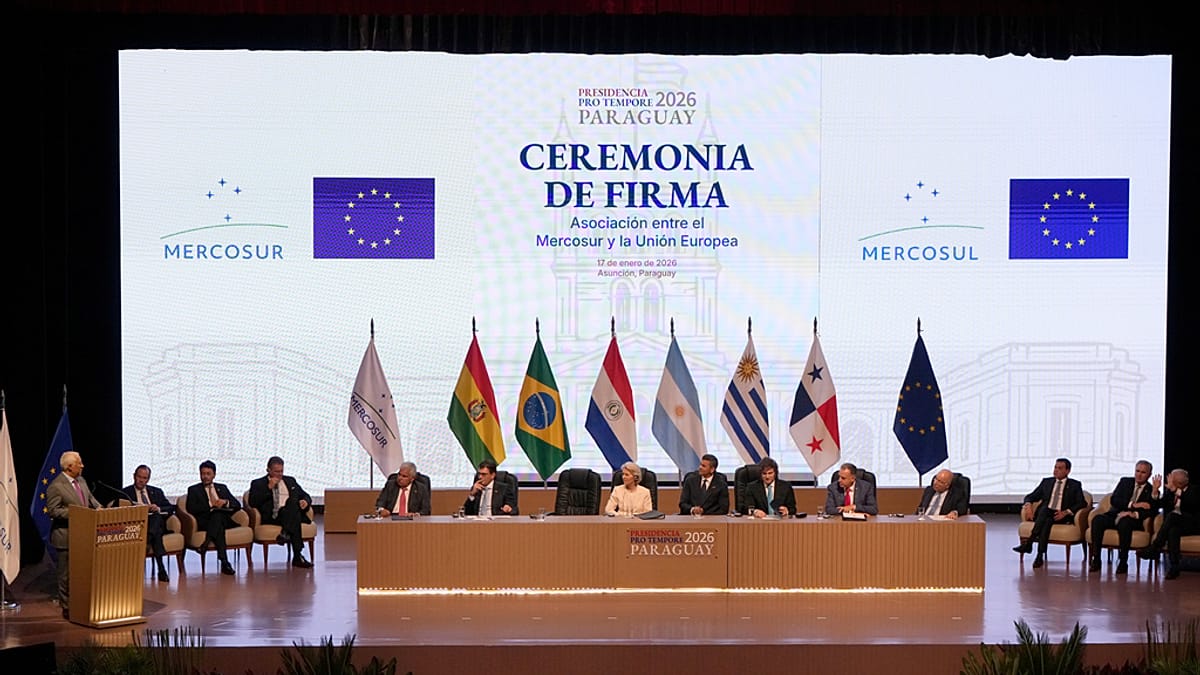
The European Union and Latin American countries led by Brazil signed the Mercosur trade deal in a historic ceremony in Paraguay after more than 20 years of negotiations .
European Commission President Ursula von der Leyen hailed the agreement as a win-in partnership that would create a market of 700 million consumers. She hailed partner countries Brazil, Argentina, Paraguay and Uruguay for choosing trade over not tariffs.
“We choose fair trade over tariffs, we chose a productive long-term partnership over isolation,” Von der Leyen said at the ceremony in Asuncion, Paraguay.
European Council head Antonio Costa said the deal sent “a message of defense of free trade, based on rules, of multilateralism and international law as the basis for relations between countries and regions.”
He said it stood in contrast to “the use of trade as a geopolitical weapon.”
Negotiated over 25 years, the Mercosur agreement would create a free-trade zone of roughly 700 million people, gradually eliminating about 90% of tariffs across the industrial, services and agricultural sectors. The European Commission estimates that EU companies would save more than €4 billion a year in customs duties. Mercosur countries have also pledged to open their public-procurement markets to European firms on the same terms as domestic competitors.
The deal provides for the recognition of 344 “geographical indications”, protecting European products from imitation, and is also intended to secure supplies of critical minerals, reducing the EU’s dependence on China.
The agreement has crystallised divisions within the bloc.
Supporters – led by Germany and Spain – argue the EU needs new trade ties as the US closes its market and China pursues an increasingly aggressive trade policy. Opponents, spearheaded by France, say the deal threatens European farmers by exposing them to unfair competition from Latin American imports.
The ball is in the European Parliament’s court
Paris ultimately failed to assemble a blocking minority to stop the signing, losing the decisive support of Italy at the last minute. Rome backed the deal after securing funding for its farmers from 2028 and an exemption from the EU’s carbon border tax on fertilisers.
Despite opposing the agreement, France secured a safeguard clause allowing tariffs to be reintroduced if imports from Mercosur rise by more than 5% in sensitive sectors.
The deal also caps tariff-free access for key agricultural products. Annual beef imports will be limited to 99,000 tonnes at a reduced tariff of 7.5%, equivalent to 1.5% of EU production. Poultry imports will be capped at 180,000 tonnes a year, or 1.3% of EU output.
According to Commission estimates, EU exports to Mercosur countries are expected to rise 39% (€48.7 billion) by 2040, while imports from Latin America would increase 16.9% (€8.9 billion).
However, as French President Emmanuel Macron wrote on X last week, “the signing of the agreement does not mark the end of the story.”
With the deal now signed, the ball is in the European Parliament’s court. Ratification requires lawmakers’ consent, and MEPs remain split largely along national lines, even as supporters hope backing from EU governments will sway undecided colleagues.
Opponents are set to test that support as early as next week, when lawmakers vote on a resolution calling for the agreement to be challenged before the EU’s top court.
Read the full article here