





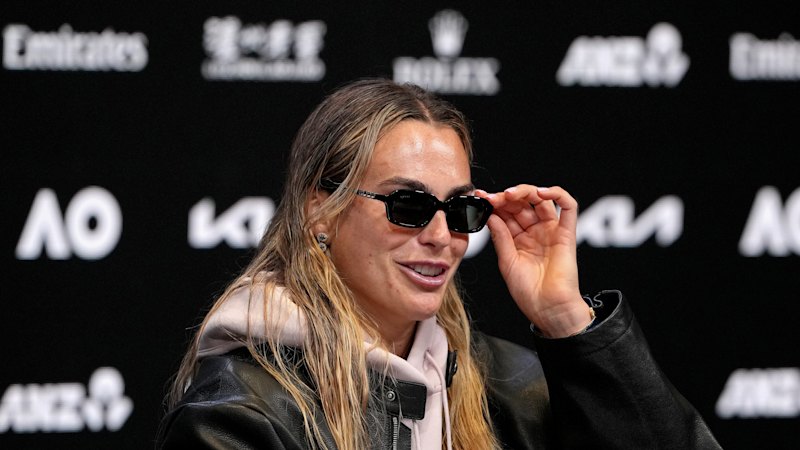
When world No.1 Aryna Sabalenka popped on a pair of Gucci sunglasses for her post-match press conference and joked that she couldn’t speak because her mind was on shopping, the impact of influencer culture on the Australian Open was evident.
The tournament and the sport of tennis itself has become increasingly commercialised over the years, and the top players are not immune to the pressure to shill for their supper.
Sabalenka uses both traditional media appearances and her own social media presence with 4.2 million followers to help promote her many partnerships.
Alongside Gucci, she is repping jewellery brand Material Good at the Australian Open, inviting followers to “shop my collection”, wellness powder IM8 and airline Emirates, alongside more traditional tennis brands Wilson Racquets and Nike apparel.
Nick Kyrgios’ appearance at the Australian Open was limited to one doubles game this year, but that didn’t stop him from an “appearance” with US player Frances Tiafoe at the newly opened Cleo rooftop bar at hotel Hyde Melbourne Place, where both were staying along with their entourages.
The pair happily answered questions about their favourite vegetable (broccoli for Kyrgios, in case you are wondering), along with nominating where they’d like to have a drink in Melbourne (Cleo, obviously).
In an interview with this masthead after the public Q&A session, Kyrgios said tennis players increasingly faced extra pressure to appear in content for their sponsors off the court.
“I’ve definitely had to deal with that a lot more than every other tennis player,” he says “Flying under the radar would be nice at times. But I guess that also comes with the territory, you know?”
Kyrgios says that as tennis has boomed, so have commercial deals and the obligations that come with them for tennis stars.
“As a sport, I mean, you look at guys like [Carlos] Alcaraz and [Jannik] Sinner and Sabalenka and all these amazing tennis players, what they deal with on a day-to-day basis,” he says. “It’s not just pressure that comes on the court. They have to show up for their brand deals, they have to show up for hotels. They have to show up for so many different things.”
The renaming of the Australian Open’s pre-tournament week from “qualifying week” to “opening week” proved to be a ticketing bonanza for Tennis Australia, but it also provided a golden opportunity for tennis stars to get their endorsements on track before the Australian Open even began.
You couldn’t swing a tennis racquet in Melbourne without bumping into one of the world’s top tennis players promoting a product or brand.
Novak Djokovic was resplendent in a royal blue tracksuit posing for photos with fans at Arbory Afloat’s floating tennis court on the Yarra in a clever bit of guerilla advertising for Lacoste, while fans of world No. 2 Iga Świątek could have a hit with her at Crown’s rooftop tennis court in an event organised by sports brand On.
The promotion did not stop when the tournament started; when Naomi Osaka walked onto the court at Rod Laver Arena wearing her self-designed jellyfish-inspired dress, it was immediately available for sale by sports giant Nike.
Sophie Bishop, author of Influencer Creep, defines an influencer as someone who is creating content in a specific niche that is also about themselves.
On a recent episode of The Culture Study podcast, ‘Is everyone an influencer now?’ Bishop says the language and strategies of influencers have become pervasive throughout society with the normalisation of posting an “OOTD” (Outfit Of The Day) or “BTS” (Behind The Scenes).
“You always have this kind of carrot dangling, which is like, if you share more, if you do more, if you put yourself out there more then it might bring success,” she says.
Tennis commentator and two-time Australian Open champion Jim Courier is starring in an Uber Eats advertising campaign during the tournament, and says tennis has changed from being a space dominated by sports brands to becoming a broader market for influence for athletes.
“Companies like Nike have for a long time utilised athletes to help with their marketing,” he says. “But in recent times, as tennis has gotten more and more popular because of incredible champions like Djokovic and [Roger] Federer, [Rafael] Nadal and Serena Williams and Venus Williams and Ash Barty, you see these companies that aren’t endemics want to utilise an event like the Australian Open or the US Open or Wimbledon as a chance to get their brands out there. It makes sense for them, oftentimes, to utilise some of the people that inhabit the tennis world.”
Tennis players are increasingly powerful content creators shaping trends beyond the court.
The biggest influencers at the Open this year aren’t posting courtside selfies – they’re the ones playing the game.
Start the day with a summary of the day’s most important and interesting stories, analysis and insights. Sign up for our Morning Edition newsletter.
From our partners
Read the full article here