





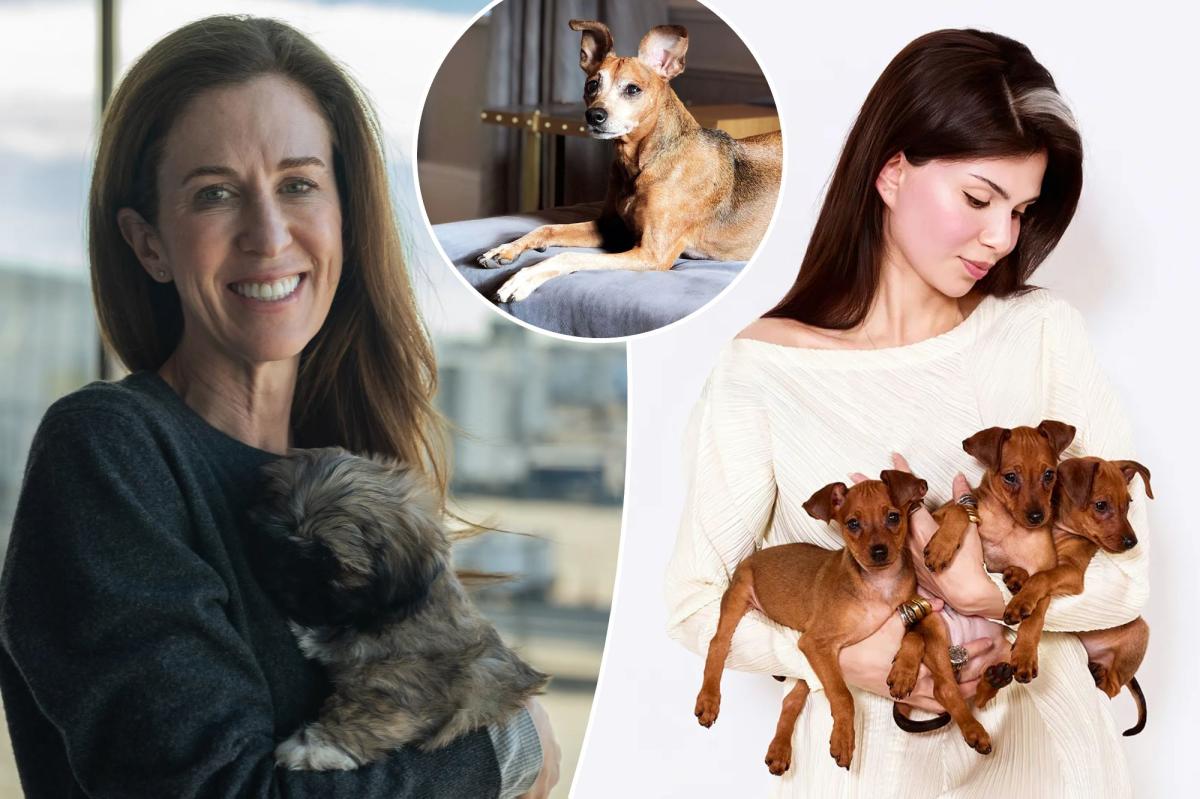
When Venessa Johnson first laid eyes on her new puppy Ollie, the adorable, 8-week-old Shih Tzu seemed more than a little familiar.
Everything about him — his little nose, his mannerisms — brought back bittersweet memories of her late, beloved companion Oliver, who passed away in December of last year.
“It was strange because it was Oliver’s eyes looking at me, but it was not wholly him,” Johnson, 48, told The Post of her first, emotional meeting with Ollie in upstate New York recently, thousands of miles away from her home on the West Coast.
There was a good reason for the uncanny canine coincidence: cloning.
Ollie is Oliver’s doggelgänger.
Thanks to radical advancements in technology, your beloved pet — or at least a version of him or her — can now live forever, using tissue samples collected before their death.
Once a quirky novelty reserved for rich celebrities such as Barbra Streisand and Paris Hilton, ordinary Americans are increasingly opting to clone their cats and dogs — turning to companies that charge upwards of $50,000 for the privilege.
Now, a new wave of boldfaced names are jumping on the trend — Tom Brady, who recently cloned his family dog, Lua, has even invested in the technology that gave him the second-gen pitbull mix.
Supporters call it a scientific miracle, allowing animal lovers an everlasting bond with their furry friends.
Critics, on the other hand, claim pet cloning opens a Pandora’s Box of ethical issues. Mortality — and, by extension, morality — are, they say, quite literally going to the dogs.
‘A ray of hope’
Losing Oliver was devastating for Johnson, an Amazon executive living in Los Angeles. After rescuing him in 2013, the two became inseparable.
“I don’t have kids; I’m single,” she said. “We were together 24/7. I brought him everywhere.”
Oliver’s untimely passing last year, just before Christmas, sent the devoted dog mom into a spiral of unrelenting grief.
Amidst her devastation, she turned to the internet and found ViaGen — a Texas-based biotech company “devoted to perfecting the genetic replication” of dogs, cats and horses.
“I was Googling ‘What to do after the loss of your dog,’ and something came up about cloning,” Johnson recalled. “I was kind of like, ‘Wait, what? That’s a thing?’… It gave me a lifeline where I felt a ray of hope, having a piece of Oliver to continue on.”
Cloning works by using what scientists call somatic cell nuclear transfer — the method famously and controversially used to clone Dolly the Sheep in 1996.
Using the collected tissue sample, the nucleus from the body cell is inserted into a donor egg that has already had its own nucleus removed. The result: An embryo that is then implanted into a surrogate mother who will carry and give birth to the clone.
Fueled by a desire to have Oliver back at whatever cost, Johnson forked over $50,000 to ViaGen — against advice from her family and friends.
“Everybody told me to wait, but I just couldn’t listen,” she stated. “My head wasn’t clear.”
ViaGen, which was acquired by Dallas-headquartered Colossal Biosciences last month, reports a near 80% success rate with cloning.
Back in 2018, a Columbia University study claimed an industry-wide success rate of just 20% — stating at the time that multiple implantation procedures would be required, in most cases. At the time, a study author warned against the practice, saying that it “doesn’t actually provide any medical benefit to the health of a pet or to people.”
Animal rights advocates aren’t fans of the trend, either — both PETA and the ASPCA have spoken out loudly against pet cloning, advocating for adoption instead, as shelters overflow with animals in need of homes.
Three’s company
Kay, a 37-year-old software developer from Seattle, also turned to ViaGen after losing her 18-year-old Pinscher, Feto, last spring.
Like Johnson, Kay works in tech, doesn’t have children, and paid $50,000 for the cloning process.
However, she got a little more bang for her buck, ending up with not one, not two, but three Feto clones.
“It feels stupid to say out loud, but it felt like reaching across the universe back in time,” Kay explained to The Post of the emotional experience, which she said completely overwhelmed her.
The moment Kay laid eyes on the too-cute trio — which she named Feto 4, Feto 5, and Feto 6 after their microchip numbers — she was immediately transported back to the day she first met Feto The First, nearly two decades ago.
“I cloned him once, technically, but sometimes the science results in multiple puppies,” she said.
While the pups are “really similar” — Kay said the pups all smell the same as the original Feto, and have had no inside bathroom accidents since arriving home because they whimper in the same way he did, when they need to go.
“I immediately knew the difference between their ‘I don’t want to be in here or ‘I need to go [to the bathroom] whines. Doing that with three, I was like, ‘Holy crap, how is this happening?‘”
In addition, each one takes on different traits of their ancestor, she reported.
“One of them nibbles on me a little bit, and that’s what Feto did,” Kay explained. “They all have different pieces of him right now.“
She plans to raise all three pups herself and hopes they’ll wind up identical. However, there are no guarantees, according to veterinarian Dr. Rebecca Greenstein.
Greenstein told The Post that those considering cloning their pets shouldn’t expect exact replicas.
“There’s obviously quite a strong debate about nature versus nature,” the Toronto-based doc declared.
“Could you really say that they’re exposed to the same environmental factors? Are they fed the same diet? Are they exposed to the same levels of pollution? Does the owner behave identically with the first one as they do the second?” she continued. “I think there are a lot of just situational factors that we haven’t accounted for.“
“So while the physical appearance may very closely match that of the deceased [original], the personality isn’t necessarily going to be the same.”
ViaGen says cloned animals can live just as long as the original, and Greenstein said there’s no reason to believe that’s not the case.
In an investigation conducted by CBS News in 2024, ViaGen was found to be in compliance with USDA regulations and animal welfare rules.
Since 2015, the company has cloned more than a thousand cats and dogs, according to the report.
Pet regret?
Both Johnson and Kay admit to feeling conflicted while pursuing the cloning path — Johnson even said she began to regret her choice, as she began to heal from the pain of losing Oliver.
“This is a decision I made in a really deep amount of profound grief,” she told The Post, before her trip back East to pick up Ollie. “I would not make this decision again. There are so many amazing dogs in shelters, that are overcrowded right now.”
“It’s not a straightforward thing. I think that there’s something super special about Oliver being unique, and us having a once-in-a-lifetime kind of love and loyalty and devotion to each other,” she mused.
Three weeks after meeting her new companion, Johnson was feeling guardedly optimistic.
“I’m happier and happier that I did this,” she told The Post from her home in L.A. “Ollie’s little walk, the way he runs in the grass and burrows into the bed, all remind me of Oliver, and that is really remarkable. It’s not a straightforward thing.”
Up in Seattle, Kay reported feeling similarly about Feto.
“If I had to give advice to anybody, it would be to wait, because you don’t want to make decisions when you’re grieving,” she stated. “It’s a gray area, I know the full implications. But now, I’m really happy I did this. This is the best thing that’s ever happened to me.”
Read the full article here