



These brows are taking a beating.
In 2016, microblading was the beauty world’s much-coveted golden ticket, offering full, semi-permanent, perfect eyebrows without the daily pencil fill-in grind, and salons were buzzing with early adopters eager to get the ultimate status symbol.
“The idea of not having to fill in my brows sounded so exciting at the time,” Viveca Chow, 30, a Queens-based content creator, recently told The Post. “I’m not good at makeup, and especially not at filling my brows, so this was a win-win.”
But fast-forward a decade, and some of those once-envied arches are giving their owners, like Chow, pause. Color shifts, blurry lines, and permanently “set in stone” shapes have turned yesterday’s must-have into today’s regret.
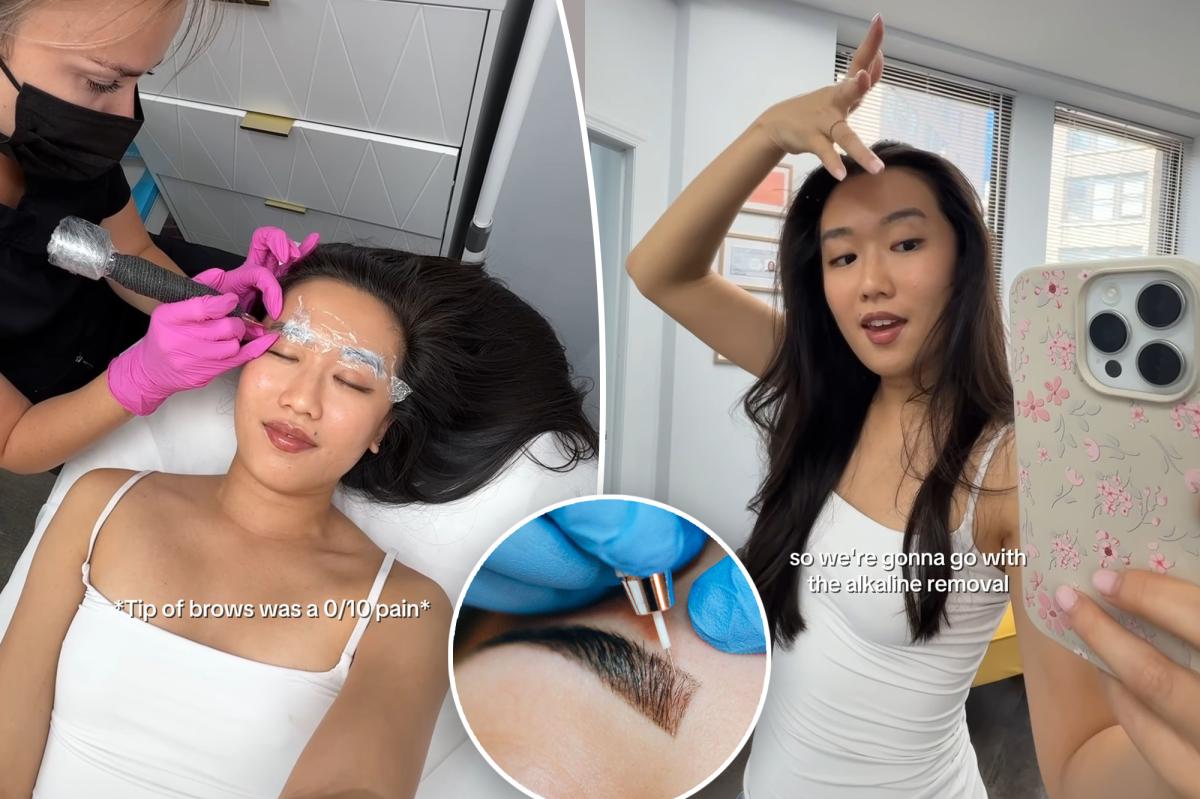
“It’s eight years later, and my brows are still completely intact,” said Chow, who is midway through agonizing chemical removal sessions that leave her skin red, scabbed and aching, with healing stretching several days.
“The pain in the removal surprised me the most,” she told The Post. “It’s almost like I got my karma for not thinking it through.”
Chow, who has gone viral for documenting her microblading removal process, is not alone in her newfound microblading regret.
“I can’t leave the house anymore after getting microblading done,” one crying gal confessed about the 2016-looking results from recent microblading. “I don’t know what to do — I feel so ugly now.”
From brow boom to brow gloom
By 2016-17, the world was obsessed with full, defined brows, whether created with the help of makeup or microblading, using a handheld tool with tiny needles to deposit pigment into the skin.
Costing anywhere from $300 to $1,200, microblading promised hair-like strokes that felt real but polished — a stark upgrade from the blocky permanent tattoos of yesteryear.
But as with all trends, time has a way of revealing the cracks. Pigments that were once perfect brown often age into gray, blue, green, orange, yellow or even pink.
Fine strokes blur into solid, unnatural shapes.
And those “semi-permanent” claims? Sometimes they last far longer than advertised.
Experts sound the alarm
“2016 brows were bold, thick, and perhaps a little too well-defined,” board-certified plastic surgeon Dr. Maryam Saheb-Al-Zamani told The Post.
“Microbladed eyebrows rarely fade fully — and over time, they can leave blocks of reddish or grayish color instead of the original fine strokes.”
“When you thought microblading your eyebrows five years ago was a good idea,” one woman recently shared on social media regarding her botched brows as a warning to others, adding that she’s “ready to laser them off.”
Chow didn’t notice her problem until five years after getting them done.
“One day, I thought to myself, ‘Huh, my brows look exactly the same as when they healed.’ That was when I speculated that my artist probably went in too deep, making the pigment pretty permanent.”
Chow said the “new wave and trends that Hailey Bieber brought to the beauty industry” last year — namely a clean, natural brow — helped her realize her inked brows felt dated and “no longer fit my style.”
“Microblading’s cookie-cutter approach didn’t suit every face,” Zamani explained. “Many patients end up with uneven brows or shapes that don’t match their natural arches — and those can be tough to fix.”
Undoing the past is no walk in the park, either.
Laser treatments can turn brows yellow, so Chow chose alkaline removal sessions at Midtown’s Spring Muse salon at a pricey $200 a pop, with a total tab likely to hit $1,000.
Progress is visible, but painfully slow — the front arches supposedly hurt the most, the back slightly easier.
“You know the pain when someone’s doing manual extractions on your nose, and you start to tear up because your body is reacting to that pain? This is what happened here,” Chow said.
The new brow rules
Meanwhile, the brow scene has evolved from the blocky barrage. Women now favor softer, more natural looks, using nano, powder, laminated, “soap” and brushed-up styles.
“Brow trends have certainly evolved to be more natural, softer, fluffy and/or laminated,” board-certified dermatologist Dr. Shannon Humphrey told The Post.
“Beauty ideals are shifting towards less contoured and rigid with a nod towards a natural look and graceful aging,” she added.
Many women today are also skipping semi-permanent ink and turning to brow gels or growth serums — like Latisse — for a more flexible, low-maintenance look, Humphrey noted.
Zamani says women with microblading fatigue have high-tech options, too: from brow growth supplements and PRP treatments to eyebrow transplants, where follicles are harvested and meticulously implanted to restore natural fullness.
Experts like her urge anyone considering microblading to think long-term, research carefully, and pick an experienced artist — because changing your mind later isn’t easy.
Chow’s advice for anyone considering microblading today? “Flexibility should be a priority,” she said.
“Having the freedom is empowering and comforting. You won’t feel stuck with something you don’t end up changing your mind about down the road,” she continued. “My brows that never faded were a result of using pigment too dark and going in too deep with a blade — basically, incorrect technique.”
Proof that, in the beauty world, less is often more.
Read the full article here