





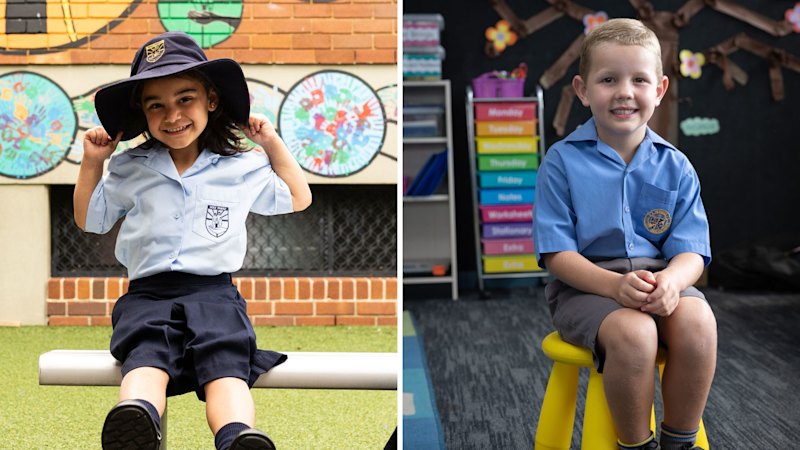
Spencer Paine, who will turn six in March, and four-year-old Arielle Katrib are 15 months apart in age – but they will both sit on the carpeted floors of a kindergarten classroom for the very first time when they start primary school this week.
Their parents have answered the question that weighs on the minds of many families: should they send their children to school early or hold them back a year?
After attending preschool four days a week, Arielle is eagerly counting down the days until she joins her three older siblings at Holy Family Primary School in Granville. Asked what excited her the most about starting school, she exclaimed: “I can see the kids at lunchtime!”
Spencer is also excited to start, grinning as he tries on his uniform for Our Lady Queen of Peace at Greystanes. But, unlike Arielle, it’s a day he could have seen a year earlier: Spencer’s mother, a primary school teacher herself, had enrolled him to start in 2025 but withdrew his application after his preschool suggested he wasn’t ready yet.
More NSW parents are waiting until the year their child turns six to send them to kindergarten.
The proportion of students starting school aged five or younger declined from 78 per cent in 2011 to 69 per cent in 2024, department data shows. In contrast, 28 per cent of students have now turned six by July the year they entered kindergarten, up from 19 per cent in 2011.
Under NSW public school rules, a child can begin kindergarten as early as age four if they turn five before July 31 of that year.
With the law requiring every student to be enrolled in school by their sixth birthday, a class can have age differences of up to 19 months.
How do you know if your child is ready?
Experts have rejected a one-size-fits-all approach when gauging whether a child is ready to start school, saying the process is highly individual for each family.
While University of Sydney early childhood education lecturer Dr Erin Harper said it wasn’t a “perfect science”, a good litmus test is assessing a child’s social, emotional and self-regulation skills.
“It’s not just about age, we want to think about some of the day-to-day things. How does the child cope with separation? How do they go following daily routines? Are they comfortable in large groups? Also, how they respond to frustration and setbacks,” she said.
“We don’t want to be sending children to school before they’re ready, but we also don’t want to hold children who are ready, back.”
Arielle’s mum, Sheena Katrib, said her daughter, who turns five in May, had been “babied” a lot as the youngest child but was very confident.
“In terms of basic numbers, colours, writing her name, she’s ready. Emotionally, she’s ready, too,” Katrib said.
“At first the preschool said she wasn’t yet ready because of her letters, but they worked hard on them with her and said she had progressed.”
What happens if children start before they are ready?
Rachel Paine said her son Spencer was ready for kindergarten coursework last year but has benefited from more time in other ways.
“Intellectually, he was fine. He’s started to read books, and he can count. Socially and emotionally, he wasn’t ready for school. He would cry every day going to preschool, and that was only two days a week,” she said.
“When I spoke to the [preschool] teachers they said he would engage with other kids sometimes but he would often withdraw himself, sit back and watch. So he didn’t have those social skills and those interactions with kids, but that got a lot better.”
By the end of 2025 Spencer was “definitely nowhere near as emotional”, and focusing for long periods and connecting with other children became much easier for him, Paine said.
As a primary school teacher, Paine said children who started school before they were ready were “just that little bit more immature”.
“They’re not as independent at certain things. Just their interactions and the way they approach situations is different,” she said.
Harper said children who start school before they are ready could feel more anxious or insecure, impacting their self-esteem and whether they view themselves as capable.
She recommended parents “get on the front foot” and talk to their child’s early childhood educators early about school readiness, continuing that conversation throughout the year.
NSW is unique in having such a wide age range for starting school. In Victoria, students must have turned five by the end of April, while Queensland’s cut-off is the end of June.
Opposition education spokesperson Mark Speakman has called on the government to review the school starting age ahead of the start of a pre-kindergarten year, taken by all children in NSW, due by 2030.
“Tweaking the earliest starting age would put students on a more even footing,” he said.
The government has no plans to review the school starting age in 2026.
10 questions to ask before enrolling your child in kindergarten
- Can they follow basic instructions?
- Do they have an interest in learning, are they curious to find out how things work?
- Can they recognise letters, count and read?
- Can they follow daily routines such as getting dressed, brushing their teeth and washing their hands?
- Can they make connections with their peers?
- Can they cope with separation?
- Are they comfortable in large groups of up to 30 other children?
- How do they respond to setbacks and frustration?
- Can they be patient and wait for their turn?
- Are they comfortable asking for help when they need it?
Start the day with a summary of the day’s most important and interesting stories, analysis and insights. Sign up for our Morning Edition newsletter.


From our partners
Read the full article here