





A lack of children and young families in some of Melbourne’s most affluent suburbs is forcing schools in those areas to the edge of a demographic cliff.
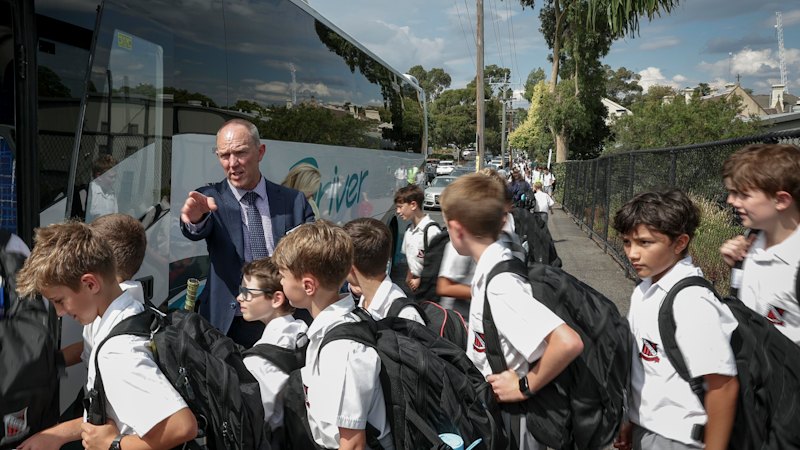
While elite private schools in the city’s inner east have been able to weather the demographic challenge by bussing children in from across the city, student numbers at local Catholic and government schools have been hit hard.
The Boroondara council area – which has the state’s highest concentration of private schools – has recorded a drop of 3220 people (7.5 per cent) aged 19 and younger between 2015 and 2024, according to the Australian Bureau of Statistics.
Enrolments in the 12 Catholic and 27 government schools in the area – which includes the suburbs of Hawthorn, Kew, Camberwell and Balwyn – have experienced a similarly sharp decline in numbers, of 1603 and 1674 students respectively, for a combined reduction of 3277, the biggest drop statewide.
Last year, Camberwell High School had a total of 824 students, down from 1276 a decade earlier – a drop of 35 per cent. Kew High School had 1015 students, down from 1118 in 2016, a drop of almost 10 per cent. Without taking children from outside their catchment areas to fill classrooms, these declines would be even sharper. The schools declined to comment.
But Boroondara’s 18 private schools, many of them operating at the high-fee end of the market, have bucked the trend, managing to add nearly 2130 enrolments since 2016.
In neighbouring Stonnington the story is similar; an under-19 population declining by nearly 1800 (9.6 per cent), overall enrolments decreasing by 229 but the private schools adding 327 students since 2016.
The trend is in stark contrast to the position of Melbourne’s outer suburbs, where enrolments have surged as young families flock to more affordable housing on the city’s booming fringe.
Matthew Deacon at Demographic Solutions said the main driver of the population challenge confronting inner-eastern schools was declining fertility rates, which have fallen from an average of 1.36 children per woman in Boroondara in 2013-15 to 1.07 in 2022-24.
“We can see the multi-faceted whammy of employment and social issues that have led to this outcome – casualisation of work, cost of living pressures including housing, problems with partnering and whether to have children or not and the effects of delayed fertility,” Deacon said.
However, some of the effect is due to the life cycles in neighbourhoods, says Johnny Barnard, population forecaster at Informed Decisions, who points to a “mini-boom of births” in the early 2000s that is now “ageing through the system”.
Barnard said this cycle occurred to an even greater extent in the 1970s and 1980s, resulting in school closures in the 1990s. “Schools in Boroondara have certainly dealt with school-aged kid declines in the past.”
The effect isn’t going unnoticed at high-fee private schools either.
Xavier College principal Lee MacMaster said the school was noticing a shift in family postcodes.
“We are seeing the home base of the 100 or so students who come into year 7 from our Xavier Junior School, Burke Hall, shifting. Where that group might typically have been really close to Xavier Senior School in terms of geography – often Kew and Hawthorn – the suburbs they come from have now broadened a little,” he said.
“The shift is towards a portion of students coming from suburbs like Glen Iris, Brighton, East Malvern, Northcote, Clifton Hill and Surrey Hills.” The other 100 boys in a typical cohort of 200 come from Williamstown to Templestowe, Essendon, Murrumbeena and Rosanna.
The school’s bus network, which transports students from the south and north of the city, is oversubscribed, MacMaster said. And while there are no immediate plans for the boys’ college to grow its 80 boarding enrolments, he said, “it certainly has been discussed and is a possibility in the future”.
Methodist Ladies’ College principal Julia Shea said over the past decade the Kew school’s inner-eastern catchment had “stayed strong” while there has been a shift towards students enrolling from a wider area.
“We have seen a gradual broadening in where our families live, particularly across middle-ring eastern and north-eastern Melbourne suburbs,” Shea said.
“We believe these patterns reflect broader metropolitan housing and demographic trends.”
Between 2015 and 2024, the number of people aged 19 and younger living in Bayside dropped by 562. Over the same period, the number of students enrolled in schools in the area has dropped by 398.
Nearby, Mentone Grammar – where enrolments have grown by 630 students in the past decade – is preparing for a predicted decline in the number of young people in Mentone, Beaumaris and Parkdale in coming years.
“There are two ways we can approach it, and we’re in the process of looking at this,” school principal Andy Muller said.
“One is to say, OK, do we actually plan for a smaller student population? Or do we strategically plan for using public transport and our own transport to access a broader catchment area?”
Although enrolments are up today, Muller says it’s “never too early” to plan for a different future. “Most local council area populations are ageing, there’s just less children being born.”
A spokesperson for the Melbourne Archdiocese Catholic Schools said demand was greatest in Melbourne’s northern and western corridors.
“In inner Melbourne, we are constantly looking at ways to strengthen Catholic school communities and support parent choice in education,” they said.
“Our priority is to build and maintain a dynamic, sustainable Catholic education system that families continue to choose, both now and into the future.”
Economist and public education advocate Trevor Cobbold said the solution was urban renewal with a greater mix of housing.
“When you compare the results of those government schools with the independent schools and the Catholic schools, they have been doing as well as, if not better, in terms of their average NAPLAN results,” he said.
“The simple bottom line is the public schools are struggling for resources to match those [schools] in terms of teaching and learning of independent schools in the area. There’s a great divide in resources.”
Start the day with a summary of the day’s most important and interesting stories, analysis and insights. Sign up for our Morning Edition newsletter.


From our partners
Read the full article here