





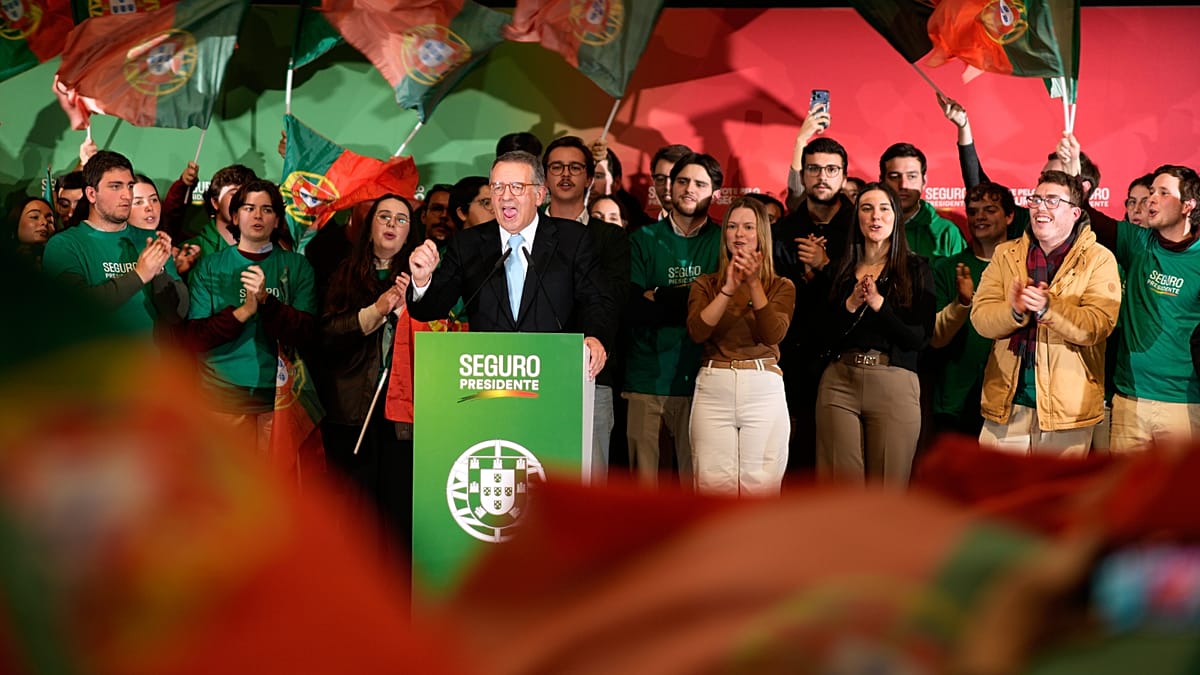
Portugal’s far-right presidential candidate André Ventura placed second in Portugal’s presidential election on Sunday, securing a place in a runoff next month against centre-left Socialist (PS) candidate António José Seguro.
Ventura’s strong showing was another milestone in Europe’s shift to the far-right, as populist parties have got their hands on, or edged closer to, the levers of power in recent years.
With almost 98% of votes counted, André Ventura, leader of the Chega (Enough) party that he founded less than seven years ago, captured 24% of the vote and placed second behind Seguro who led with almost 31%. They will face off in a second-round ballot between the two top candidates on 8 February.
It was the best result for a Socialist candidate since Jorge Sampaio in 2001, who at the time obtained 2,411,453 votes (55.76%).
Seguro will now have the arduous task of increasing his vote in a political environment marked by the decline in the weight of the left.
The PS-backed candidate promised to “honour the vote of confidence” given to him, reaffirming the independent nature of his candidacy: “I am free, I live without ties”.
Seguro declared his victory in the first round as one that “won democracy”, vowing to do so again on 8 February.
In his speech late on Sunday night, he invited “all democrats, progressives and humanists” to join his candidacy and together “defeat extremism”.
The winning candidate in the first round also promised to be “the President of all Portuguese people”.
“I’m ready to be the President of the new times. It’s time to defeat fear and raise hope,” he said, adding that his victory in the second round is the “victory of Portugal, of freedom and democracy”.
Ventura winks at non-socialist voters
Ventura’s sudden and growing presence in Portuguese politics has snatched support from the country’s two main parties that have alternated in power for the past half-century: the center-right Social Democratic Party (PSD), currently in government, and the centre-left Socialist Party.
One of André Ventura’s most significant results in these presidential elections is in the Autonomous Region of Madeira, the historic bastion of the Social Democrats, where he won with 33% of the vote.
On Sunday evening, when he addressed his supporters, he said that the country believed he was the “alternative” despite the “talk of the far right and the manipulation of the polls”.
“We’re going to lead the non-socialist space in Portugal. The right has fragmented like never before, but the Portuguese have given us the leadership of that right,” he summarised.
“We managed to defeat the candidate of the government and of Montenegrinism; the candidate who claimed to be liberal, but had been on the globalist agenda, woke, and against Portugal; and we campaigned without personal picardy, without offence,” he said.
In an appeal to the non-socialist vote, he addressed “leaders who are not socialists”, reiterating that “the right will only lose elections with the selfishness of the PSD, IL and others who call themselves right-wing”. “Now we’ll see what fibre they’re made of.”
One of Ventura’s main targets has been what he calls excessive immigration, as foreign workers have become more conspicuous in Portugal in recent years. “Portugal is ours,” he says.
During the election campaign, Ventura put up billboards across the country saying, “This isn’t Bangladesh” and “Immigrants shouldn’t be allowed to live on welfare.”
At the same time, more moderate voters remain sceptical of Ventura, and various opinion polls have pointed to a defeat against António José Seguro in the second round.
PSD faces weakest performance in 25 years
Currently at the head of the government, the PSD and People’s Party (CDS-PP) decided to support Luís Marques Mendes, the former leader of the Social Democrats, in this presidential election.
With Marques Mendes not receiving more than 11% of the vote, in fifth place, it was the worst result for a PSD-backed candidate since Joaquim Ferreira do Amaral in 2001, when he got 34.5% of the vote and came second to Jorge Sampaio.
In previous presidential elections, the two social-democratic candidates secured first-round victories and were re-elected for a second term.
Aníbal Cavaco Silva won the 2006 presidential elections with 50.5% of votes, and was re-elected in the 2011 presidential elections with 52.95% of votes.
His successor Marcelo Rebelo de Sousa won the 2016 presidential election with 52% of votes and was re-elected in the 2021 presidential election with 60.67%.
Luís Marques Mendes publicly took full responsibility for his defeat in the presidential elections and revealed that he is not supporting any other candidates in the second round of the presidential elections.
In a speech at PSD headquarters, Prime Minister Luís Montenegro also sought to prevent Marques Mendes’ result from contaminating the government and the PSD’s electoral expression in the legislative elections.
“Our political space will not be represented in this second round. We accept this choice with democratic humility. The PSD will not be involved in the electoral campaign. We won’t be giving any indications, nor are we supposed to,” said the Social Democrat leader, adding that “the PSD was chosen to govern the country and that’s what it will be doing over the next three weeks, as well as over the next few years”.
“The PSD will be governing Portugal, the autonomous regions, the majority of local councils, in the course of a legitimate, free, democratic choice by the Portuguese,” he emphasised.
When questioned by journalists, Montenegro repeatedly tried to avoid associating a defeat for Marques Mendes with a defeat for the PSD.
“That’s what democracy is,” he relativised, stressing that the Portuguese make a “distinction” in the different elections. “The Portuguese chose us to govern and we will continue to govern.”
Nine other candidates ran in what was the most hotly contested presidential election ever, but none came close to the 50% required for a first-round victory.
The winner will replace President Marcelo Rebelo de Sousa, who has served the limit of two five-year terms.
Read the full article here