





In a Quebec courtroom last October, Sylvie Desjardins delivered a message to her daughter’s killer that was 30 years in the making.
“You thought you were taking a life, but in truth, you only added weight to your own existence,” she told killer Réal Courtemanche.
“You will carry this silence, this emptiness, this gaze you extinguished until your last breath.”
For decades, the murder of 10-year-old Marie-Chantale Desjardins north of Montreal had haunted investigators and her family. Her battered body was found in 1994, with her bicycle leaning against a nearby tree, four days after she had headed home from a friend’s house.
The case came to a close this year with Courtemanche’s second-degree murder conviction. It was one of several high-profile Quebec murders that have been recently solved thanks to advances in DNA analysis, techniques that are raising hopes of solving not only more cold cases, but also active cases, says the head of the province’s DNA forensic lab.
While police are coy about the exact strategies used to identify killers, the judge in the Desjardins case said, “scientific advances and major breakthroughs in the field of forensic biology” made it possible to identify Courtemanche’s DNA from crime scene evidence.
Diane Séguin, who heads the DNA section of the provincial crime lab — Laboratoire de sciences judiciaires et de médecine légale — says her team analyzes some 50 cold cases per year, and has helped police solve between eight and 10 in the last year or two.
She says case resolutions have come from better DNA extraction techniques and from genetic genealogy — the comparison of DNA from crime scenes to public DNA databanks composed of profiles uploaded by members of the public researching their family roots.
“I’m optimistic … the more people put their DNA in those banks and accept to be part of criminal research for human remains research, the more there will be some matches and investigations that will be resolved,” Séguin said.


Get breaking National news
For news impacting Canada and around the world, sign up for breaking news alerts delivered directly to you when they happen.
Cold cases are only a small part of the work of the lab, which processes between 30,000 and 40,000 pieces of evidence each year. From that evidence 4,000 to 5,000 DNA profiles are uploaded to a national DNA databank called the crime scene index.
In both cold and active cases, Séguin said, the first step is to upload a DNA profile extracted from crime scene evidence to the national database to see if it matches that of a known convicted offender.
She said the lab sometimes pulls DNA samples from decades-old evidence that was never tested before, or extracts a new profile with today’s more sensitive equipment. The sheer increase in the number of profiles in the database makes identification more likely, she said.
Séguin says the lab also carries out “patronymic research” — running the unknown DNA through a database that links profiles with surnames. While the process is imperfect, sometimes it can associate a DNA profile to a last name.
If researchers find a match between crime scene evidence and a DNA sample uploaded to a public website — even if the match only identifies a suspect’s distant relative — investigators can start building a family tree using genetic genealogy.
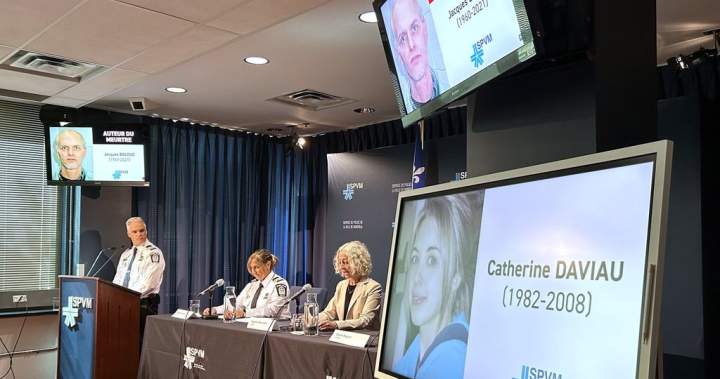
In September, that technique was used to identify the killer of 26-year-old Catherine Daviau, who was murdered in her Montreal apartment in December 2008. According to a police news release, a DNA sample at the scene was found to be related to profiles in public databases.
That eventually allowed investigators to focus on Jacques Bolduc, who had died in 2021 in prison while serving an unrelated sentence. The investigation found that Bolduc hadn’t known the victim but had answered an online ad she had placed to sell her car.
Seguin stresses that the results from genetic genealogy only generate the equivalent of a lead that can be passed on to police to help narrow down their investigations — it is up to officers to gather more evidence.
In the future, she’s hoping to use genetic genealogy on more active cases in order to prevent crimes from going cold. “So if ever, for example, we have a series of sexual assaults and the person is unknown … they might do another (assault),” she said. “So it’s good to work on cold cases, but it’s also good to work on contemporary cases to prevent some other assaults.”
She said members of the public who want to help solve cases can do so by uploading their DNA profiles to the databases the lab uses — FamilyTreeDNA or GEDmatch — and granting permission for them to be used by law enforcement.
Quebec provincial police say advances in DNA analysis allowed them to arrest a suspect in September and charge him with manslaughter in a 1979 home invasion in Causapscal, Que. And in July, police were able to prove that a body found in 1997 in P.E.I belonged to a missing man from Quebec who had gone missing the previous year.
In September, police in Gatineau, Que., announced an arrest in the 2011 murder of 18-year-old Valérie Leblanc, who was found in the woods near a college campus following what a coroner described as a skull fracture from a blow to the head. Police said the development was due to “new investigation techniques,” but declined to say if those included DNA.
While some experts such as Séguin are eager to see the use of genetic genealogy expanded, Michael Arntfield, a criminologist at Western University and former police detective, says there’s also a push to see that technique rendered obsolete.
He says some groups, including the Canadian Association of Chiefs of Police, have advocated for the expansion of the list of crimes that require an offender to have their DNA uploaded to the national databank; currently only a handful of serious crimes are part of the list. Doing so, Arntfield said, raises civil rights and privacy concerns, but would also help solve crimes much more rapidly.
“With increased buy-in to this technique there will be a time when you could almost retire the term cold case because, particularly if it’s used in real-time homicides, it would never get to the stage of it being cold,” he said.
Read the full article here