





The Antarctic Peninsula is an early warning system for the southernmost continent when it comes to climate change. And the prognostications are grim — but it’s not yet too late to avoid irreversible changes, researchers report February 20 in Frontiers in Environmental Science.
In the new study, the team first documented how the peninsula is already transforming as the planet warms, and then assessed how different amounts of warming by 2100 could alter the peninsula’s fate, including its marine and terrestrial ecosystems, land and sea ice, ice shelves and extreme weather events. Those global warming estimates — of 1.8, 3.6 and 4.4 degrees Celsius relative to pre-industrial times — are based on three different what-if scenarios of future greenhouse gas emissions.
“The Antarctic Peninsula is really the alarm bell for the continent,” says Bethan Davies, a glaciologist at Newcastle University in England. It’s a relatively tiny piece of the continent in area, but is disproportionately visible due to fisheries, tourism and scientific research.
“Changes that happen in the Antarctic Peninsula also don’t stay in the Antarctic Peninsula,” Davies says. Retreating glaciers in the southern part of the peninsula can make glaciers in West Antarctica more vulnerable to melting. Decreased sea ice around the peninsula increases warming around the Southern Ocean more broadly. That, in turn, can slow down the formation of a water mass known as Antarctic Intermediate Water, which links the Southern Ocean to global ocean circulation. Less sea ice also means fewer krill (Euphausia superba), the tiny crustaceans at the base of the Southern Ocean food web.
In 2019, with Earth’s average temperature about 1 degree Celsius above pre-industrial times, the Antarctic Peninsula was already seeing significant changes. Relatively warm Circumpolar Deep Water swirling near the peninsula was speeding up melting; several massive chunks of ice had broken off from the mainland glaciers. But the nearby ocean food web, dependent on sea ice and krill, was still intact.
“Unfortunately, we’re now at about 1.4 degrees C of warming,” Davies says. Limiting future warming to no more than 1.5 degrees C has been targeted a best-case scenario for the planet. In November, the U.N. Environment Programme stated that there is now zero percent chance that the world will stay in that limit, as nations continue to not meet their own emissions reduction targets. “So we were motivated to look at the Antarctic Peninsula under multiple scenarios.”
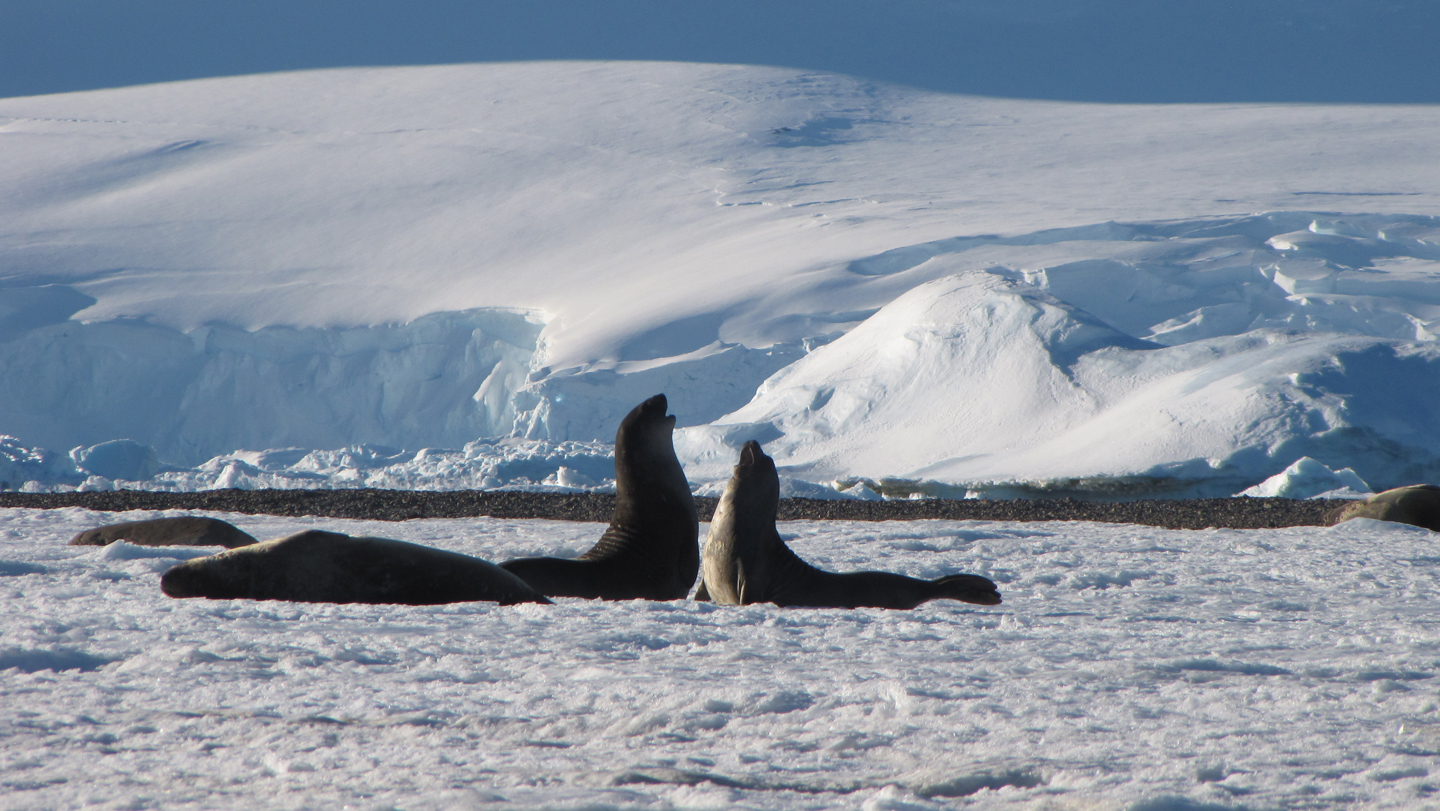
Under a best-case scenario of 1.8 degrees C of warming by 2100, that ocean food web shrinks as winter sea ice shrinks and ocean temperatures rise. Wildlife populations begin to shift: Species less dependent on krill and sea ice, such as fur seals, elephant seals and gentoo penguins (Pygoscelis papua), become more abundant.
Medium-high greenhouse gas emissions that could warm the planet by about 3.6 degrees C by 2100 would dramatically shrink sea ice concentration and more warm Circumpolar Deep Water would flow up to eat away at the peninsula’s ice shelves. Extreme events, including ocean heat waves and atmospheric rivers, would become both more severe and more frequent.
The worst-case scenario, with very high greenhouse gas emissions, would warm the planet by about 4.4 degrees C relative to pre-industrial times by 2100. That dramatically increases the impacts seen in the medium-high scenario, Davies says. Sea ice coverage could shrink by 20 percent, devastating krill-reliant species such as whales and penguins and warming ocean waters globally. The Larsen C ice shelf, which lost a Delaware-sized chunk of ice in 2017, would probably collapse fully by 2100. By 2300, the George VI ice shelf might collapse; it’s currently helping to hold back inland ice from draining to the sea. That could raise sea levels by as much as 116 millimeters.
What makes this most worrisome is that many of these changes would be irreversible, at least on human timescales. “Once you start to retreat glaciers, you trigger marine ice sheet instability, and that process is essentially irreversible. It’s very difficult to regrow those glaciers,” Davies says. Sea ice, too, is very difficult to recover once lost; darker open ocean waters absorb more heat from the sun, making it hard to get it cold enough to reform the sea ice, she says.
“All of this illustrates what decision makers worldwide should know: Every decision we make to reduce carbon emissions today makes the challenges of the future more manageable,” says Peter Neff, a glaciologist at the University of Minnesota in St. Paul, who was not an author on the new study.
“The Antarctic Peninsula has long been considered the canary in the coal mine for Antarctic Ice Sheet loss … where we’ve seen smaller versions of the ice shelf collapse that scientists fear for West Antarctica,“ Neff says. West Antarctica, including the rapidly melting and intensively studied Thwaites Glacier, tends to take up all the conversation on Antarctic change, Neff adds. That includes proposed geoengineering solutions to slow that melting. “None of those proposed ‘solutions‘ would do anything to save the Antarctic Peninsula,” he says.
Read the full article here