





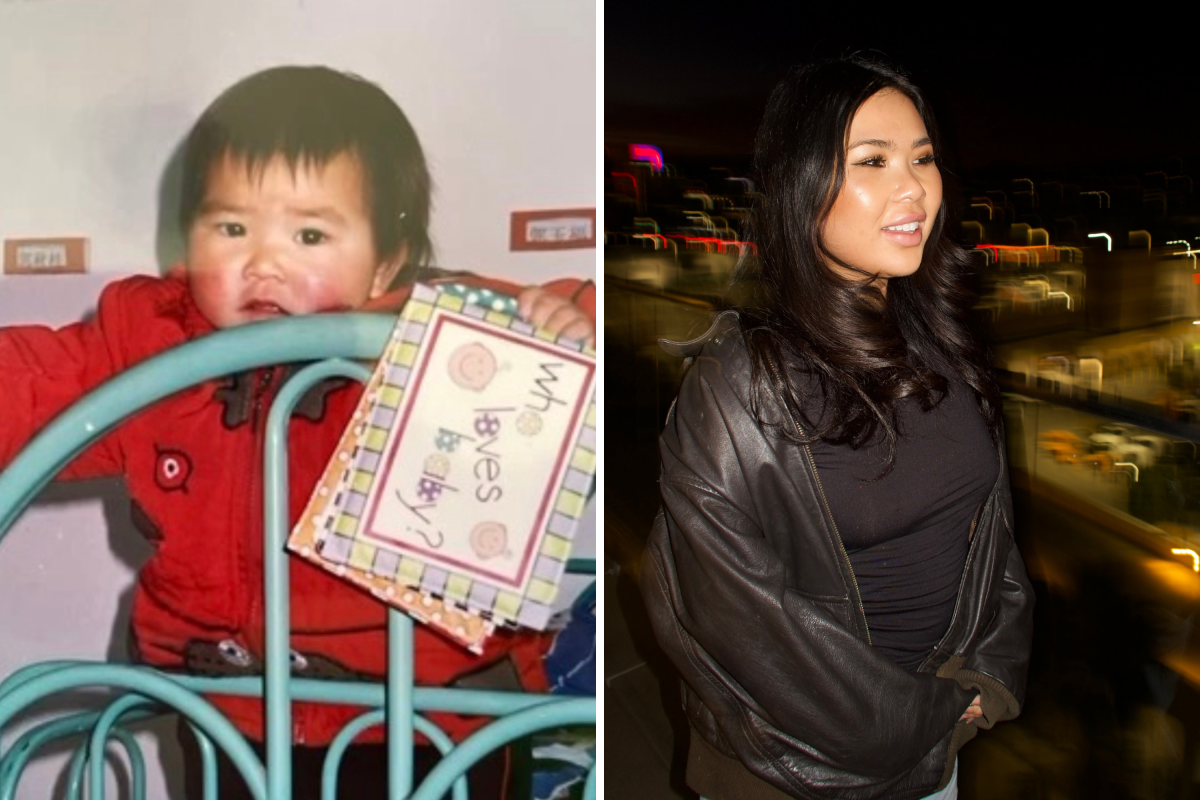
A woman adopted from China after being abandoned as a baby is making waves online by sharing her story—and one childhood video has broken hearts across the internet.
Emma Ming Fuller is 24 years old, and grew up in California after being adopted from China, where she was born in Hubei Province on October 10, 2001.
“I only know this because of the note that was left in my basket almost three months after I was born,” Fuller told Newsweek. “That small piece of paper is the only record of my beginning.”
In 1979, the Chinese government issued a one-child policy to curb the country’s population, which had ballooned from 542 million to 975 million in just 30 years. In the mid-1980s, officials modified the rules to allow a second child in families whose first child was a girl or disabled.
Now, while the policy was ended in 2016, China is struggling with one of the lowest birth and fertility rates on the planet.
Fuller was discovered in a basket in front of the MingShan government buildings early on the morning of December 29, 2001, where she was found by a passerby and taken to the police station, before being transferred to an orphanage, where she lived until she was two years old.
Until, one day, her parents came from Northern California to welcome her into their family.
“They had been anticipating having a child even before I was born, long before they knew my name or my face,” Fuller said. “Their love became the foundation of everything that followed.”
Fuller grew up knowing her adoption story, and her parents “did everything they could to connect me to my heritage,” including Mandarin lessons and celebrating Chinese New Year.
“The orphanage gave me a small baby book filled with photos of me as an infant. I had seen it my whole life, so I knew exactly what my beginning looked like,” she said.
“Still, it never really felt like mine. As a child, I never fully processed that it had happened to me. My adoption felt distant, almost abstract, more like a story I would tell people than a lived experience.”
As a child, Fuller “only wanted to fit in,” and “never felt like I truly belonged in those spaces.”
“I had a very happy childhood,” she recalled. “I grew up as an only child in an all-white community, rarely seeing anyone who looked like me. I was not friends with another Asian girl until early high school, and she, too, was adopted from China.”
To help their daughter feel connected to her heritage, Fuller’s parents brought her on a trip to China with other adoptees when she was 12 years old, visiting the area she was born—and Fuller returned to the spot where she was found as a three-month-old infant.
At 12, it was difficult to process this, Fuller explained. Rather than feeling “heavy,” the experience was “exciting and unfamiliar,” and “I was not yet thinking deeply about identity or loss.”
And when she found a video she took on that trip as a pre-teen, it brought up a range of emotions, including “sadness” for a girl who had “learned to speak plainly about being left without understanding the weight of those words.”
In a video shared to Fuller’s TikTok account, @emmafulleer on January 12, 12-year-old Fuller excitedly showed the front of the government building and shared casually: “This is my finding area, this is where I was found.”
“This is where my mom left me, right here. And the director of the orphanage is pretty sure that my parents live in this town somewhere,” she said, before panning to apartment blocks and grocery stores nearby.
In the video, young Fuller sounds relaxed about revisiting the place she was found, but she told Newsweek that deep-rooted feelings about being abandoned and adopted showed up in different ways throughout her childhood, including “intense emotional outbursts,” which felt “overwhelming and impossible to control.”
“Those emotions often surfaced when my mom left for her annual business trips, leaving before dawn so she could make her flights. I also struggled with food from a very young age,” she said. “I lived with a constant scarcity mindset, an underlying fear that there would not be enough. As I grew older and became more aware of my body, that struggle shifted into the opposite extreme. I battled bulimia for five years.”
Now, as an adult, Fuller is delving into these feelings and her history, and sharing parts of her life to TikTok, which has “connected me with other Chinese adoptees in ways I never expected.”
“Growing up, I rarely felt understood in this part of my identity. Now, through telling my story, I have found language for emotions I once carried silently,” she explained.
She has also heard from others with similar stories that sharing her experience online has helped them to “feel seen,” and she is now working on a book about what it was like growing up as a Chinese adoptee.
The reaction to her childhood video was enormous, being viewed more than 1.5 million times, with commenters asking questions, sharing their own stories, and praising Fuller’s resilience.
“Your little voice. I am so grateful you were found safe and got a chance to live a life,” one wrote, as another said it was “heartbreaking to refer to the person who left you as ‘mom.'”
“For such a young voice you sound so strong,” one commenter wrote. “And for you to not only go back but to be strong enough to say it like it was just a way of life makes you so powerful.”
And another shared their wish: “I hope the orphanage treated you well and you are doing thriving now.”
Fuller told Newsweek that this is the case: “I went on to earn two college degrees, one in finance and one in math, graduated top 5 percent in my class, and became the first female two-term student body president in my school’s history.
“I often joke that I fit the overachiever stereotype of adoption, but the truth is that much of who I am comes from how I was raised.”
She praised her parents for going “above and beyond to raise me with care and intention,” saying they “never treated me as anything other than their daughter. I truly believe that their love shaped the person I am today.”
Fuller is still interested in finding her biological parents, “simply to understand the missing pieces of my story,” though has so far not found any relatives using online services such as 23andMe and Ancestry.
“As I continue to grow, my feelings may change,” she said. “For now, I am content with my life, my parents, and the people who love me.”
Read the full article here