





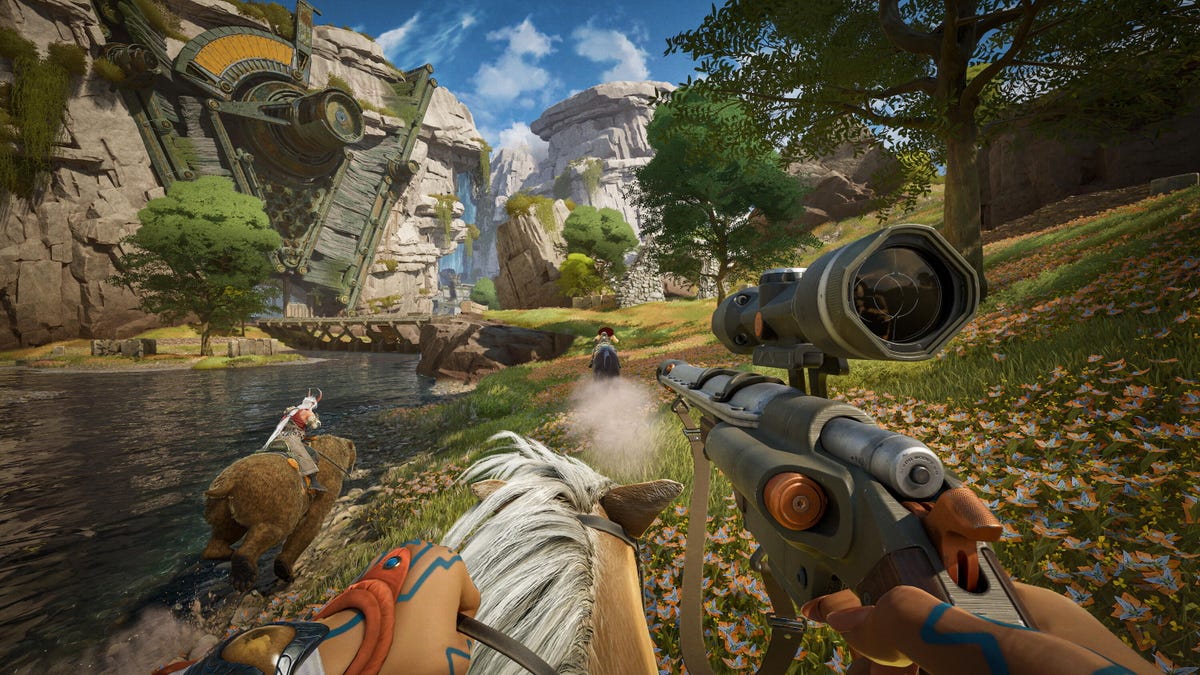
I was hurtling across a fantasy landscape on horseback with my two companions, racing toward the enemy base with the opposing team hot on our heels, a magic sword on my back that would win us the match, and all I could think was, Hell yes, this rules. I spent the entire day gleefully queuing back into more sessions to recapture that moment.
At an event in Los Angeles, I got to play Highguard days ahead of its launch. While I walked into the preview without a clue about what the game was, 8 hours later, I was more hyped for this shooter than any I’d played since Apex Legends (2019). That’s fitting, as many of the developers at Highguard are veterans of Apex studio Respawn who left to form a new company, Wildlight Entertainment, and make something completely new.
Fans may know Highguard from its reveal at The Game Awards in an admittedly confusing trailer. In several conversations during the preview, Wildlight developers acknowledged that the trailer didn’t properly represent their game, but they’re confident that players will change their tune once they get their hands on the game, which is available now and free to play on PS5, Xbox Series X and PC. It has full cross-play and cross-progression, too.
I’d be shocked if those developers aren’t proven right. Wildlight faces a nigh-impossible task in explaining their game in a trailer. Broadly, Highguard is a multiplayer shooter that teeters on the edge of chaos but blends elements of different games into a carefully refined dish of palate-pleasing novelty. With elements of Apex Legends, Valorant, Rainbow Six: Siege and League of Legends, Highguard is an amalgam with few rivals in its lane.
As a casual shooter fan with hundreds of hours each in Destiny 2 and Apex Legends, I found Highguard’s squad-based gameplay to be right up my alley. During the eight matches I played in my preview, I picked up the game pretty quickly and finished the day wanting to queue up for more.
Wildlight plans to upload dozens of videos explaining each of the game’s components, from its Warden hero classes (eight at launch) to weapons to maps to bases. But it’s not nearly as complicated as it sounds on paper — all thanks to lots of design iteration as the studio spent the last four years making their inspired Frankenstein of a multiplayer game.
Each Warden has their own set of abilities. Pictured is Kai, who can make ice walls, repair broken walls by freezing them and transform into a frost giant.
What makes Highguard the world’s first Raid Shooter
For lack of a proper multiplayer descriptor, Wildlight invented its own: Raid Shooter. This combines first-person shooting, the lane skirmishing of MOBAs and the base raiding of games like Rainbow Six: Siege.
At launch, there’s only a single mode in the game, Raid, that pits a pair of three-person teams against each other. Matches in this mode last between 15 and 25 minutes (or shorter if either team steamrolls). Each match loops a set of four phases, each time-limited to keep matches flowing. Trust me, those loops will feel like second nature after a few matches.
Before each match begins, players pick their Warden, each a distinct hero with different passive, tactical and ultimate abilities (much like Apex Legends). Squads then vote on their pick from four different bases (of six at launch, with more coming). This is what they’ll defend from enemy raiding, each with a different layout better suiting some Wardens and play styles over others. Think of it like picking between Cinderella’s Castle, Helm’s Deep or Castle Dracula, which slot into the game’s maps. (Players only get to choose their base, not the larger map, for each match.)
Once the match starts, the first phase begins, giving players a minute to fortify their base’s walls, which can be destroyed with gunfire or tools. When the base’s shield opens, the gear phase begins. Squads have 2 minutes to ride out into the broader map to pick up more powerful versions of the guns they choose at launch, as well as find armor and mine minerals to spend at shops.
While squads are free to fight each other at any time in that second phase, the third phase shoves teams together in a true brawl. After a visible countdown, a special sword drops down for both squads to fight over. The Shieldbreaker, as the blade is called, must be brought to the enemy team’s base and slammed into the edge of its shield to crack it open.
Once players plant the Shieldbreaker sword in an enemy base, the Raid phase begins, where a massive siege tower portals in. In addition to breaking open the enemy base’s shield, it has a vendor at the top for attackers to replenish and rearm.
Once the Shieldbreaker is deployed, the fourth phase — the Raid — begins. A siege tower emerges from a portal where the Shieldbreaker was stabbed into the enemy base and slams into the shield until it splits apart. Then the attacking team invades the base of the defending team, seeking to burn it down.
Each base has 100 hit points. By deploying the Shieldbreaker, attacking players deal 30 damage to the enemy base, but to finish it off, they have two options: deploy bombs at two generators on the periphery of the base to deal 35 base damage apiece, or go for broke and plant explosives at the Anchor Stone, which takes longer to destroy, but will instantly win the game if detonated. Defenders can defuse bombs, forcing attackers to plant them again, but the Raid phase lasts only a few minutes; if the defense is successful and nothing is destroyed, the attackers’ base is dealt 30 damage as punishment.
After that, the phases restart: build your base back up, find more gear, fight over the Shieldbreaker and start a Raid. To amp up the pressure, each new loop increases the rarity of the weapons you’ll find, increasing their lethality via faster reloading and firing speeds. Gold-colored legendary guns are significantly deadlier — one we coveted during the preview, a revolver, lets you fan the hammer to fire blindingly quickly.
Because there are no other game modes at launch, it lives or dies on how much that gameplay appeals to players. On paper, it’s a sampler platter of elements from other games. In practice, each phase flows so smoothly into the next that you’d never guess it had ever resembled anything else.
But from the Wildlight developers’ perspective, this is the terminus of a long, long journey figuring out how all these disparate pieces work together.
The Big Rig is a light machine gun that airdrops onto the battlefield on rare occasions, giving players an edge over the other team.
Years of chipping away to get to the Raid Shooter’s final form
I joined a group interview among several other journalists at the preview to chat with Jason Torfin, vice president of product and publishing at Wildlight, as well as a writer on the game and Mohammad Alavi, the game’s lead designer.
Both are veterans of Respawn and described a lot of lessons learned from surprise launching Apex Legends in 2019 on the same day it was announced. As fate would have it, Highguard is launching nearly seven years to the day after that release. Aside from fixing bugs and issues that inevitably crop up, they explained how they’ve honed their production pipeline to reliably get out new content. During the preview, the team shared a roadmap for new “episode” seasons, coming every two months, each featuring a new Warden and map.
Live-service games like Highguard retain players by releasing additional content over time. By showing a clear plan for the months ahead, Wildlight hopes to build trust with the game’s player base that they’ll keep supporting and adding to Highguard, retaining their interest among stiff competition from established multiplayer titles like Arc Raiders, Battlefield 6, Helldivers 2 and Overwatch.
Wildlight has other guidelines to build player trust. In-game items are all cosmetic and won’t offer gameplay advantages. While monetization is necessary for a free-to-play game to stay afloat, Highguard’s store at launch will have items from the $9 battle pass-like War Chest bundles of cosmetics to $20 exotic mounts. War Chests won’t expire and can be bought any time after they’re released. Players who don’t want to spend money can still earn cosmetics through weekly and seasonal challenges.
On top of that, every new Warden, weapon, base and map is free for all players. As Torfin explained, the team wants to make sure the game respects players’ time and money, which he says not all live service games competing for attention do.
When the Raid phase starts, attacking players have to infiltrate the defending team’s base, using Warden abilities and tools to crack open walls to get to generators and the Anchor Stone.
Raid won’t necessarily be Highguard’s only mode. The roadmap we were shown had limited-time modes, like the just-for-fun ones that popped up in Apex Legends, Torfin said. These could lead to permanent options. Over the course of developing Highguard, there were a lot of gameplay ideas that didn’t work, but could be revisited and make it into a limited-time mode. Sometimes these are “sugar junk food that you just need for a week,” Torfin said in response to another journalist’s question. Other times, they’re engaging enough to become real additions.
Highguard is a multiplayer-only game, but there is a background story that’s seeded through item descriptions and product bundles that players can piece together. In response to another journalist’s question, Torfin described that “the world of Highguard is itself a character,” a continent that reappeared like Atlantis after 300 years of absence. Two weeks after the game launches, its second episode of content will drop, including the first inklings of story that will continue to be added alongside new maps and wardens. Eventually, Wildlight wants to branch out to other media to continue telling the story in comics, novels, animated shorts and so on.
Wildight’s roadmap for releasing new content through 2026, which will be free for all players.
Getting to the Raid mode we see today, Highguard’s first and so far only way to play, was a long process. At one point, the game pitted four three-player teams against each other, but it wasn’t fun to have your base raided while out attacking another squad’s empty home turf. And cutting the team count in half to just dueling squads didn’t solve the issue. To draw players toward each other, developers innovated a “lock and key” mechanic to focus on one base at a time to begin raiding — and why not make it a rad magic sword?
A lot of refinement came from the Wildlight developers’ competitive urge. Originally, the bases didn’t have a health bar, and every wall needed to be pulled down, and Torfin recalled an internal match that lasted 4 hours until the servers broke. But every decision led to making a game with “a lot of competitive integrity,” he said. That means making the game fair and balanced, something that’s easy to get into but hard to master, Alavi noted. But for sweatier players, there will be a Ranked version of Raid mode coming two weeks after launch, which will let players test their mettle as they try climbing competitive ranks.
But what about the opposite audience — will the game’s complexity be too much for casual players? I asked the developers whether I, who scraped together wins over my journalist counterparts but got demolished by a team of Wildlight’s best internal players, would enjoy the game.
“I suck at our game, so I’m right there with you,” Alavi said, laughing. And yet, “we, the devs, play it constantly, and we come from all walks of how good we are at shooters.”
Ranked mode will siphon off some sweaty players, Alavi said, giving casuals a bit of breathing room. And there are plenty of more complicated elements from games that influenced Highguard that have been left out, like League of Legends’ complex item recipes. Tactically, Highguard also includes several comeback mechanics designed to level the playing field. Because each phase resets part of the match, teams have repeated opportunities to let players gear back up and get another go at winning a Shieldbreaker fight.
To illustrate his point, Alavi recalled a match where his team was losing 100 to 10, in which letting the enemy team even get the Shieldbreaker would result in a loss. He bought an item to plant bombs faster, picked up a legendary gun from a shop, won their phases to start a raid and planted their bomb on the Anchor Stone before the enemy team knew what happened. Boom! Alavi’s joy was infectious, a had-to-be-there moment that I recognized from my own mad horseback dash to win my game — something that Highguard seems refined to produce.
“Having these comeback mechanics is super important. Is it gonna happen every time? No,” Alavi said. “But you know, even just getting that sugar high that one time keeps me coming back for more.”
Read the full article here