





American bunker buster bombs were dropped on the coast by the Strait of Hormuz, but even the 5,000-pound munitions have not cracked the impasse over the waterway Iran is holding hostage as the world grapples with how to unblock the passage through which one-fifth of the world’s energy transits.
U.S. Central Command touted Tuesday’s strikes as hitting hardened missile sites along Iran’s coastline from where anti-ship cruise missiles risk shipping in the strait.
Since the war in Iran started on February 28, at least 20 commercial vessels have been attacked off the Iranian coast, not all of them in the vicinity of the Hormuz Strait, according to the BBC.
Iran insists the strait is only closed to the U.S. and Israel and countries attacking the Islamic Republic, but the 138 ships that used to pass through the waterway per day have dwindled to half a dozen, with drones, missiles, fast attack boats and mines posing ongoing dangers which have spooked maritime insurers.
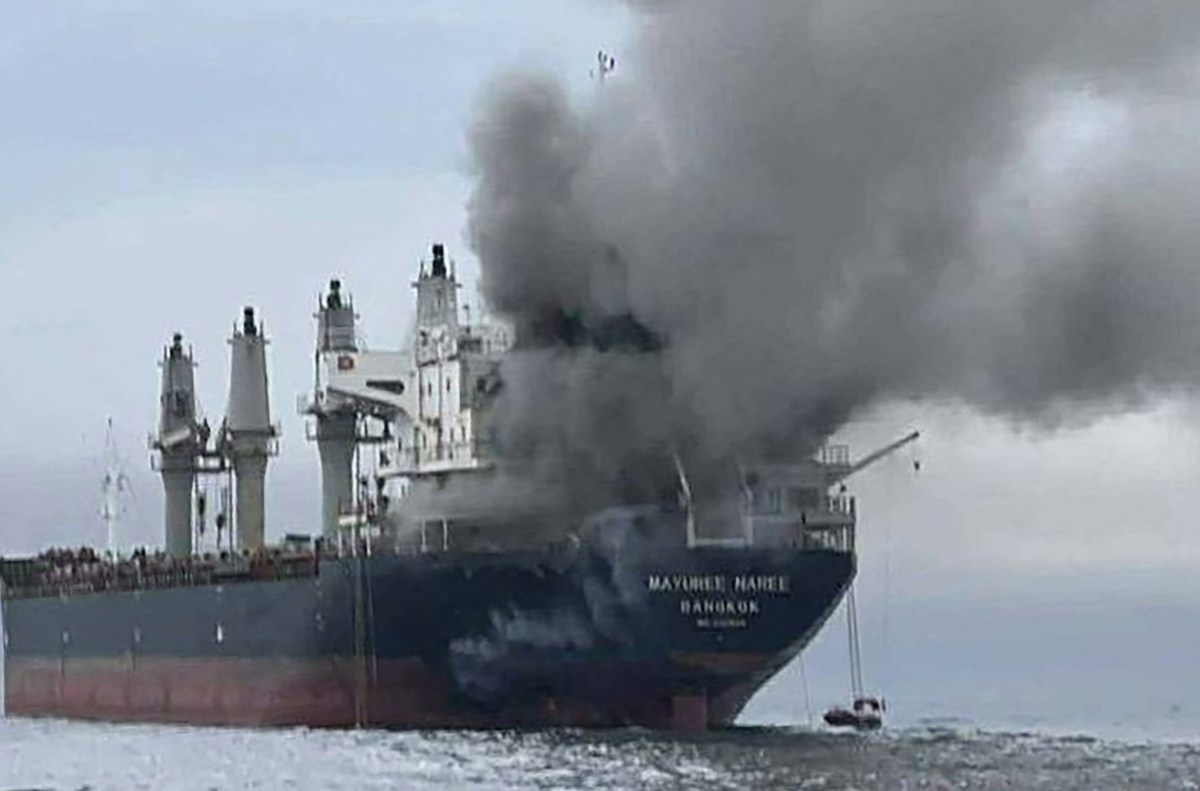
The Thai-flagged bulk carrier Mayuree Naree was struck on March 11 by projectiles in the strait, as was the U.S.-owned crude oil tanker Safesea Vishnu, which was sailing under the Marshall Islands flag.
Capturing Kharg Island
U.S. President Donald Trump is unlikely to end the war on his terms unless he breaks Iran’s chokehold on the strait. His administration is considering occupying or imposing a blockade on Iran’s Kharg Island to pressure Tehran, according to Axios, citing four unnamed sources with knowledge of the issue. However, any move to seize the island 15 miles offshore, where 90 percent of Iran’s crude oil exports are processed, could put U.S. troops more directly in the line of fire.
This could only happen after the U.S. military further degrades Iran’s military capacity around the strait, but it would also require more troops, which the White House and the Pentagon are considering, according to the outlet.
Retired Rear Admiral Mark Montgomery told Axios that such a mission could expose U.S. troops to high risk and that seizing Kharg Island would see Iran “turn off the spigot on the other end. It’s not like we control their oil production.”
Montgomery told the outlet it was more likely that, following two more weeks of attacks to degrade Iran’s capabilities, the U.S. would send destroyers and aircraft to escort tankers.
Combined Maritime Forces
Trump has said that NATO faces a “very bad future” if allies don’t help, but European countries are balancing a reluctance to join a war they didn’t start with fears the U.S. might abandon the trans-Atlantic alliance if they don’t heed his call.
French President Emmanuel Macron has rejected Trump’s claims that his country would help unblock the strait, and Japan, Germany and Luxembourg have also expressed a similar sentiment.
A multinational naval force has been mooted, such as the Combined Maritime Forces (CMF), a long-established Bahrain-based grouping, to operate in the Persian Gulf, the Strait of Hormuz, and the approaches from the Indian Ocean. The CMF has been used repeatedly since 2001, mainly in the Middle East, the Indian Ocean, and the Red Sea.
It could be repurposed to protect vessels passing through the Strait, which would be easier than setting up a grouping from scratch, with the possibility that some of its 47 member nations can opt out, Kevin Rowlands, a journal editor at the Royal United Services Institute (RUSI), a London think tank, told Newsweek.
“The downside of using CMF could be that it has links with and dependencies on the U.S. Navy in the region and so, if not carefully managed, it could be seen as an extension of them and not a truly independent body,” Rowlands said.
Another option could be a European mission akin to the EU’s Aspides operation that has helped to patrol and defend shipping against the threat from Iran’s proxies, the Houthis, in the southern Red Sea.
But a multinational mission to open and keep open the Strait of Hormuz would probably have to be commanded by anyone but an American, most likely from the Gulf states, Rowlands said.
Contributing forces could come from the region or Europe and the Indo-Pacific, and would likely resemble a maritime peacekeeping force rather than an offensive one. However, Rowlands said it would need to be able to defend itself and the vessels it is escorting—proactively if necessary.
There would also need to be logistic support regionally, including food, fuel and repair facilities, such as via Dubai, Bahrain in the Gulf, or Duqm in Oman.
“Whether or not those countries would want to be seen providing that support is a political call, but we should remember that it is their economies which depend almost entirely on the flow of oil,” added Rowlands.

Easing Insurers’ Fears
Operation Earnest Will was launched in 1987 and 1988 by the U.S. to protect Kuwaiti-owned tankers from Iranian attack. Four decades on, Iran’s drone and missile capabilities are greater, the U.S. Navy’s fleet is half the size, and the 300 vessels currently stranded would be time-consuming and costly to clear.
Instead of escorting individual vessels through the entire 500-mile Gulf transit, Gregg Roman, executive director of the Middle East Forum (MEF), a U.S. think tank, said there should be a defended corridor through the 21-mile-wide strait itself.
“You have to have a screen. You have to have littoral class ships that the U.S. has stationed in Bahrain,” he said, “a lot of people talk about them just for their mine laying operations, they’re also quite significant in taking out speedy attack craft that the IRGC Navy has left.”
Vessels would come from the Gulf of Oman, transit the defended corridor in organized convoys and air cover, then disperse inside the Gulf. This would reduce the escort distance from 500 miles to 40 miles.
Roman does not see Iran’s Hormuz closure as a conventional naval blockade but rather an insurance-driven shutdown of commercial shipping in which fear, not mines, is the main weapon for Iran.
He told Newsweek that Iran does not need to maintain a blockade but only needs to carry out occasional strikes to prove that transiting through it is too risky for insurance underwriters.
“There’s alternative means of providing protection and insurance schemes by saying, ‘the United States will assume the liability associated with your underwriting of coverage for a tanker,’” Roman said. “So the US could take the role of secondary insurance provider so long as the primary insurance provider would feel that they have a fallback option.”
Alternative Energy Routes
Alternative energy corridors are also key, Roman said. Routes via Saudi Arabia’s 750-mile East-West pipeline from the Abqaiq oil field to Yanbu at the Red Sea, as well as the United Arab Emirates’s Abu Dhabi Crude Oil Pipeline (ADCOP) from Habshan to Fujairah on the Gulf of Oman, can also partially ease the pressure on oil supplies.
Roman said another option for the U.S. would be to co-opt the Ahvazi Arabs who live in Khuzestan Province, marginalized by Tehran. “You have to make the IRGC turn their guns inward,” he said.
But another lever is to emphasize that Iran’s closure hurts Iran at least as much as it hurts the coalition, because its own oil exports transit Hormuz.
“You have to have a multi-layered asymmetrical effort,” said Roman, “a convoy effort, an alternative means of transporting energy effort—everything has to be done in concert.”
In a polarized era, the center is dismissed as bland. At Newsweek, ours is different: The Courageous Center—it’s not “both sides,” it’s sharp, challenging and alive with ideas. We follow facts, not factions. If that sounds like the kind of journalism you want to see thrive, we need you.
When you become a Newsweek Member, you support a mission to keep the center strong and vibrant. Members enjoy: Ad-free browsing, exclusive content and editor conversations. Help keep the center courageous. Join today.
Read the full article here