





When I was growing up, my family hosted a young girl from Belarus every summer as part of a respite program designed to remove young children from areas affected by the Chernobyl disaster. It eventually became a tradition to host the same girl each year for several years. She became family. Still is.
There’s a huge learning curve when it comes to finding a balance between Belarusian and American culture, but none as significant as the language barrier. My parents and I did our best with broken Belarusian. She did her best with broken English. When we had a breakdown in understanding, we relied on pointing and hand-waving, and when needed, running to the gargantuan PC in the corner of the bonus room to search for translations of words and phrases. It wasn’t perfect, but it was realistic and worked.
And really, there is a beauty to that exchange. There’s something special about navigating the awkwardness and discomfort of language barriers and emerging with genuine understanding and connection. Seriously, it’s so special when you see someone’s eyes light up when they finally get what you mean and the excited “yeah, yeah, yeahs” that inevitably follow.
But even I can admit there’s a real time and place for frictionless communication.
That brings me to one of the coolest devices I’ve tried out since attending CES 2026. The Vasco Translator Q1 device even made me take back some of the negative things I’ve said about translators in the past.
Even though the CES show floor is rarely quiet, standing there amid the noise, I found myself having a surprisingly natural conversation with someone I shouldn’t have been able to speak with at all.
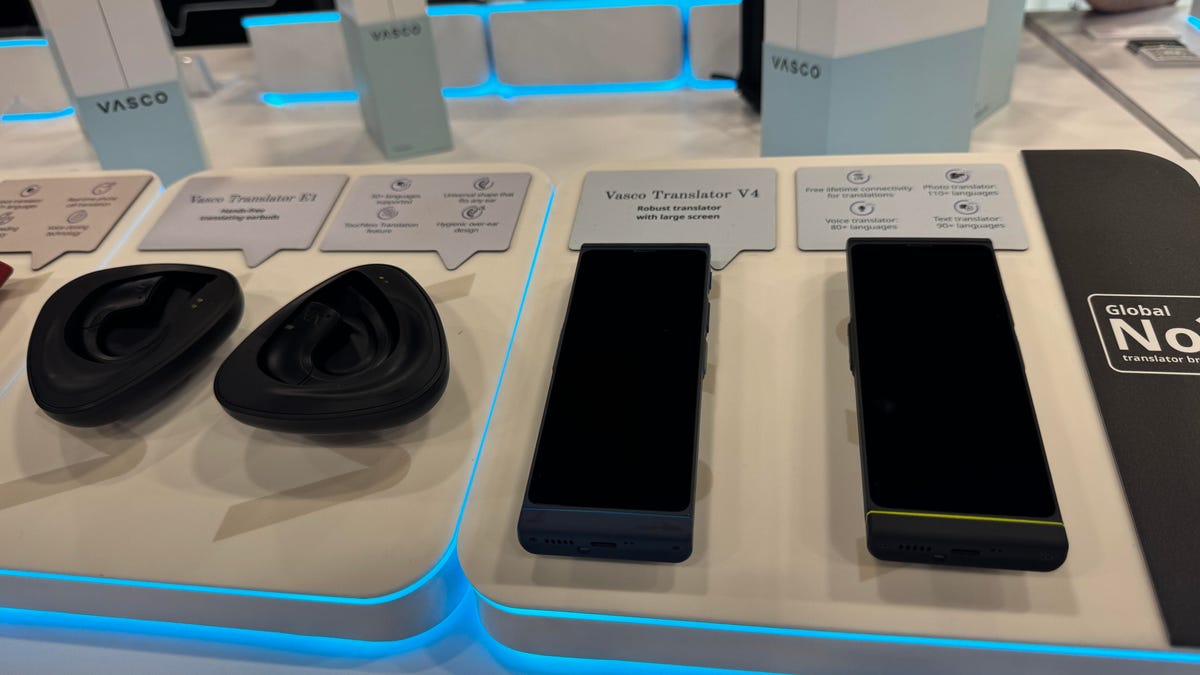
The Vasco Translator E1 earbuds translate conversations in 51 languages.
Her name was Hanna. She’s from Krakow, Poland, and during a demo of the Vasco Q1 translator, we spoke for several minutes — me in English, her in Polish. Neither of us switched languages. Neither of us slowed down unnaturally or repeated ourselves. The translator simply handled the gap between us.
In this particular demo, we used the Vasco earbuds. I spoke in English, but Hanna heard Polish. When she responded in Polish, I heard English. Back and forth we went, uninterrupted and after a few minutes, I stopped thinking about the technology altogether. That’s usually the moment you realize a translation product is doing something right.
What stood out even more was that this wasn’t even the most advanced setup Vasco offers. The Q1 translator itself does more and, in some ways, feels even less invasive than wearing earbuds.
Read more: Official Best of CES 2026 Awards: 22 Winners and Best Overall, Awarded by CNET Group
Trying out the Vasco Q1 translator
The Vasco Translator Q1 is a purpose-built, stand-alone language device — not just another app on your phone. It’s engineered to make real-time, two-way conversations effortless, whether you’re traveling, doing business or connecting with someone who speaks a different language.
Rather than flipping a phone back and forth or tapping buttons, the Q1 is designed to let dialogue flow naturally. With features like Automatic Mode and Touchless Mode, the device can instantly detect speech and translate over 50 languages hands-free.
In tests with earbuds or a one-on-one setup, each person hears the conversation in their own language almost simultaneously. That near-continuous exchange feels far less clunky than traditional turn-based translators.
Under the hood, the Q1 uses a three-step translation pipeline similar to high-end voice translators:
- Speech → text: Automatic speech recognition captures spoken language quickly and accurately.
- Text → translated text: Neural machine translation interprets meaning, not just words, to avoid stilted, literal output.
- Text → speech: Natural-sounding text-to-speech delivers the result back in the chosen language.
The Q1 also packs advanced extras, such as voice-cloning technology (which allows translations to sound like your own voice), real-time phone call translation, group translation support and unlimited global internet connectivity courtesy of a built-in SIM.
Why this device stands out
The Vasco Translator Q1 has a touchscreen, so you can make the translated text larger or smaller.
Language translators aren’t novel inventions. You could probably scroll Amazon for hours looking at available translators or just rely on Google features already baked into your phone. What makes this device feel different from tools like Google Translate or Google Lens is that the Q1 is designed around conversation first, translation second. Instead of mediating the exchange through a shared screen, it sits quietly between two people and lets each speak naturally, in real time, without turning the interaction into a tech task.
The most impressive thing about the Vasco Q1 wasn’t any single feature; it was how quickly it disappeared while conversing. Talking with Hanna didn’t feel like a demo for long. It just felt like a conversation that happened to cross a language barrier.
At CES, where every product is fighting for attention, that kind of invisibility might be the strongest feature of all.
Read the full article here