


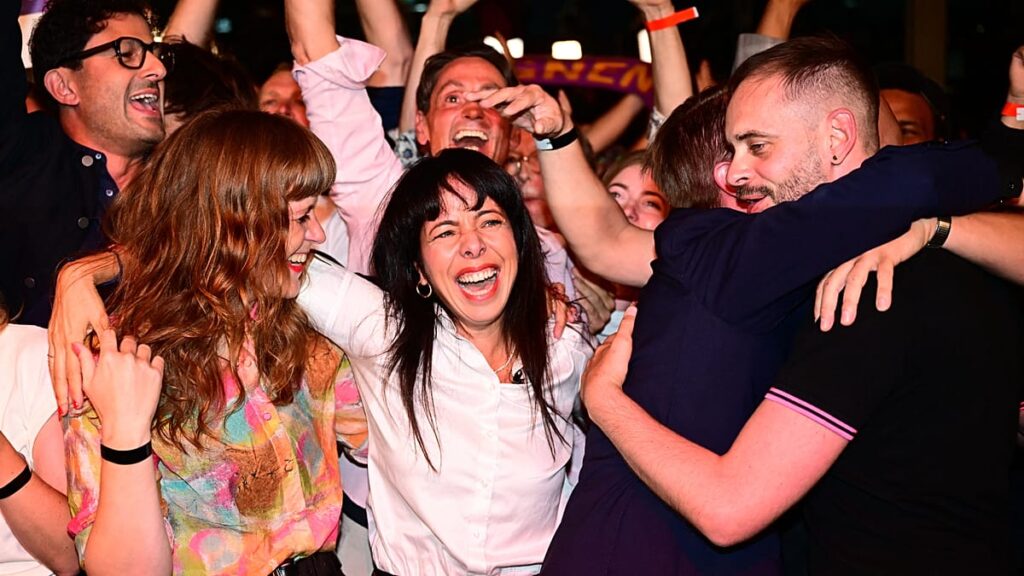
Germany’s final state elections of the year have redrawn the political map, with the Left emerging as the strongest force in Berlin and the AfD taking the lead in Mecklenburg-Western Pomerania. The CDU suffered heavy losses in both states, while the SPD made significant gains under state premier Manuela Schwesig.
In Berlin, the latest Infratest dimap projection puts the Left at 25.7% of the vote. The CDU comes second with 18.8%, followed by the AfD at 16.3% and the Greens at 14.3%. The SPD has fallen further behind to 12.1%, while the BSW narrowly clears the threshold for parliament.
The result means the capital’s previous CDU-SPD coalition no longer has a majority. In Mecklenburg-Western Pomerania, the AfD leads with 38.2%, closely followed by the SPD at 35.5. The CDU records its worst result in the state’s history with just 4.9%, while the Left, Greens and BSW all remain around or just above the threshold for entering parliament.
Merz: Mecklenburg-Western Pomerania result is a ‘disaster’
Chancellor Friedrich Merz said there was no way to “sugar-coat” the CDU’s result in Mecklenburg-Western Pomerania. “It is a disaster,” the CDU leader said in a statement at the party’s headquarters in Berlin. He said his party had been “squeezed out” as the contest narrowed to a battle between the SPD and AfD.
Should the CDU stay below 5% in the final vote count, it would mean that the party would fail for the first time to win seats in a state legislature anywhere in Germany.
In Berlin, by contrast, CDU lead candidate Stefan Evers had secured a “respectable result” despite a difficult starting position, Merz said.
Merz then turned to the wider situation in Germany. He said the country had become too complicated and that its economy was facing a period of profound change. Public debate was becoming increasingly heated, while trust in institutions was declining, Merz said. He called for further reforms, arguing that the disruption they would bring – and the fact that they would not be universally popular – would have to be accepted.
He ended by warning of the “authoritarian poison” that he said was increasingly finding its way into society through the “fascination with authoritarianism”. As CDU leader and chancellor, he said he wanted to take responsibility. Germany, he said, must once again become a “country of new beginnings”.
AfD leads in Mecklenburg-Western Pomerania, as Schwesig could remain in office
Following the election result in Mecklenburg-Western Pomerania, AfD lead candidate Leif-Erik Holm claimed the right to form the next state government. He said the party would “naturally also talk to all the other parties” in an effort “to get things moving”. “It’s about the people of our state. We want to improve politics,” Holm told German public broadcaster ARD.
Asked about possible cooperation with other parties, Holm pointed out that the AfD in Mecklenburg-Western Pomerania is not being monitored by the Federal Office for the Protection of the Constitution. He said the party had a “conservative programme” covering education, the economy and security.
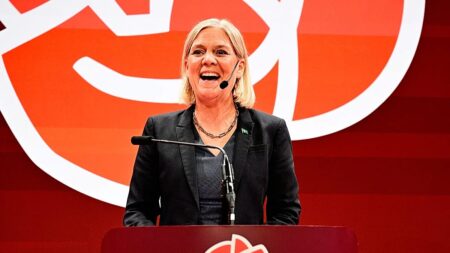
Manuela Schwesig, the SPD’s state premier in Mecklenburg-Western Pomerania, could therefore stay on despite the AfD coming out ahead. During her campaign, she put herself at the centre of the SPD’s campaign with the slogan “Woman against Blue”, a play on the AfD’s party colour.
Speaking to ZDF, Schwesig described it as the “toughest state election” her party had ever faced. In an interview, she said the SPD had stood up to the AfD “with substance, with people, with clarity and with a united effort”. Schwesig’s political record also includes her past support for Nord Stream 2.
In 2021, her state government set up the Foundation for Climate and Environmental Protection MV, which backed the construction of the pipeline. After Russia invaded Ukraine, Schwesig acknowledged that her position at the time had been a mistake. During a visit to Kyiv in 2024, she said that “Ukraine must win this war” and backed further arms deliveries.
Berlin’s ‘Mamdani effect’
Berlin’s Left party made social issues and affordable housing key themes of its election campaign, with lead candidate Elif Eralp also looking to New York. After left-wing Democrat Zohran Mamdani won the New York mayoral election, she told the German Press Agency (dpa): “If a left-wing candidate can win in New York, then there’s no reason it can’t happen in Berlin.”
The Left has now emerged as the strongest party in Berlin for the first time. If Eralp becomes governing mayor, she would be the first mayor of Berlin from a migrant background. Her parents fled Turkey for Germany in 1980, while Eralp was born in Munich.
The housing crisis was at the heart of Eralp’s campaign. She called for tighter regulation of rents, more social housing and further moves towards bringing large housing portfolios into public ownership.
The Left is the successor to the former East German ruling party, the SED (Socialist Unity Party of Germany). After the fall of the Berlin Wall, the SED initially rebranded itself as the PDS (Party of Democratic Socialism), retaining some of its assets and personnel. It later became known as the Left.
The election victory now leaves the party facing a difficult task in forming a government. The SPD and Greens have not ruled out working with the Left, but both have made clear that any cooperation would depend on how the party deals with antisemitism. SPD lead candidate Steffen Krach said before the election at an event organised by Berlin’s Jewish community: “If there are antisemitic incidents, then it’s over. Simple as that.”
The issue was brought into focus by an appearance by rapper Dahabflex at a Left campaign event in Berlin’s Neukölln borough. Chants including “Death to the IDF” and “Yalla Yalla Intifada” were heard at the event.
Eralp distanced herself from the remarks and called for an investigation and consequences. The Greens have also set out a clear condition. Lead candidate Werner Graf said his party would not sign a coalition agreement that did not take a clear stance against antisemitism.
Eralp, for her part, stressed that the overwhelming majority of the Left stood for protecting Jewish life. She said antisemitism was a problem across society and also existed within the Left. She said she wanted to protect Jewish, Palestinian and Muslim communities.
Read the full article here