





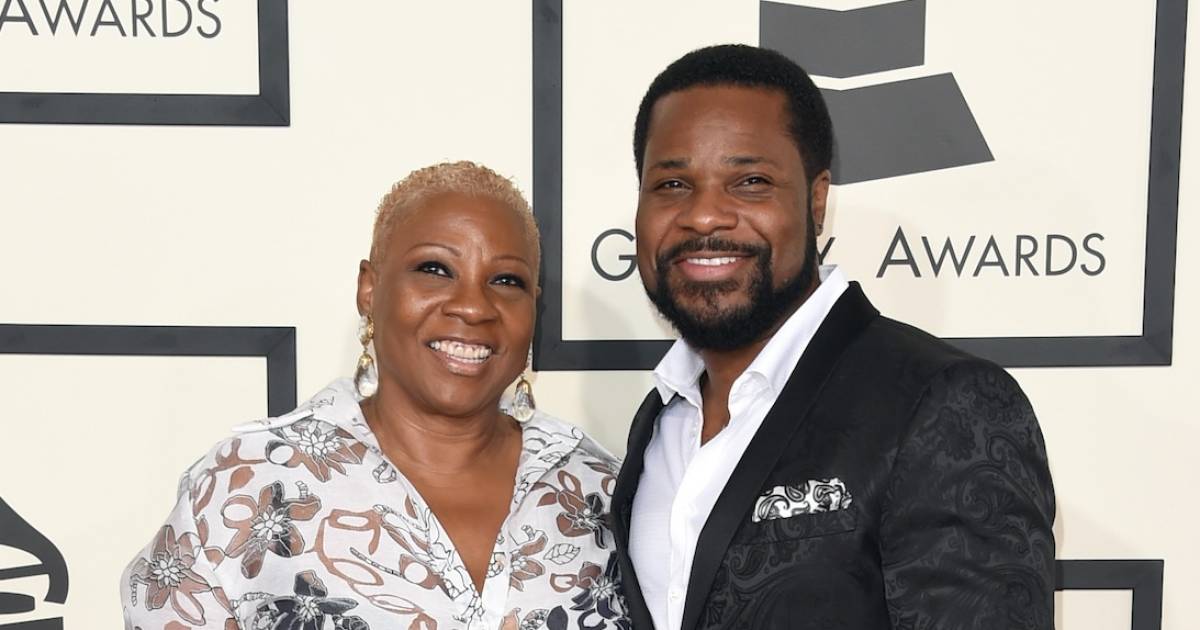
Holidays were a special time for Pamela Warner and her son, Malcolm-Jamal Warner, but not in a traditional sense. “I remember one Thanksgiving we had tacos,” she tells Us Weekly with a laugh. “I said, ‘Well, we’ve got turkey meat, we’ve got corn tortillas, lettuce and tomatoes and cheese.’ We had a ball.” She has a similar memory from an Easter they spent together when the actor was a child. “He must have been about six or seven. [We got] all dressed up and we went to church, and then we came home and ate tuna fish sandwiches. That was our Easter dinner, and we were just as happy.”
Pamela is holding memories of her late son close to her heart. On July 20, the beloved star of The Cosby Show drowned on a Costa Rican beach after getting caught in a riptide at the age of 54. He was traveling with his wife, Tenisha, and their 8-year-old daughter, who witnessed the tragedy but was not, despite early official reports, in the water. “I’m doing OK,” Pamela says. After spending more than four decades as Warner’s manager, she’s now focusing most of her energy on running the Malcolm- Jamal Warner Living Legacy foundation (Warner’s widow launched a separate endeavor, The Warner Family Foundation, in September). “We had conversations prior that I see now were really goodbye conversations. That has made it a little better for me,” Pamela says. “I can’t think of anything I wish I could have said to Malcolm.”
Speaking to Us Weekly, Pamela reflects on the despair of learning Malcolm had lost his life and how he would like to be remembered.
How are you coping?
I’ve been doing well. There’s nothing you can do about it, and anything other than acceptance is nonproductive. I’m at peace because there’s nothing I can do, and because he and I were in a very good space. I don’t have the shoulda, woulda, couldas. People have certain expectations because it’s a major loss, and the world knew of our closeness, so they’re expecting a tremendous [outpouring] of emotion. I’m not saying it won’t happen, but it hasn’t happened. There’s a lot of business to be taken care of, and that piece really helps [keep me] distracted.
Grief comes in different stages.
Exactly. I don’t know how I’ll be in six months, but this is where I am. I’m going to miss him. And, as the onion peels and the layers come up, I’m sure I will go down a rabbit hole or two. Maybe I’m still numb.
What do you recall from the day you found out he died?
Malcolm’s best friend came and told me the news. I said, “Is this about Malcolm?” and he said yes. And then I just went into outer space. I said, “Is he dead?” and he shook his head, and I completely lost it. I yelled so loud. I live on a cul-de-sac, and my neighbors came running out of the house. They could hear it. The level of grief is something unimaginable.
What was your last conversation with Malcolm?
He sent me a text and said that he was on his way [to Costa Rica] and he loved me. When he got to Costa Rica, he sent me a video with him and his daughter. [I was thinking] he’ll be home on such-and-such date, and he’s having fun. That was how we left it.
Have you learned what his final moments were like?
I haven’t spoken with authorities, but I did speak with the gentleman who was with Malcolm in the water. [Malcolm, Tenisha and their daughter were traveling with another family in the homeschool community. They were all in Costa Rica as part of a Spanish language immersion program. The other husband also got caught in the riptide with Malcolm, who Pamela says was “not an experienced swimmer,” but survived.] I met with him and his wife because this gentleman is suffering tremendously from survivor’s guilt.
How did that conversation go?
It was emotional. He needed to know I held nothing against him. He has a daughter, like Malcolm did. So he had to save himself. He was being pulled out to sea, and he had to fight. When we left our meeting, he felt relieved. It was healing for him.
Did it give you closure?
Yeah, because I saw how deeply this young man and his wife were affected. I did not want them to stay in that state because they have a child to raise as well. This was something that was beyond anyone’s control. I wanted him to feel more at peace.
How is Malcolm’s wife doing?
She’s dealing with her grief.
And who’s helping their daughter navigate this?
Her mother. She has her doctorate in psychology. So I feel she has the skills and is equipped to help her daughter.
What was Malcolm like as a dad?
Oh, he was fantastic. I was very impressed with the deepness of his care… and by his ability to be a kid and do kid stuff. He really enjoyed it. [Because of] what was happening with our politics at that time, he would say, “The way the world is now, I don’t want to bring a child into this.” But then magic happened. He chose projects that wouldn’t take him away for too long. [When he was away for work], there was a lot of FaceTime.
You and your son were extremely close. Tell Us about your bond.
He was my confidante. Depending on what I needed, he was so emotionally intelligent that whatever responses he had for me were spot on. Once a child marries, things will change a little bit, but we still had an emotional connection and the business connection because I was still his manager.
You mentioned some non-traditional holidays you celebrated together. Do you have any other favorite memories?
I have so many, and they’re coming back like crazy. He was such a good kid. I could talk to him. I didn’t have to institute corporal punishment. I [came to] understand that gets you nowhere. All it does is create a psychopath. By the time he was eight, I was able to have very thought-provoking conversations with him. That’s when he became my best friend.
How did you balance being his mom with being his manager?
My only focus was his mental, emotional and physical health. How he was feeling was more important to me than his fame. That didn’t mean anything to me. I wrote a book for parents entitled A Parent’s Guide to Managing Showbiz Kids.
Tell Us more about the Malcolm-Jamal Warner Living Legacy foundation.
My work is to use the foundation to help young people be all they can be and [be involved in] whatever part of the arts they choose for themselves. That’s my vision.
Fans were devastated by Malcolm’s passing. Were you surprised by how many people were affected?
I was [and] I wasn’t. It was huge. It makes me feel good that he had that impact on such a large number of people, beyond The Cosby Show.
Why do you think people felt so connected to him?
There was such an appeal [to] the way [The Cosby Show’s Theo Huxtable] was written. It was universal. He was a human teenager, and everyone could relate. And then his subsequent work was excellent. He was always studying; he always wanted to be better.
Have any of his Cosby Show costars reached out in a way that touched you?
All of it has. [They shared] their sadness and that they are missing him and loving him. They were all babies, and now they’re middle-aged. It’s so wonderful to see them being adults. They’ve all been very, very kind.
Did any other celebs contact you?
I’d rather keep that private. Malcolm had relationships with a lot of people, but we are not Hollywood people.
Do you feel his presence?
I feel him. His father [Robert Warner] talks to him every day. [Pamela and Robert divorced when
Malcolm was 3 years old.] I don’t do that, but I do feel his presence very strongly.
Do you think Malcolm is at peace now?
I don’t. I think there’s so much work to be done, and I think he’s very concerned about all of us [and] his wife and daughter. And I believe he’s doing whatever he can from that side to give them comfort.
What do you want people to know about him?
He was really a good man with a good heart. He was very kind, even when people were not necessarily kind to him. When you interacted with him, he gave you his absolute best. And he appreciated his fans and their love and support. We give people in front of the camera an extra something, but he just wanted to be seen as a human being. He’d begun transformational coaching. That was going to be a new way of serving people.
What do you hope his legacy will be?
What was important to him was integrity. Your craft is your baby, and you must treat it as such. But more than that, be the best human you can be.
Read the full article here