





The state government has set a tree canopy target of 30 per cent in urban areas by 2050.
But one expert who advised the government on the issue has accused it of being timid and squibbing the opportunity to make a sensible change that would boost urban tree cover.
The government baulked at calls from a committee it appointed to permanently reduce the minimum clearance from one metre to 30 centimetres. The committee included electricity distribution companies such as AusNet, Jemena and Powercor, Fire Rescue Victoria, the Municipal Association of Victoria and landholders.
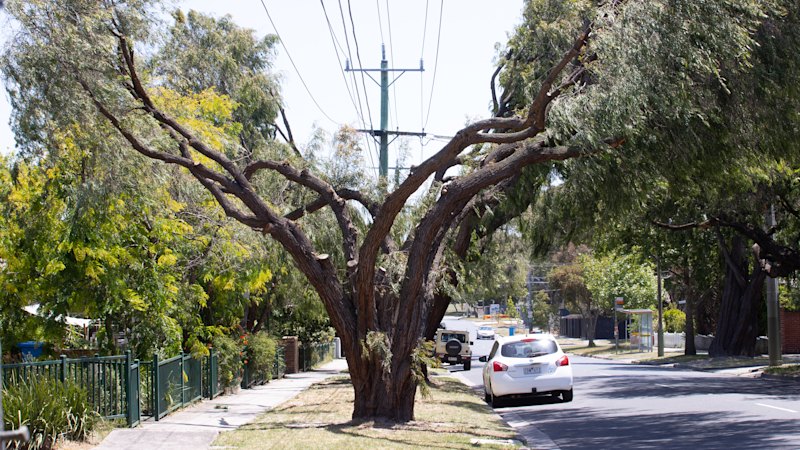
A tree in Coburg that has been heavily pruned to meet power line clearance regulations.
South Australia has reduced its minimum clearance from one metre to 30 centimetres in low-risk areas.
But the Victorian Department of Energy, Environment and Climate Action is unwilling to follow South Australia’s regulation change without more evidence, despite support from most committee members for doing so.
“[The department] considers long-term changes to the Code as unacceptable without a convincing body of evidence to demonstrate that reduced [minimum clearance standard] requirements are safe to apply in Victoria,” the department’s regulatory impact statement for the trial says.
“Although reducing the standard … to 300mm is not supported, DEECA does support future reductions of the standard if there is evidence to justify the reduction.”
Loading
Dr Greg Moore, a senior research associate with the University of Melbourne, was part of the state government’s electricity line clearing consultative committee, until he resigned over what he considers Energy Safe Victoria’s timidity and refusal to consider climate change.
Moore said South Australia had reduced its minimum clearance for power lines from one metre to 30 centimetres more than a decade ago without harm and Victoria could follow its lead rather than run a limited trial with no commitment to make the change permanent.
“I think Victoria is being extremely timid in relation to low-voltage lines in low bushfire risk areas,” Moore said.
He said the proposed reduced clearance “makes a huge difference to streetscapes. It saves you literally hundreds of millions of dollars in pruning. And it gives you a cooler urban environment.”
Moore said Energy Safe Victoria had taken a rigidly prescriptive approach to fire safety.
Between 2019 and 2024, an average of 47 fires broke out each year in Victoria due to trees contacting power lines. Vegetation touching wires resulted in two clearance workers receiving electrical shocks. One worker died and one was seriously injured.
Moore argues that Victoria’s current one-metre clearance endangers workers because it puts them in more frequent proximity to power lines.
“I think you’re putting people’s lives at risk by sending people into these situations when you don’t need to be pruning them at all,” he said.
Loading
Council peak body the Municipal Association of Victoria said the current regulations were excessive and came at a huge and unnecessary cost to communities and the environment.
“Councils, and the communities they represent, have long been frustrated with Victoria’s electric line clearance regulations as they often result in excessive pruning and lopping of vegetation in urban areas and townships with low-bushfire risk,” association president Jennifer Anderson said.

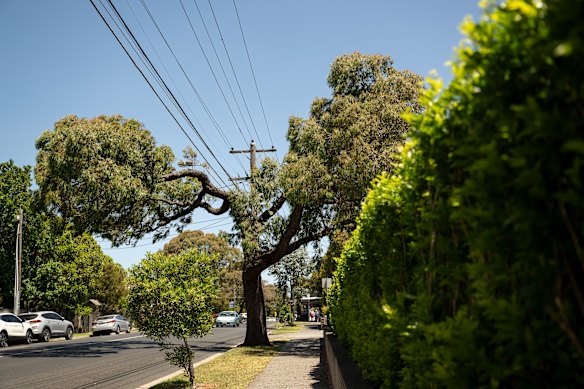
A tree pruned around power lines in Sandringham.Credit: Penny Stephens
Councils face fines for failing to prune trees according to the guidelines.
Anderson, a Macedon Ranges shire councillor, said communities were losing green canopy that cooled streets, and provided habitat for native fauna.
“Unfortunately, significant trees of social and historic interest, and native trees are not spared from excessive pruning to meet the government’s line clearance requirements,” she said.
“As the state government seeks to make our towns and cities denser, and the impacts of climate change are making our streets hotter, we need to protect and enhance tree canopy, not lop it, where there is no safety risk.”
The City of Boroondara – an eastern suburbs council with one of Melbourne most extensive tree canopy covers – strongly endorsed the change. It argued a 30-centimetre clearance would help protect $1 billion in tree value across the state, lower costs to councils and ratepayers, and support community liveability and climate adaptation.
Type your suburb in the interactive below and click on the outline to view the canopy cover in your area
An Energy Safe Victoria spokesperson said the agency recognised the importance of public feedback in shaping policies that kept people safe and encouraged people to have their say on the proposed trial.
The agency did not provide details of when and where a trial could happen, how long it would run for or what evidence was being sought before considering a permanent change to the regulations.
“Our role is to enforce the regulations once finalised and in effect,” the spokesperson said. “As the proposal is still under consultation, it’s too early to comment on any potential trials or implementation.”
Fire Rescue Victoria declined to comment.
Start the day with a summary of the day’s most important and interesting stories, analysis and insights. Sign up for our Morning Edition newsletter.
Read the full article here