






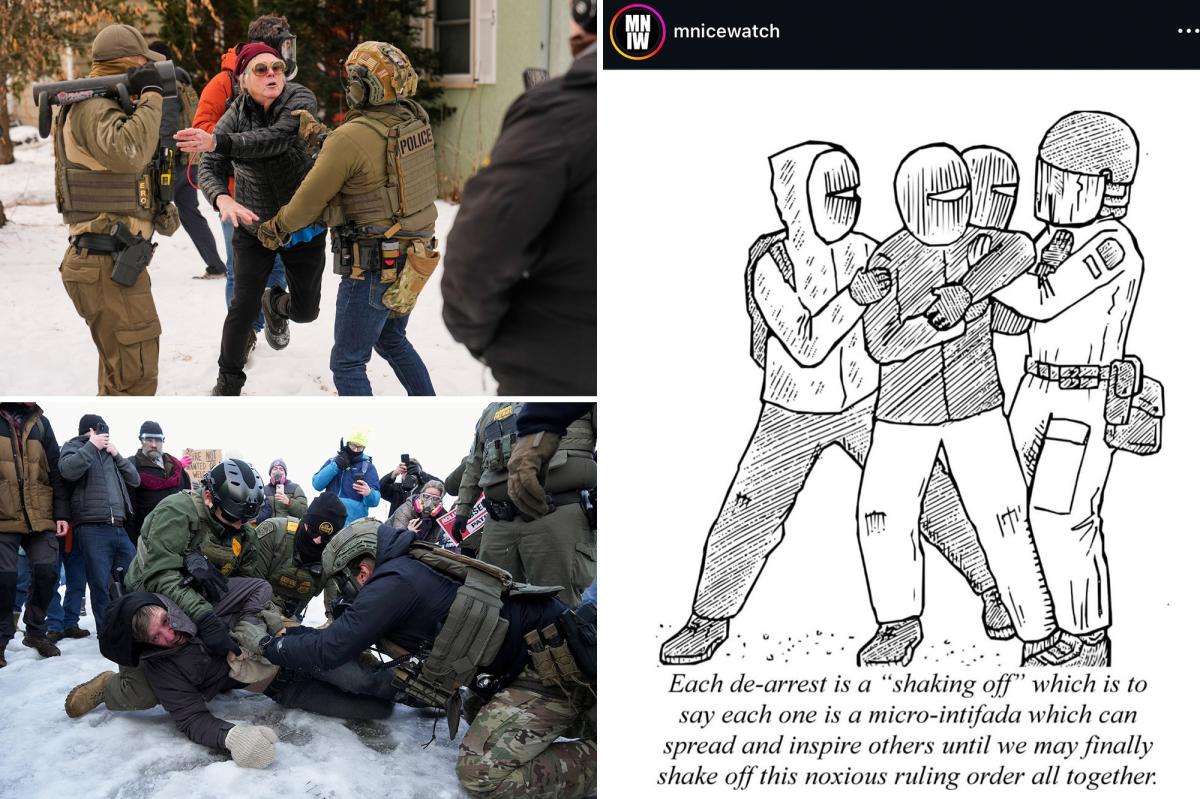
The Minnesota ICE Watch group of which slain Minneapolis protester Renee Good was a member shared a detailed manual providing instructions on fighting police officers to free arrested radicals from their grasp, comparing each “de-arrest” to a “micro-intifada.”
The “de-arrest primer” manual was reposted on Instagram in June by MN ICE Watch, part of a loose collective of agitators who teach members how to disrupt law enforcement officers performing their duties, including ICE agents.
Neighbors have told The Post that Renee Good had regularly attended meetings with the local chapter and had received “thorough training” from the group.
The manual — which says on the front cover it was published in the spring of 2024 — outlines four tactics for interfering with arresting officers, such as the best kind of grip to use while yanking someone in custody out of their hands, or even suggestions on “pushing and pulling an officer” off of an arrestee.
“Technically speaking for pushing off form you should have a low center of gravity and a wide base and push up explosive power with your head up at all times if possible,” the instruction guide reads.
“For breaking a grip, try striking the grip,” the manual advises while warning that making physical contact with a law enforcement officer “can get construed as assault in court.”
However, it rationalizes the risk associated with “striking” an arresting officer as “always contextual,” claiming, “an arrest or even a general pacified attitude can lead to greater harm than not taking the risk and acting decisively when you see the repression take place.”
Tactic 3 encourages readers to open unlocked doors of law enforcement vehicles containing suspects to let them out, a move it acknowledges “could be considered a crime.”
The fourth and final tactic involves “pressuring” cops to simply release individuals they’ve taken into custody, “totally surrounding” the officers, “or otherwise blocking them and/or their vehicle and chanting ‘Let them go!’ until the [law enforcement officers] cave to the mounting pressure.”
The manual boasts this particular technique has “come out of the Palestine solidarity campus occupations.”
An illustration on the final page of the manual shows a pair of protesters trying to free somebody being arrested from an officer’s arms, with the caption “Each de-arrest is a ‘shaking off’ which is to say each one is a micro-intifada which can spread and inspire others until we may finally shake off this noxious ruling order all together.”
Intifada typically refers to two distinct historical periods in which terrorists committed acts of violence against Israeli civilians, including suicide bombings, shootings and stabbings, targeting people on city buses, eating in restaurants or out at nightclubs — resulting in over 1,000 people killed,” the Anti-Defamation League writes.
References to intifada, more specifically the slogan “globalize the intifada,” is “generally understood as a call for indiscriminate violence against Israel, and potentially against Jews and Jewish institutions worldwide.”
The manual grouses that “being arrested can have drastic negative life altering affects [sic], especially for targeted populations like people who aren’t white, Muslims, LGBTQ people, and certain radicals,” the missive’s introduction reads in part.
“It follows then that reversing an arrest can be well worth the risks involved.”
Read the full article here