





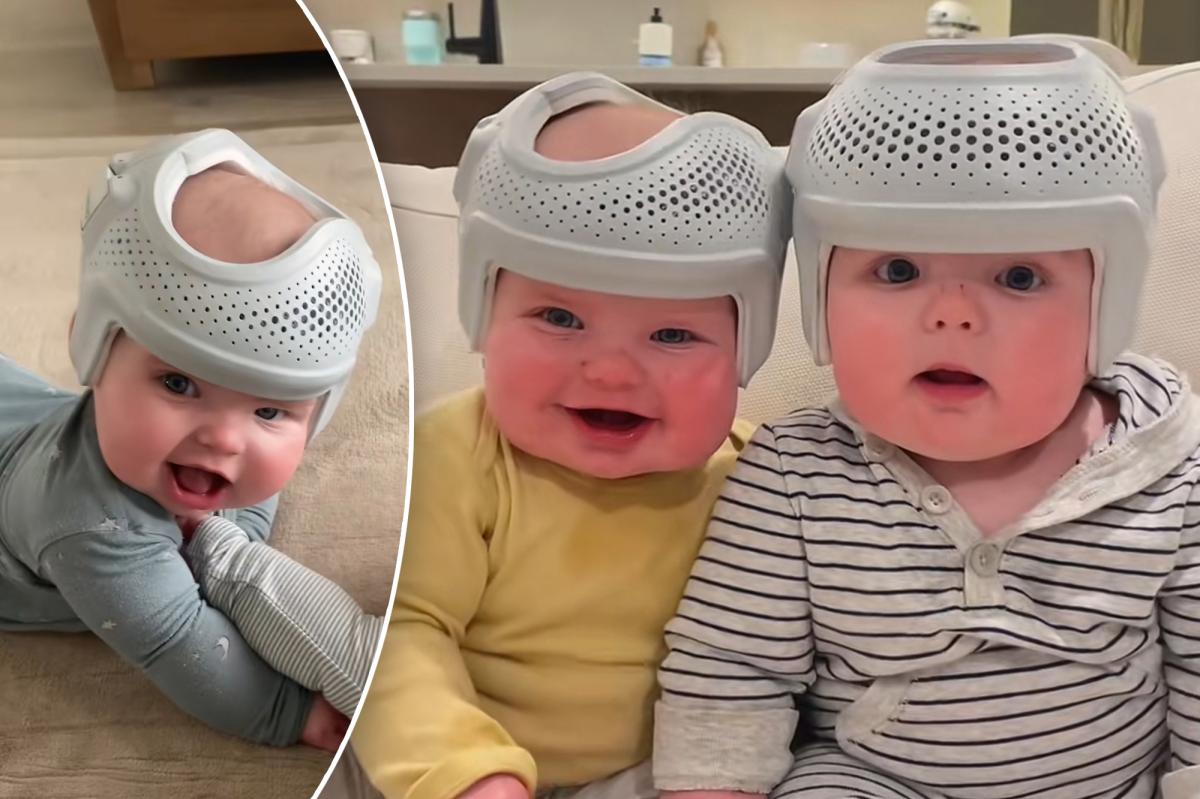
Madeline Lawrence, a married mother of three, including newborn twins Nico and Ash, is determined to fix a flat.
The Utah native is working to remedy the flatness of her babies’ skulls with $700 3D-printed head-shaping helmets — and she’s getting a whole lot of backlash.
“The babies wear their helmets 23 hours a day because that’s just what [their pediatrician] recommended,” Lawrence, 32, from Utah, told The Post. “To start, we did one hour on, one hour off to help acclimate them to the helmet.”
“My daughter started off with 14 millimeters of asymmetry, and she’s was down to 3.75 millimeters after six weeks of wearing the helmet.”
Lawrence’s twins are among the one in every eight healthy infants who suffer from grapple with plagiocephaly, also known as flat head syndrome, according to recent data from the University of Illinois Hospital and Health Sciences in Chicago.
The condition, which does not affect brain development or intelligence, is identifiable when a baby’s soft skull is misshapen or flattened in one area. In severe cases, the deformity may cause the ear on the flattened side of the head to appear pushed forward, and can trigger asymmetry in the face, neck, or jaw.
Plagiocephaly can be caused by the birthing process, sleep positioning, a lack of tummy time and pregnancies with multiples — such as Lawrence’s duo — per Cleveland Clinic.
To reverse the issue, experts have strongly suggested helmet therapy, which can cost families between $1,495 to $5,195 (without insurance) depending on how early in life babies begin treatment.
Lawrence, who paid $700 out-of-pocket for each of her kids’ helmets, says her tiny twosome was first prescribed their headwear at the four-month mark. She tells The Post that the doctor suggested waiting until the tots built up enough neck strength to support the prosthetic piece before placing it atop their fragile frames.
Still, internet naysayers — trolls watching her social media clips, some of which amass over 20 million views — are biting her head off for keeping her kiddos strapped up round-the-clock.
“Twenty-three hours is crazy,” carped a commenter.
“I will never understand helmets like this for babies. It is unnecessary,” another chimed.
“So sad. Don’t use helmet come on,” added an equally disturbed detractor.
The digital gripes, however, don’t get under Lawrence’s skin. Instead, she takes comfort in knowing she’s doing the right thing for Nico and Ash.
“If it were me, and I had a head that was that flat, which could potentially cause asymmetry to my face, I’d want my parents to do what they could to fix it,” she said. “I kind of compare putting my babies in helmets to kids wearing braces. If it’s fixable, why not.”
The mom first noticed flat spots on her children’s heads shortly after giving birth in May.
“It probably started in the womb, probably from a lack of space in there [being that they’re] twins,” Lawrence, who’s also a mother to a two-year-old son. “My husband, our pediatrician and I didn’t see it until they were about two-weeks-old because the twins [were premature] and had to keep beanies on their heads due to the low birth weights.”
She explained that Nico and Ash often practice tummy time — resting on their stomachs that helps reduce further smushing to the backs of their heads, and also strengthens their neck, shoulder and back muscles. But she credits their helmets with really doing the trick.
“The pediatrician sent them to a place that specializes in prosthetics and orthotics. They do measurements of the baby’s head and take 3D images,” she detailed. “Then they send those images to the 3D printer. Each helmet is foam lined on the inside and that’s how they make adjustments as the baby grows.
“The idea is that the helmet’s perfectly round, and their heads will [begin mimicking that shape] as they grow.”
It’s an idea backed by scientific research.
“Helmet therapy was shown to be an effective tool for infants with moderate to severe positional plagiocephaly,” wrote the study authors of a 2023 report, insisting that the longer a baby wears their helmet, the better.
“Better treatment outcomes were achieved when the treatment was started earlier than 9 months of age and the helmet was worn for more than 15 hours per day,” said the insiders.
Lawrence, whose daughter recently completed her helmet therapy, agrees.
And she’s happily letting her son, little Nico, continue therapy until his head rounds out just right.
“His asymmetry is down to between six and seven millimeters now,” said Lawrence, adding that docs recommend that a baby with plagiocephaly reach one to three millimeters before saying bye-bye to their helmets.
“I’m just more inclined to keep his on longer since he’s a boy and might not always have hair to cover up any [long-term flatness].”
And when it comes to the scathing remarks she receives online, Lawrence says she’s learn to stand head and shoulders above the shade.
“After first it was really stressful, but as I’ve kept posting about their helmet therapy, I really just wanted to help destigmatize it,” she said. “I get so many messages from moms saying how long they felt when they were going through this and how much they appreciate my TikToks.”
“My content is all about spreading awareness and positivity.”
Read the full article here