






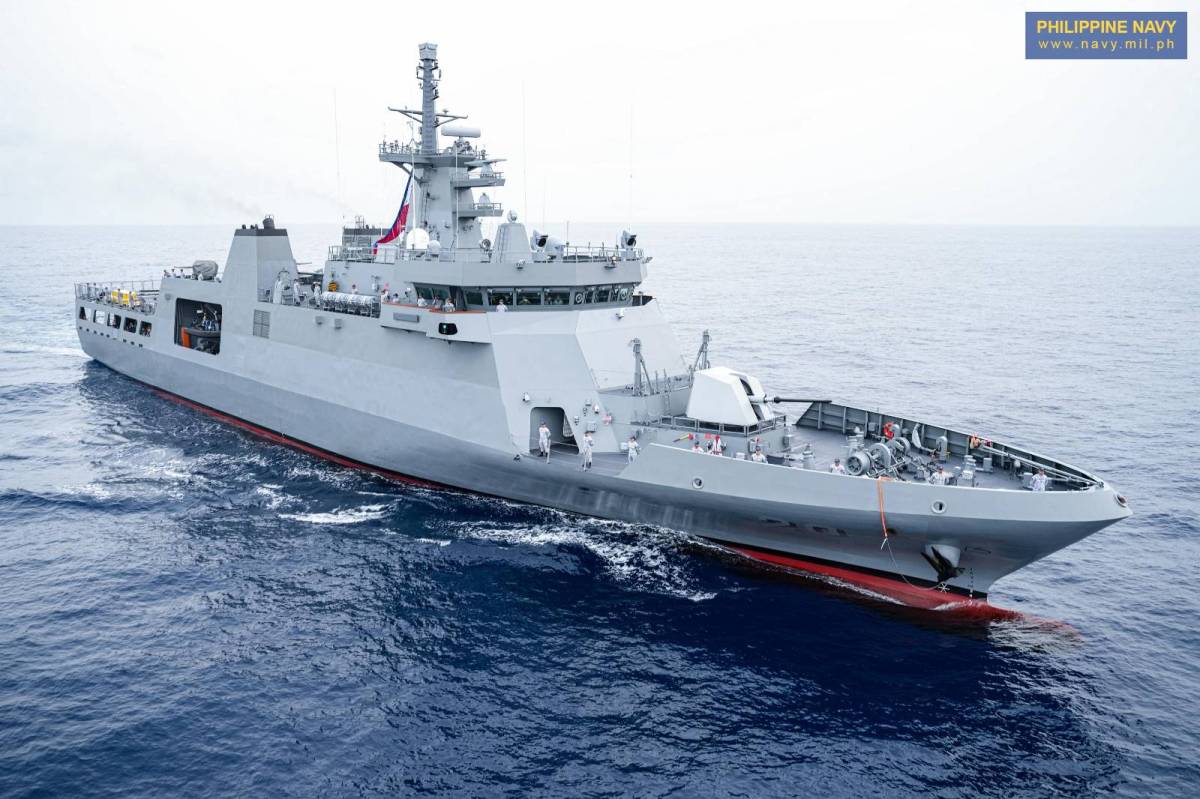
The Philippines continues to bolster its capabilities to counter China’s assertive behavior in the South China Sea, where both sides have overlapping maritime claims, as the Southeast Asian ally of the United States recently received a new patrol vessel.
The Chinese Foreign Ministry did not immediately respond to a request for comment.
Why It Matters
China has claimed sovereignty over most maritime features in the South China Sea, citing what it describes as “historic rights,” and has maintained a strong presence of naval and coast guard ships—along with its maritime militia fleet—across the region.
Territorial disputes have often led to clashes between Chinese and Philippine maritime forces, including the use of water cannons and dangerous maneuvers between vessels.
Facing China’s continued military buildup on its doorstep, the Philippines, a mutual defense treaty ally of the U.S., is strengthening its military to defend its archipelagic territory, including by acquiring anti-ship weapons and missile-armed naval vessels.
What To Know
The Philippine navy announced on Monday that its newest offshore patrol vessel, BRP Rajah Sulayman, arrived in the country after departing South Korea on Saturday. The 2,400-ton ship was built by HD Hyundai Heavy Industries and launched in June 2025.
Describing the ship’s arrival as a significant addition to its growing modern fleet, the Philippine navy said it was committed to strengthening its maritime defense and law enforcement capabilities through a “modern, multi-domain and self-reliant” force.
Prior to its official commissioning, the Rajah Sulayman—named after a Muslim ruler who defended Manila against Spanish forces in the late 16th century—is set to undergo “post-delivery activities and technical checks,” including the process of acceptance.
According to the defense outlet Naval News, the Rajah Sulayman and its five planned sister ships have a range of about 6,300 miles and are equipped with weapons—including a 76 mm main gun and two 30 mm secondary guns—radar and tracking systems.
Meanwhile, the Philippines and China engaged in a war of words over South China Sea disputes. Jay Tarriela, a spokesperson for the Philippine coast guard, recently posted footage on social media showing Chinese activities in the region, including what it described as ramming vessels and harassment of Philippine fishermen in the country’s economic waters.
“It has always been the Philippine side that has time and again provoked troubles,” said Guo Wei, a deputy spokesperson for the Chinese Embassy in the Philippines. The official listed incidents he said showed that Manila, not Beijing, should be blamed for regional tensions.
What People Are Saying
General Romeo S. Brawner Jr., the Armed Forces of the Philippines’ chief of staff, said: “The launch of Offshore Patrol Vessel No. 1, the BRP Rajah Sulayman, is not merely the unveiling of a new ship—it is a bold declaration of our commitment to maritime security and the defense of our sovereignty. This vessel marks a new chapter for the Philippine Navy, reflecting our resolve to enhance our operational capabilities and extend our presence across our vast maritime domain.”
Jay Tarriela, a spokesperson for the Philippine coast guard, said: “Defending every square inch of our territory is a solemn commitment to the Filipino people—but not surrendering the voices that fight for our sovereignty is even more vital.”
Guo Wei, a deputy spokesperson for the Chinese Embassy in the Philippines, said: “China stands ready to engage in candid dialogue with the Philippines on the basis of mutual respect to manage differences properly. Meanwhile, we will continue to tell facts and share truth to promote understanding and avoid miscalculation so as to grow China-Philippines relationship in a sound way.”
What Happens Next
It remains to be seen whether the Philippines will further expand its navy amid China’s presence in the South China Sea as Beijing seeks to assert sovereignty over the waters.
Read the full article here