





Hopes for life inside bubbles on Titan have deflated.
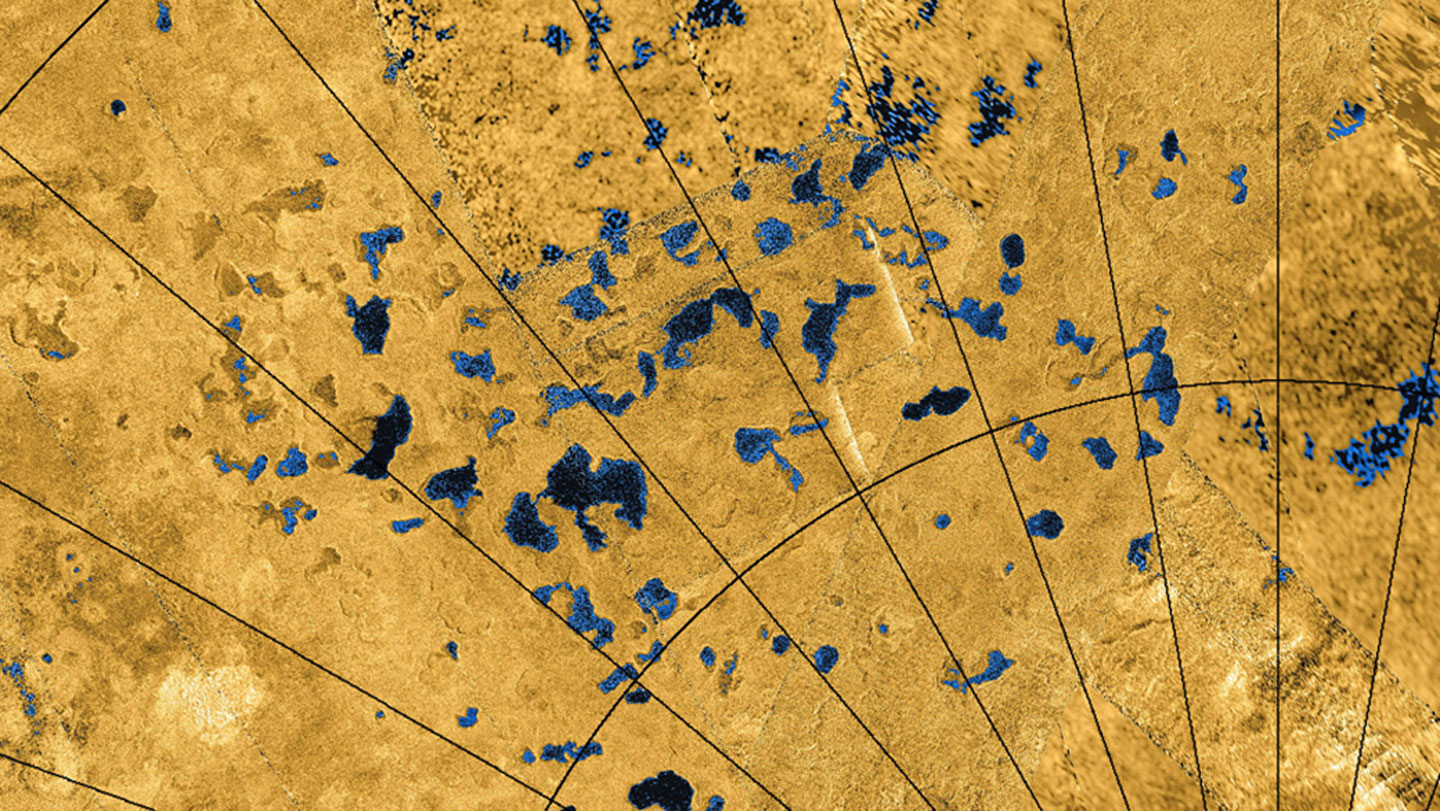
Oceans of liquid methane and ethane on Saturn’s biggest moon may not support the formation of cell-like spheres called azotosomes, researchers report March 11 in Science Advances.
Titan doesn’t have liquid water and is so cold that membranes like those that encase cells and organelles in Earth organisms would freeze and shatter there. That would normally exclude the moon as a likely place for life. But in 2015, some computer simulations suggested that a component of synthetic rubber called vinyl cyanide, or acrylonitrile, could make azotosomes in liquid methane. If true, that might mean that life on Titan is possible because the compound could make protective shells around any possible cells on the moon. A later simulation, though, predicted that azotosomes couldn’t self-assemble on Titan.
No lab experiments have been done to see which simulation is right, says planetary scientist Tuan Vu of NASA’s Jet Propulsion Laboratory in Pasadena, Calif. So Vu and JPL colleague Robert Hodyss devised an experiment in which they sprinkled solid vinyl cyanide over supercold liquid ethane or liquid methane.
That mimics “one way that they can come into contact on Titan, when you have acrylonitrile forming in the atmosphere [and] coming down onto the surface where it condensed as a solid, and it comes into contact with a lake,” Vu says.
Liquid ethane and vinyl cyanide form crystals together, not bubbles, the researchers found. And no azotosomes formed in liquid methane either. Those results seem to pop the bubble hypothesis.
But the experiment doesn’t rule out life on Titan, Vu says. There may be other ways azotosomes could form, he says. Or perhaps Titanic life-forms don’t need azotosomes.
“We tend to interpret life as we know it, because that’s the only form of life that we know,” Vu says. “But on Titan it could be life as we don’t know.”
Read the full article here