





As more than 170,000 American troops prepared to retake the Philippines at Leyte Gulf in October 1944, the Japanese Navy threw everything it had into one last attempt to stop them.
Over 300 Allied craft, including four Australian warships, faced off against a force of almost 70 Japanese vessels. Outclassed by Allied air power and denuded of experienced pilots, the Japanese began using a desperate strategy: the kamikaze attack.
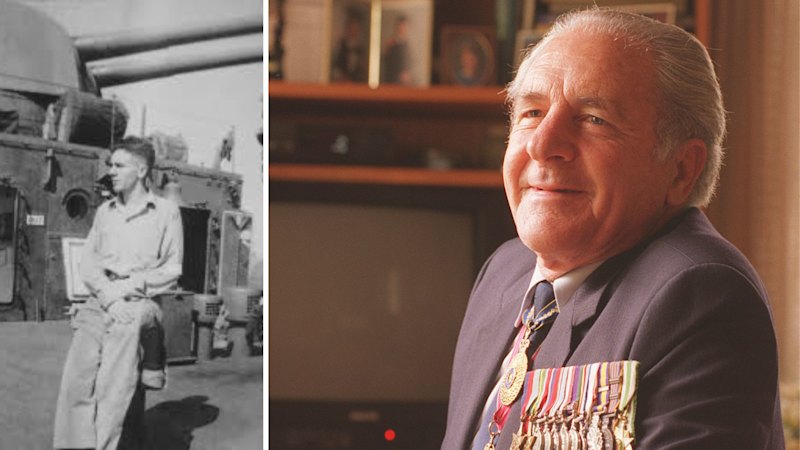
Rothesay Swan had just turned 18 when he witnessed his first kamikaze attack. The Australian was serving as a midshipman on HMAS Shropshire as the largest naval battle in history unfolded. He told the NSW War Memorial Register there were “a lot of near misses”.
“There is no doubt about it, I am very lucky. You never knew from one moment to the next if you would be alive the next day,” he said.
“There were many very difficult moments but I was determined to succeed. You had to grit your teeth and get on with it.
“I was in charge of tracking low-level aircraft coming in to attack the ship. It was very exciting … Some of them came so close the ship would disappear in spouts of water.”
Rear Admiral Rothesay Swan AO CBE RAN (Retired) died in Sydney on Christmas Eve at the age of 99.
Sent to the war in the Pacific aged just 16, he was the last surviving World War II veteran to be promoted to a flag rank, (commodore or above).
“Swan will be remembered as one who, throughout his naval and later career, set high standards for himself and all who worked from him,” said Commander Stephen Moss CSC RAN (Retired), vice president of the Tall Ships Association of Australia and New Zealand.
A mentor of young men and women in tall ship sailing, Swan was a pioneer of the navy’s Young Endeavour Youth Scheme, which since 1987 has taken 16 to 23-year-olds on sailing ship voyages to teach naval skills.
“It’s the thing I miss most about the navy,” Swan said in an interview before his death, “leading young people and bringing the best out of them.”
Born in Orange on June 1, 1926, Swan joined the navy as a cadet midshipman in 1940 at the age of 13, moving to Victoria to attend the Royal Australian Navy College.
In World War II, he saw action at Cape Gloucester, the Admiralty Islands, Hollandia and Biak in New Guinea, and Leyte and Lingayen gulfs in the Philippines.
Following the war, Swan served on Royal Navy ships in the Mediterranean before commanding navy ships on active service during the Indonesian Confrontation and the Vietnam War.
In 1978, after commanding aircraft carrier HMAS Melbourne on duties related to Queen Elizabeth II’s Silver Jubilee, Swan was promoted to Rear Admiral. He retired in 1983.
Swan spent the next five years organising hundreds of tall ships from 30 countries to sail from England for Australia’s Bicentennial celebrations in 1988.
Swan’s funeral was held at the Garden Island Navy Chapel on Thursday, attended by Chief of Navy Vice Admiral Mark Hammond, along with Swan’s family, friends and shipmates.
His coffin was carried by six uniformed sailors, along with his medals and his officer’s sword. A Royal Australian Navy band brass quintet accompanied a series of hymns, and the Naval Ode was read before the Last Post and a minute’s silence.
Swan is survived by his children and grandchildren, and two of his siblings. His wife of 70 years, Margaret, died in 2023.
From our partners
Read the full article here