






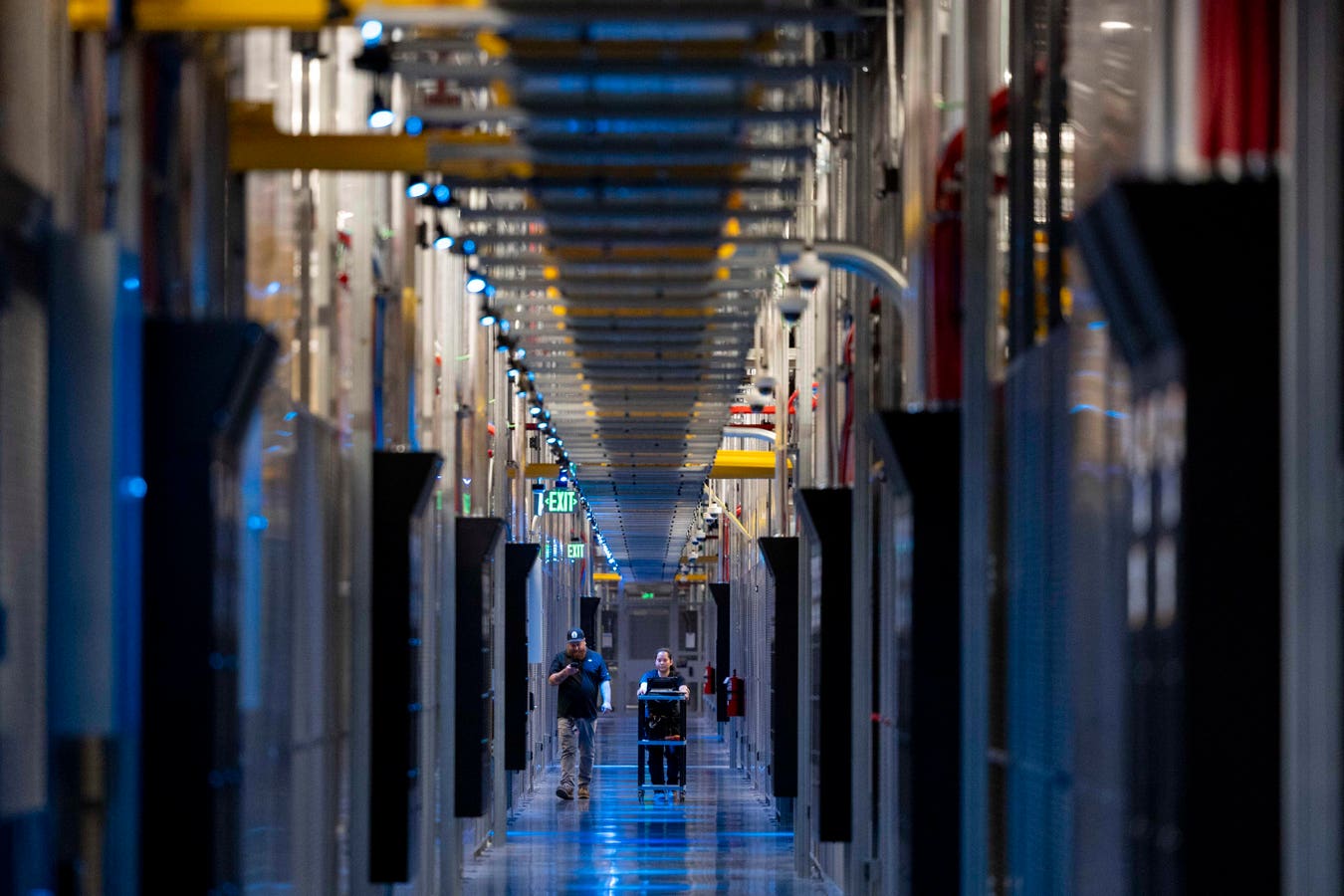
Swollen with seemingly insatiable demand for computing power, the AI boom has birthed hundreds of unicorns out of thin air, minted dozens of billionaires and alchemized more than a trillion dollars in market value for big public tech companies like Nvidia, Broadcom, Google and Meta. It’s also inspired an infrastructure land grab perhaps unprecedented in financial breadth. Earlier this week, Meta CEO Mark Zuckerberg announced plans to build out tens of gigawatts of AI infrastructure this decade, and “hundreds of gigawatts or more over time.” At $50 billion per gigawatt, that’ll likely cost trillions.
Boom times for AI infrastructure should mean banner years for the companies that have historically provided it: data center real estate investment trusts, or REITs. Yet three of the biggest, Equinix ($78 billion market cap), Digital Realty ($55 billion market cap) and Iron Mountain ($27 billion market cap), aren’t seeing them. Their share prices are down 13%, 11% and 16% over the last year, respectively, compared to the S&P 500’s 17% increase.
These companies are the landlords for the internet; they buy real estate, build data center shells with supporting infrastructure, and lease the property to tech company tenants. They should be killing it. They’re not, and it’s likely because of a few things: lower appetite for risk, power constraints and lack of access to more—and more speculative capital.
Have a tip related to AI infrastructure or tech companies? Contact Phoebe Liu at pliu@forbes.com or phoebe.789.
Right now, the market believes that chips from Google, Broadcom, Nvidia and others “will capture the economic profits of AI, not mercenary data center developers [like] REITs,” says Mark Giarelli, analyst for Morningstar. It doesn’t help that the top 20 data center development contracts signed in 2025 were won by companies other than data center REITs like Equinix and Digital Realty, says Michael Funk, an analyst at Bank of America.
Part of the challenge lies in the REIT structure itself. It was originally designed back in the 1960s to let ordinary people in on real estate investing by not charging corporate income tax, and requiring that any REIT company pay out 90% of its taxable income as dividends to shareholders. Data center REITs started popping up around the turn of the century and largely accomplished their mission; their share prices have more or less mirrored market indexes since. Until AI and its gargantuan data centers took over.
Now, it’s not working out so well. Needing to pay out such a hefty dividend leaves them with less capital for reinvestment in an industry where capital is king. So it’s harder for public REITs to commit up front to the same colossal sums of capital their deep-pocketed rivals are touting. That’s a tough row to hoe in this new era of data center bidding wars. As a REIT, “you can’t stick your neck out there” in the way others are doing, says Andy Cvengros, co-lead of the U.S. data center markets team at public real estate firm JLL. “It’s really held them back in a big way.”
To land the big deals, Equinix, Digital Realty and Iron Mountain need to compete with a snowballing list of well-funded companies. Some, like Meta, which is both building its own data centers and leasing them from other firms, are bankrolled by cash-cow revenue streams. Others like private companies Vantage and QTS, which both build and operate data centers, are increasingly partnering with big investment firms. But REITs’ spending power is limited by their risk-averse shareholders, who are more akin to investors in pension funds, rather than those betting on tech stocks.
REIT shareholders simply don’t want these companies to invest in deals involving debt with a non-negligible risk of default, which, these days, is often what’s needed to build a data center. In addition, REITs often borrow less than five times their equity, compared to private companies’ leverage ratios of 10-15x.
All of this makes it harder for data center REITs to do business with the biggest players like OpenAI—which is currently on the hook for some $1.4 trillion in spending, without a clear way to pay for it, or neocloud CoreWeave, due to its junk-rated debt.
The difference in risk appetite is perhaps best illustrated by what happened with Oracle earnings in September, when it announced an earnings miss but projected a massive increase in spending to build data centers. Its share price shot up 38%. But when Equinix told analysts the same in June—lowering revenue expectations but projecting heavy investments to build AI-focused data centers—its share price plummeted 18% over the following two days.
There’s further risks beyond debt. Some multibillion-dollar data center contracts have provisions like early termination clauses, which allow data center tenants to end a contract sooner than agreed upon based on wild card factors like construction delays. This happens all the time. More than half of data center projects in 2025 had delays of three months or more, per JLL. And Microsoft and Meta have both reportedly acted on such provisions; CoreWeave blamed a third-quarter earnings miss on a delay.
Public data center companies also aren’t immune from the challenges facing anyone building AI infrastructure right now. Power bottlenecks are a major problem, as there simply isn’t enough grid capacity to go around. “When we have an empty data center shell that isn’t delivering megawatts of power, that will drag returns,” Giarelli told Forbes. Combined, this all looks like a bad deal to a REIT shareholder.
The REITs are timid in other ways. They’ve clung to their core markets, like Northern Virginia and Los Angeles, rather than buy land in less developed, remote places. But that’s where “AI is being built,” says Funk, because that’s where there’s space to house huge supercomputers. Without more space in already crowded urban areas, the REITs can’t grow exponentially. That’s a key reason why Equinix’s revenue growth has fallen short of what it projected to analysts last summer, while Digital Realty’s revenue from AI-related workloads has decreased.
But there’s an opportunity there too. The majority of AI’s computational power is moving from building models to running them, which requires more speed and bandwidth. Data centers in more urban areas are physically closer to the people who are using AI, and also have access to better fiber networks than rural data centers. That could give Equinix and Digital Realty a leg up moving forward.
Analysts are particularly bullish on Equinix: they say it’s best suited for running AI models in part because of its hyperfocus on speed and connectivity. Already it is rapidly expanding its xScale business, which works with tech giants like Amazon and Oracle building data centers like mad. “We are seeing them change course pretty rapidly,” says Cvengros.
So don’t count these public data center companies out yet. There’s so much demand that there’s lots of space to stake a bigger claim in the current boom. Take Applied Digital, once a little-known data center hosting company for crypto miners. In 2023, it went all-in on building data centers instead for a few large AI customers. As a result, its stock price and revenue have tripled in the last year and pushed it to a $10 billion market cap. But to pull that off it had to take a sizable risk and land a $5 billion infusion of capital.
For REITs with significantly more to lose and shareholders without any appetite for a gambit of that scale, the path is more difficult. They need to make sure big swings are reasonably hedged while raising additional capital. Truly cashing in on the AI boom, though, will mean making a bet and committing to it. Otherwise they’ll be playing an ongoing game of catch up in an AI race where speed is everything.
Read the full article here