






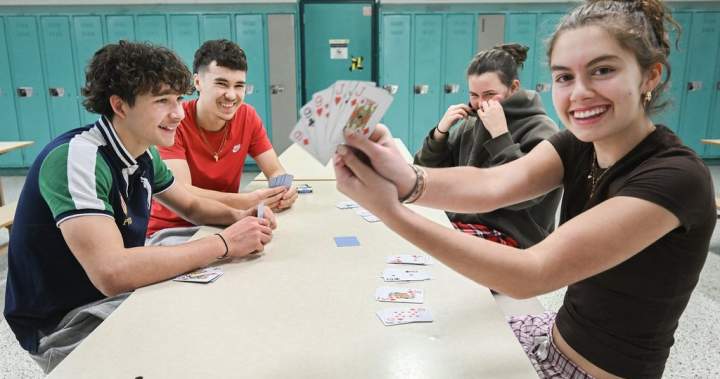
Quebec’s expanded school cellphone ban is getting top marks from some students and administrators who say the measure has improved students’ concentration and social interactions.
On a recent day just before the holiday break, students at École Monseigneur-A.-M.-Parent high school on Montreal’s South Shore flooded into the hallways at the sound of the lunch bell, as the student radio station played Christmas songs.
Amid the hubbub, some students sat down to play cards, while others played Ping-Pong or board games.
“Before, people were on their phones a lot and playing games, but since they can’t do that anymore, now they play together or talk to each other,” Grade 11 student Constance Boie told The Canadian Press.
Sitting next to her, Shelby Miclette said she is “quite introverted” and that the ban on phones at school has encouraged her to connect with her peers. “I’m more open to others than I used to be,” she said. “It’s brought me out of my shell a little.”
Cellphones have been banned since January 2024 during classroom time across Quebec, with a few exceptions. In the fall, the government widened its ban to prohibit students from using the devices on elementary or high school property for the entire school day, including during breaks and in hallways.


Get breaking National news
For news impacting Canada and around the world, sign up for breaking news alerts delivered directly to you when they happen.
Mélanie Lacourse, the principal of École Monseigneur-A.-M.-Parent, said she’s seen a positive impact on students’ social lives, physical activity levels, and academic success. “It’s a friendlier atmosphere and sometimes, yes, noisier, because they’re talking to each other, but it’s great to see,” said Lacourse, adding that she has noticed “a decrease in isolation.”
She’s also convinced that students who spend their breaks on activities such as foosball, exercise or quality time with friends are better able to settle down to learn in class.
Miclette also believes concentration has improved. “We don’t check our phone notifications before going to class,” so, “our minds aren’t elsewhere,” the Grade 11 student said.
The principal of Quebec City-area secondary school Séminaire St-François says the expanded ban has had “major” positive impacts on students’ social skills.
Before the new rules, students would pull out their phones between classes. “Now we see them playing, laughing, and talking to each other,” he said. “You can hear the change in the hallways; there is much more talking and laughing.” While there was some pushback from older students initially, he said the change was overall a smooth one.
Clinical psychologist Linda S. Pagani said she wasn’t surprised to hear that banning phones has had positive results. Excessive cellphone use among young people, she said, not only hinders academic learning but also impedes personality development.
“Cellphones are so distracting that they delay all the tasks that teenagers need to do to build their identity,” said Pagani, who is also a researcher at Montreal’s Sainte-Justine hospital research centre.
Pagani notes that long hours of exposure to digital platforms, including social media, can lead to cognitive overload that increases the risk of mental fatigue and compromises learning abilities. She also thinks it’s beneficial for students to write and take notes by hand, which “consolidates learning.”
Boisvert says some administrators are now questioning the choice to require students to use tablets in class, adding that his school will shift to laptops next year. Tablets, he said, can be used as educational tools, but also “as recreational tools” that create “management and supervision challenges” for both teachers and parents.
Read the full article here