




MESSA DA REQUIEM ★★★★
Glasshouse Theatre, QPAC
Until April 4
Crikey. Nobody can accuse Ivan Gil-Ortega of launching the Glasshouse Theatre – and his artistic directorship of Queensland Ballet – with anything tentative or modest.
Messa da Requiem is instead a great, big, earth-shattering bang – a work of Biblical proportions in every sense.
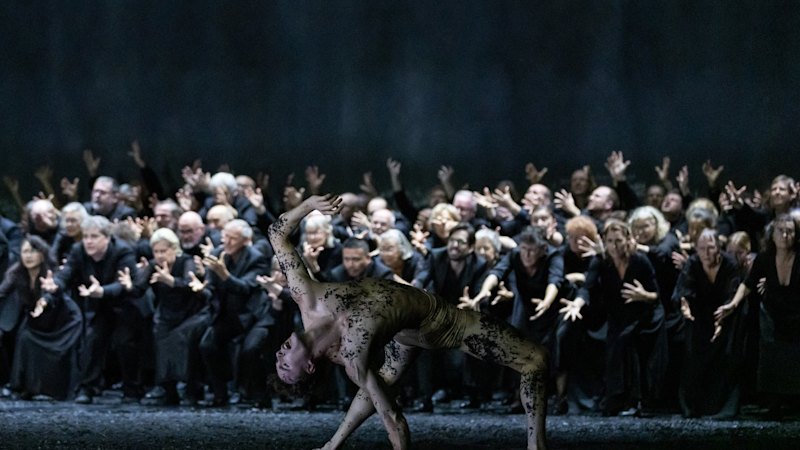
There are roughly 150 people on the stage for most of this show’s 90 minutes, not to mention the 67-strong Queensland Symphony Orchestra playing under it (with Simon Hewett conducting). I am fairly certain I’ve never seen so many performers all doing one thing together, short of a military parade, or an Olympics opening ceremony.
The piece is Giuseppe Verdi’s 1874 Messa da Requiem, a Latin funeral mass composed to memorialise the novelist and politician Alessandro Manzoni, who is often attributed with unifying the Italian language.
Verdi, 19th-century opera’s untouchable megastar, was not greatly religious, but he knew devastating loss (his wife and children all died when he was in his 20s), and the piece is more generally an essay in mortality and the pain of being alive.
Composed for orchestra, two choirs and four vocal soloists, it’s packed with drama, with some famous bits often used in movies and commercials.
The German choreographer Christian Spuck came up with his dance accompaniment while director of the Ballett Zurich, with whom he mounted it at the Adelaide Festival three years ago. Now it’s Brisbane’s turn, using the brilliant Queensland Ballet ensemble, four opera singers, the Brisbane Chorale, and Canticum Chamber Choir.
In terms of staging, it’s both minimal and maximal. The set consists of just three towering, plain, grey walls. At curtain-up, a female dancer in a nude-coloured leotard stands alone centre stage while two dancers perform behind her. Lurking stage left and right are large crowds of singers, like witnesses to a trial, which it is – souls are being judged here by an apparently vengeful god.
Spuck’s masterstroke is to involve the 100-plus choristers in the dance. They don’t just stand at the back and sing their parts. During the famous Dies Irie (Day of Wrath) section, they flail their arms while a solo male dancer – Joshua Ostermann on opening night – leaps and convulses. The singers form milling crowds, Mexican waves, roiling seas, tumbling walls.
Dancers emerge from among them throughout the performance. Ascension is of course a major theme and the ballet involves many male dancers lifting female ones, sometimes en masse.
I mentioned the military before but what is comforting about this Messa da Requiem is its sheer humanity. This is no fascist display of might, of bodies subjugated to a single purpose. The choir members may all wear black, but each is an individual, old, young, short, tall. And all seem to be having a wonderful time, despite the apocalyptic theme.
In one telling moment, the singers turn to the walls and write on them in chalk, only to wipe away their marks immediately, leaving a misty white halo around the stage. It’s a powerful reminder of the brevity of human existence – no one is safe in the crowd.
Verdi’s music is tumultuous, cinematic, terrifying, transcendent. The piece brings the lead soprano to the fore at the concluding Libera Me section, singing from fear of death to ultimate acceptance. Naomi Johns held focus on opening night in a huge black skirt, piercing through the turmoil with angelic top notes.
This very first in-season production at the Glasshouse is a showcase of the new theatre’s broad stage, which seems to bring the action forward into everybody’s face. It’s the live equivalent of a widescreen TV.
Gil-Ortega says the production “reflects both the scale and the artistic direction” he hopes to set for Queensland Ballet as we head toward 2032. Messa da Requiem demonstrates how a large pool of willing local talent, infused with world-scale ambition, can pull off something quite extreme but also marvellous. A bit like an Olympic opening ceremony, in fact.
Start the day with a summary of the day’s most important and interesting stories, analysis and insights. Sign up for our Morning Edition newsletter.


From our partners
Read the full article here