






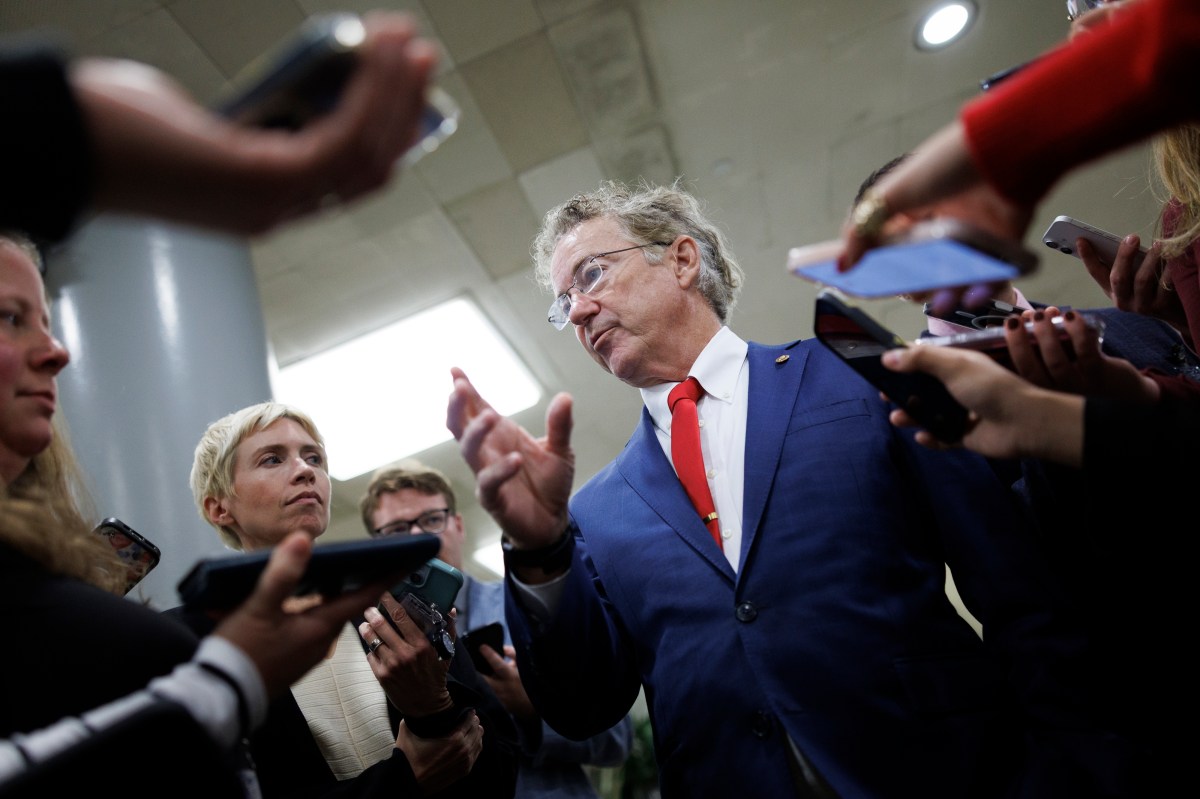
Senator Rand Paul of Kentucky has warned that if the Republican party continues to pursue President Donald Trump’s redistricting agenda it will lead to further “civil tension and probably more violence in our country.”
“Both sides are doing it,” Paul said, “So is one side going to sit quietly and not do it? You can argue who started it, but I do think this: This is on the negative aspect of both parties doing this. I think it’s going to lead to more civil tension and possibly more violence in our country.”
Newsweek reached out to the White House by email on Sunday evening for comment.
Why It Matters
Trump urged Republican legislatures to redistrict and find an advantage for the party going into the 2026 midterms amid concerns that the razor-thin majorities in the U.S. House of Representatives and Senate – a two seat majority and three seat majority for Republicans, respectively. Republicans have already raised concerns that a Democrat majority would derail Trump’s agenda.
Texas was the first to respond to the president’s request, redrawing the state voting map to give Republicans five more seats. California responded with a similar effort to balance out the Texas initiative, and Indiana Senate Republicans failed to advance the map as drawn by the State House of Representatives.
What To Know
Paul spelled out his concerns about the tit-for-tat redistricting that has started to play out across the country, particularly that the way the redistricting is headed means states will become one-sided, which would be a “mistake of both parties.”
“I don’t know exactly how we deescalate this because once, you know, Texas is done and changed five seats to be more Republican, California’s going to do the same thing. And it’s back and forth and back and forth. And how do you put the genie back in the box? I mean, how do you get back to détante?” Paul said.
Other states that have said they would consider redrawing their maps include New York, Louisiana, Alabama, Florida, Maryland, Virginia, and North Dakota.
“I think it’s bad, but it’s really not one party or the other doing it. It’s both parties have been doing it since the beginning of time,” Paul said. “But in general, when it becomes so extreme, like if California has no Republican representatives after this is done or has one left, I think that makes people so dissatisfied, they think, ‘”‘Well, the electoral process isn’t working anymore. Maybe we have to resort to other means.'”
“And I don’t want that. And I think both parties it could happen to. But I think we need to be aware of and think about that before we do all of this,” Paul added.
What People Are Saying
President Donald Trump in a Truth Social post last week, in part: “Republicans in the Indiana State Senate, who voted against a Majority in the U.S. House of Representatives, should be ashamed of themselves. Headed by a total loser named Rod Bray, every one of these people should be “primaried,” and I will be there to help! Indiana, which I won big, is the only state in the Union to do this!”
Texas Governor Greg Abbott, a Republican, earlier this month wrote on X: “We won! Texas is officially—and legally—more red. The Supreme Court restored the congressional redistricting maps passed by Texas that add 5 more Republican seats. The new maps better align our representation in D.C. with the values of Texas.”
Representative Joaquin Castro of Texas, a Democrat, earlier this month wrote on X: “Donald Trump demanded five congressional seats from Texas. Governor Abbott did what he was told. The conservative Supreme Court sealed the deal. They can’t win by delivering for hardworking Americans—so they turn to corrupt and racist redistricting. The dissent made it clear: the majority is now ‘rewarding intentional discrimination.’ Texans are going to keep fighting.”
Representative Frank J. Mrvan of Indiana, a Democrat, last week on X, in part: “I strongly commend the courage and resolve our Indiana lawmakers demonstrated in reaching a firm decision against mid-decade redistricting. Their willingness to stand by the maps adopted in 2022 reflects a clear commitment to stability, transparency, and responsible governance.”
Read the full article here