




Published on
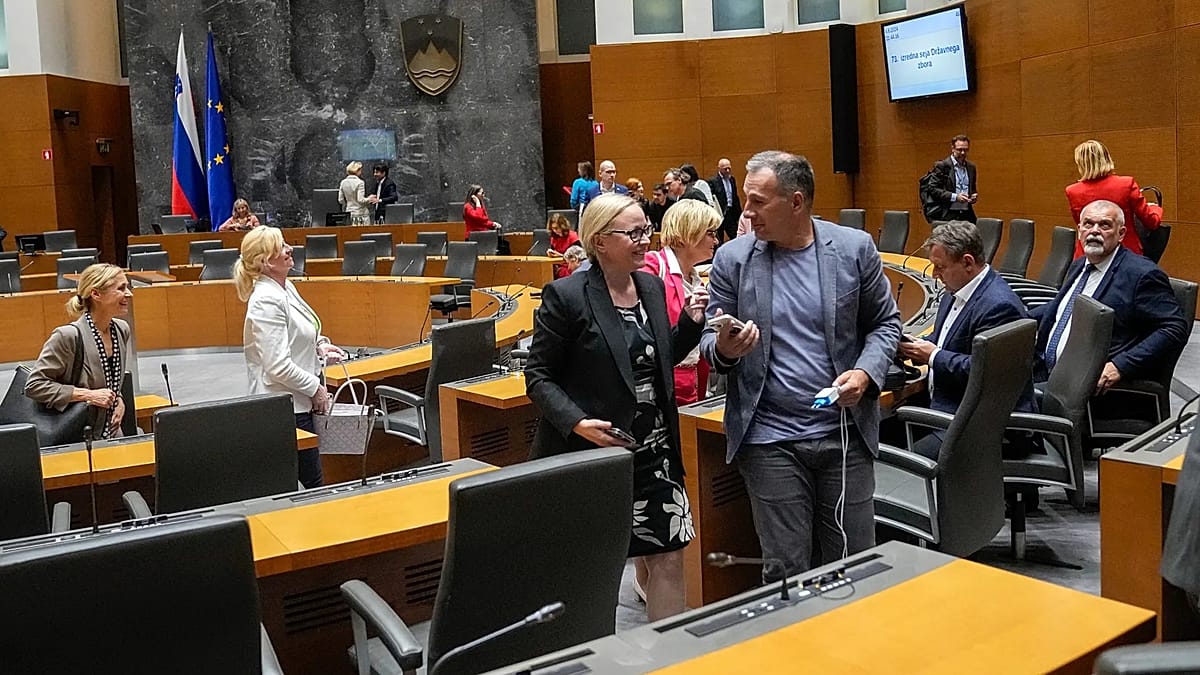
Slovenia’s newly elected parliament will come together on 10 April opening the way for tough coalition talks after the liberals’ razor-thin win this month, the EU country’s president said on Monday.
“As soon as the official results are published, I will call the constitutive session of the new parliament on April 10,” Slovenian President Nataša Pirc Musar told journalists after her first consultations with the leaders of seven parties that entered parliament at the 22 March vote.
She warned current geopolitical circumstances require swift coalition negotiations that will put in place a new government as soon as possible but admitted the current positions of the two blocs in parliament suggest “several rounds of talks are predictable.”
Outgoing Prime Minister Robert Golob’s liberal Freedom Movement (GS) scored a tight victory winning 29 seats in the 90-seat parliament ahead of US President Donald Trump admirer Janez Janša’s Slovenian Democratic Party (SDS), that took 28 seats.
According to final results, none of the parties combined with their allies could secure a majority, forcing them to talks with two independent parties, the anti-establishment party Resni.ca (Truth) and a conservative party formed by former Janša ally Anže Logar.
Golob launched coalition talks last week, attended by Resni.ca and Logar, proposing the formation of a national unity coalition to face the potential global economic crisis caused by the US-Iran war.
“Through collaboration on concrete measures that will benefit people and economy we can build trust between those that have been on opposite banks in the past,” Golob said after meeting Pirc Musar on Monday.
Janša rejected any coalition talks claiming the results of the election will be known only when the irregularities denounced by his party are cleared out.
Pirc Musar reacted to Janša’s claims saying “I reject any doubts whatsoever about the legitimacy of these elections.”
By law, the president has to propose to parliament a prime minister designate 30 days after the inaugural session.
Backdrop of scandals
The 22 March elections took place against a backdrop of scandals, when just days before polling started video and audio recordings were leaked alleging misconduct by Golob and his inner circle.
Golob sent a letter to EU leaders, including European Commission President Ursula von der Leyen and European Council President António Costa, raising concerns about foreign influence in Slovenia’s elections.
The recordings, published on the anti-corruption 2026 website, reportedly show high-ranking officials discussing the acceleration of public procurement processes, the transfer of state funds, and manipulations in business deals.
Among the most contentious cases is the purchase of a partially ruined building in Ljubljana for €7.7 million, nearly five times its 2019 acquisition price. The revelations have intensified scrutiny over alleged misuse of public funds, influence peddling and pressure on businesses and journalists.
Later, the Slovenian government decided against joining South Africa’s genocide case against Israel at the International Court of Justice, despite having previously expressed desire to participate in the proceedings.
While Golob had initially been inclined to join the case, he was ultimately swayed against doing so by national security officials, local media reported.
They reportedly cautioned that joining the lawsuit could jeopardise Slovenia’s national security, noting that many of the country’s cyber defence systems are of Israeli origin.
Additional sources • AFP
Read the full article here